How Does HRV / ERV Work? Heat Recovery Ventilation Explained
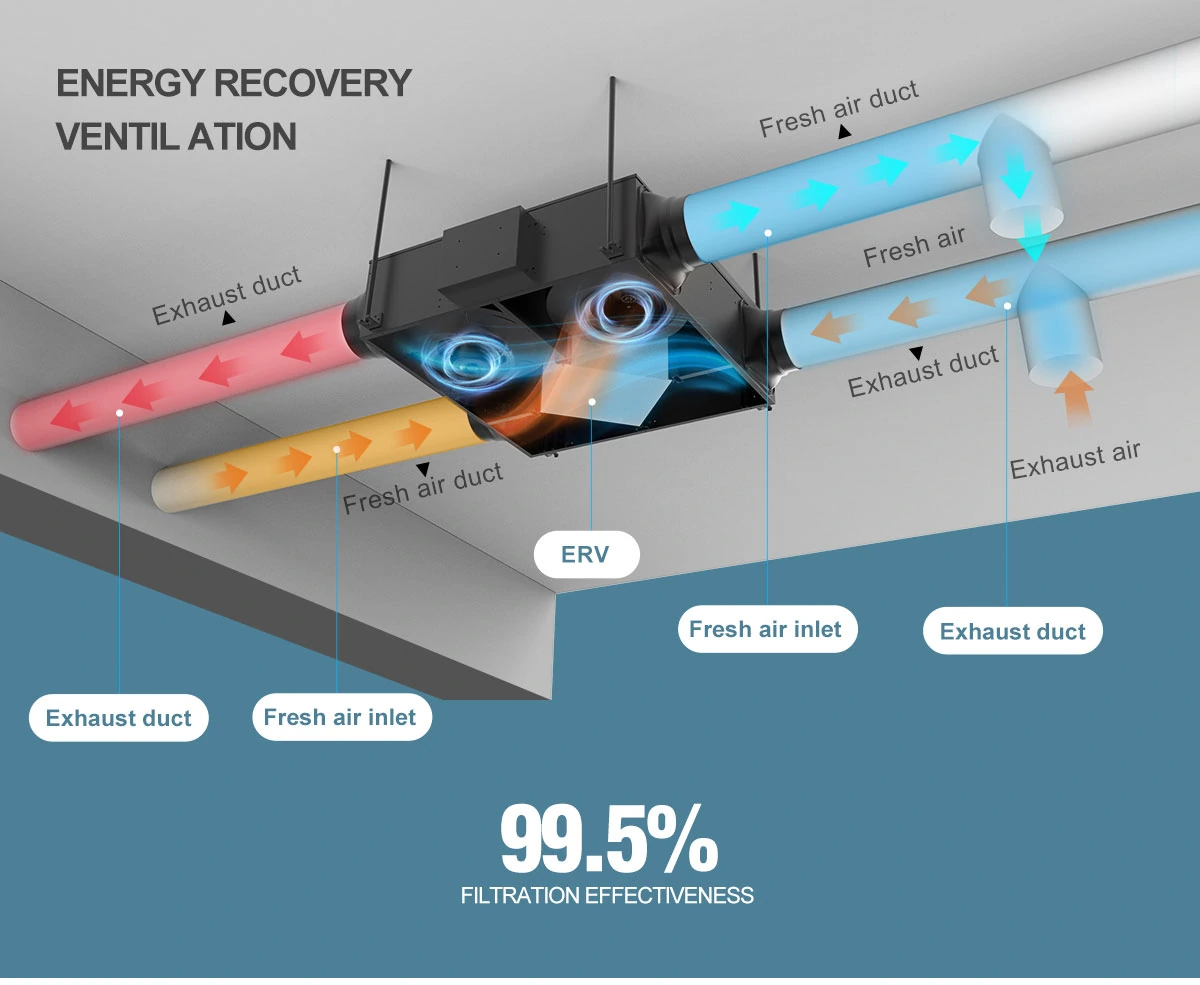
Heat recovery ventilation (HRV) and energy recovery ventilation (ERV) are the two core technologies behind modern balanced ventilation. They continuously bring fresh outdoor air into a building while recovering most of the energy from the air being exhausted. For distributors, contractors, and project buyers, understanding exactly how these units work is the foundation of correct product selection — and of explaining their value to end customers.
This guide breaks down the working principle of HRV and ERV units, the difference between the two, and how to match each technology to a project.
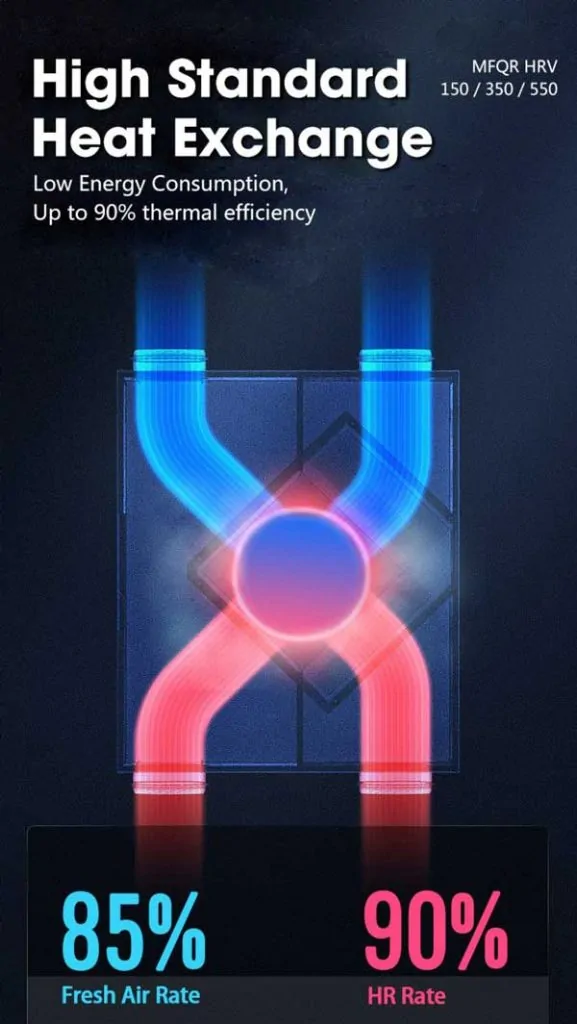
A heat recovery ventilator (HRV) transfers sensible heat only — temperature — from one airstream to the other.
كيف يعمل نظام HRV
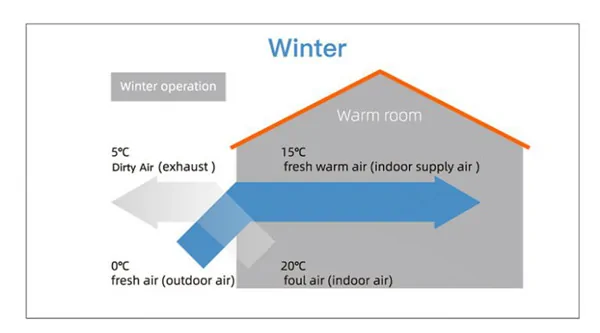
Heating Season
When heating is on, warm stale air leaves the room and passes through the core. The cold outdoor air traveling in the opposite direction absorbs that warmth before entering the room. Indoor heat loss is reduced, so the heating system works less hard to maintain comfort.
Heating season: recovered warmth pre-heats cold outdoor air before it enters the room.
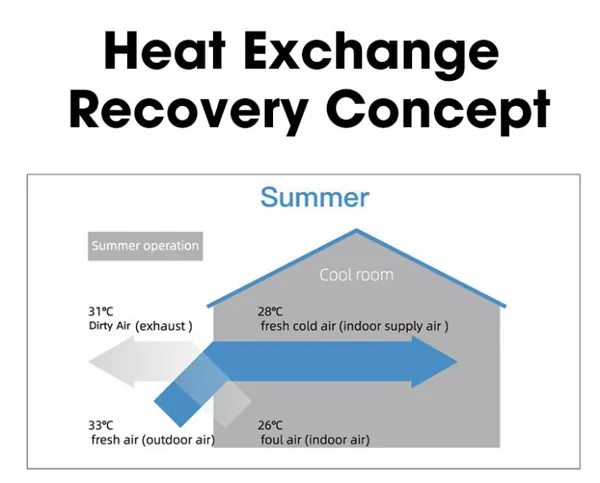
Cooling Season
The process reverses. Air-conditioned exhaust air pre-cools the hot outdoor air before it enters the building, reducing the cooling load.
كيف يعمل نظام ERV
An energy recovery ventilator (ERV) transfers كلاً من الحرارة والرطوبة between the airstreams. This makes it the right choice where humidity management matters.
In winter, if the indoor air is drier than the incoming outdoor air, the ERV transfers moisture to the fresh air, reducing over-drying caused by heating.
In summer, if the outdoor air is humid, the ERV transfers moisture to the outgoing air, reducing the humidity load on the air conditioning system — which would otherwise fight to dehumidify a continuous stream of humid outdoor air.
Cooling season: the ERV pre-cools and dehumidifies incoming air using conditioned exhaust air.
HRV vs ERV: Which One for Which Project?
Factor
HRV
ERV
Transfers heat
✅ Yes
✅ Yes
Transfers moisture
❌ No
✅ Yes
Best climates
Cold, dry (Canada, northern US, high-altitude)
Humid or mixed (US South, coastal, Midwest summers)
Winter benefit
Recovers heat, may dry air further
Recovers heat and keeps indoor humidity balanced
Summer benefit
Pre-cools fresh air
Pre-cools and dehumidifies fresh air
Typical applications
Cold-climate homes, offices
Mixed/humid climates, commercial spaces with high occupancy
The decision rule: if humidity is a concern in the project’s climate, choose an ERV. If the climate is cold and dry, an HRV is simpler and more cost-effective.
Common Installation Configurations
Ducted whole-house systems — a central unit serves multiple rooms through a duct network. Ideal for new construction and whole-building projects. See our Whole-House ERV & HRV Systems.
Ductless single-room units — compact through-wall units that serve one room without ducting. Ideal for retrofits, apartments, and room-by-room upgrades. See our Single-Room HRV.
Fresh air ventilation systems — for projects where filtration and continuous supply are the priority. See our Fresh Air Ventilation range.
Key Selection Criteria for B2B Buyers
When specifying HRV/ERV equipment for a project, verify these parameters against the space:
Airflow (m³/h or CFM) — must cover the ventilation rate required for occupancy and area.
Recovery efficiency — higher efficiency means lower running cost over the unit’s lifetime.
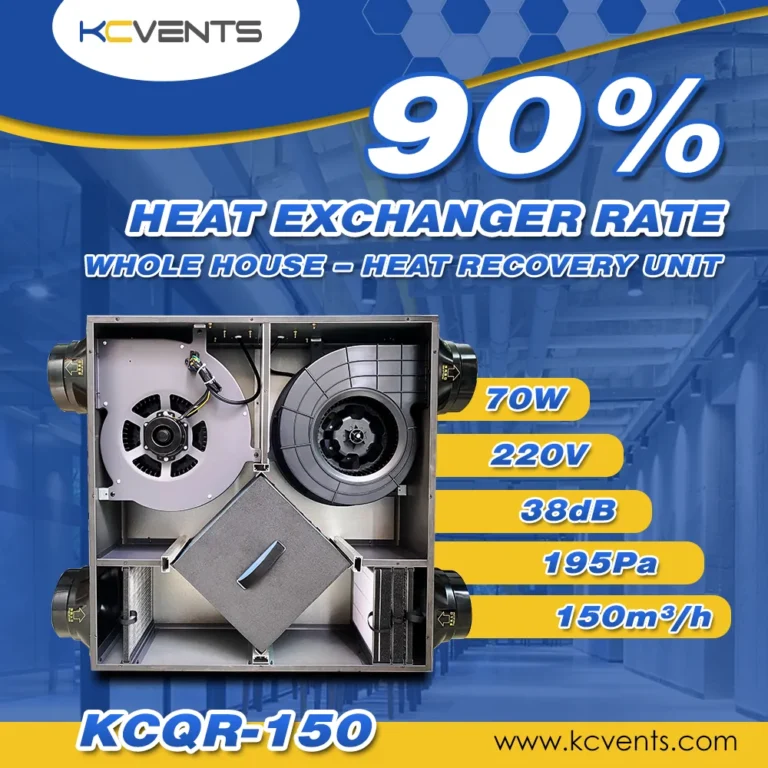
Static pressure — determines whether the unit can push air through the intended duct length.
Filtration — match filter grade to the application (MERV 8 standard, MERV 13/HEPA for healthcare or high-traffic spaces).
Noise level — important for offices, classrooms, and bedrooms.
Frost protection — required for cold climates where core freezing is a risk.
الخلاصة
HRV and ERV units solve the fundamental conflict in modern sealed buildings: you must bring in outside air continuously, but you cannot afford to throw away the energy you spent conditioning indoor air. An HRV recovers heat; an ERV also manages moisture. The right choice depends on the project’s climate, the space type, and the ventilation load.
For project-specific guidance, sizing support, or product specifications, contact the KCVENTS engineering team — every space has unique requirements, and the right starting point is a clear understanding of how the equipment works.
Newsletter Updates
Enter your email address below and subscribe to our newsletter