What Is the Right Temperature and Humidity for Cannabis Crops?
Indoor cannabis plants grow best when the air around them stays within a fairly narrow band: roughly 68–77°F (20–25°C) during the day, with relative humidity kept steady rather than swinging with every light cycle. If the grow space feels too hot, too cold, or too damp for you, your plants are usually stressed too — growth slows, nutrient uptake suffers, and dense buds become vulnerable to mold.
Temperature and humidity are only half of the story. In an enclosed grow space, air exchange is the lever that keeps both of them under control. Heat builds up fast under lights, humidity spikes when plants transpire heavily, and stale air pockets form in corners. A properly sized inline duct fan continuously removes hot, humid air and pulls in fresh air — which is why ventilation is often the backbone of a stable environment.
In this guide we cover the target ranges for each growth stage, what happens when conditions drift out of them, the most common climate problems in indoor grow rooms, and how to choose a ventilation setup that keeps conditions consistent.
Ideal Temperature and Humidity for Cannabis Crops
The table below summarizes the commonly cited target ranges for indoor cannabis at each stage. These are general grower guidelines — specific cultivars, light intensity, and CO₂ levels all shift the ideal slightly.
Stage
Daytime temperature
Night temperature
Relative humidity
Seedling / clone
70–77°F (21–25°C)
Slightly cooler
65–70% RH
Vegetative
70–85°F (21–29°C)
5–10°F cooler
40–70% RH
Flowering
65–80°F (18–26°C)
~10°F (5–6°C) cooler
40–50% RH
Two patterns matter more than the exact numbers:
Day/night swings. A large temperature drop at lights-off makes relative humidity jump, because cool air holds less moisture. That nightly RH spike is a classic trigger for condensation and mold.
Late-flower humidity. When buds are dense, keeping RH in the 40–50% range with steady airflow is the practical way to reduce the risk of bud rot.
Why Temperature and Humidity Control Matters
Temperature and humidity do not just affect comfort — they directly control how a plant breathes, drinks, and grows:
Transpiration. Plants cool themselves by moving water through their leaves. Air that is too dry makes them lose water faster than the roots can replace it; air that is too humid slows transpiration and can interfere with nutrient uptake.
Photosynthesis and metabolism. Inside the right temperature range, leaves convert light into growth efficiently. Too cold slows metabolism; too hot increases stress and, during flowering, can reduce aroma and potency as terpenes volatilize faster.
Disease pressure. High humidity plus weak airflow is the standard recipe for powdery mildew and bud rot, especially when buds become dense in late flower.
RH follows temperature. Warm air holds more moisture than cool air. When lights switch off and temperature drops, RH jumps — this is when condensation forms on surfaces and mold risk rises if ventilation is weak.
The practical takeaway: plants tolerate short “imperfect” moments, but they perform best when temperature and humidity stay stable and air is exchanged steadily.
Common Climate Problems in Indoor Grow Rooms
Even with good genetics, lighting, and feeding, many growers hit the same wall: the environment becomes unpredictable. The typical failure patterns are:
Dead zones and poor circulation. Leaves barely move, air feels “thick,” and humidity lingers under the canopy. Microclimates form — one corner runs hot while another stays damp.
Heat accumulation. Lights, drivers, pumps, and dehumidifiers all add heat. A small enclosed space can climb several degrees within minutes if exhausted air has nowhere to go.
Humidity spikes. During heavy growth stages plants transpire large amounts of water. Dense canopies and wet substrate push RH up quickly, right when mold risk matters most.
CO₂ depletion and stale air. In a closed space, plants consume the available CO₂. Without fresh air exchange, growth slows even when everything else looks fine.
Odor buildup. Especially during late flowering, odor control becomes a real concern for indoor growers.
None of these are “grower mistakes.” They are the normal outcome of growing inside a small, enclosed system — which is exactly why the ventilation design matters as much as the lights.
Traditional Fixes and Their Limits
Most growers start with simple fixes. They help, but they often do not address the root cause: the lack of consistent air exchange.
Opening a door or vent. Helps temporarily, but it is inconsistent and can introduce dust, pests, and unstable temperature and humidity.
Clip-on circulating fans only. Great for moving air inside the space, but they do not remove hot or humid air, and they do not bring in fresh air.
Portable AC or dehumidifier. Effective at conditioning air, but they work far harder — and often still fail — when hot, humid air is not being exhausted continuously.
Passive vents only. Adequate in mild conditions, but usually insufficient once light output and plant mass ramp up.
How the Right Ventilation System Helps
A properly matched inline duct fan with ducting provides what the fixes above cannot: controlled exhaust that actively removes heat and moisture while pulling in fresh air.
When paired with a carbon filter (for odor control) and a speed controller (to stabilize temperature and humidity automatically), it becomes a foundation system rather than a temporary patch.
What a ventilation system realistically does for a grow room:
Continuously removes the heat and humidity generated by lights and plants
Maintains fresh air exchange, reducing stale-air and CO₂ problems
Works with a carbon filter for odor control
With a controller, keeps conditions more consistent without constant manual adjustment
An honest boundary: a fan alone cannot “create” perfect conditions. But it is often the main lever that makes every other tool — AC, dehumidifier, humidifier — work more effectively and efficiently.
Recommended Product: EC Mixed-Flow Inline Fan with Controller
For grow-room exhaust duty, KCVENTS’ EC mixed-flow inline fan with controller combines an energy-efficient EC motor with built-in speed control, so you can match airflow to the heat and humidity load instead of running flat-out all day. Mixed-flow design keeps static-pressure performance in longer duct runs, while the EC motor keeps noise and power consumption lower than an equivalent AC fan.
If your setup runs long ducting or needs a simple reversible layout, the inline duct fan category lists the full range of inline, mixed-flow, and silent options with their airflow and pressure specifications, so you can compare against your space.
Choosing a Ventilation Setup for Your Grow Space
A practical sizing process looks like this:
Calculate the volume of the space (length × width × height).
Set an air-exchange target. As a rule of thumb, growers typically aim to exchange the full volume every 1–3 minutes during peak load. Verify the fan’s airflow rating (CFM / m³/h) against that target at your expected duct resistance.
Account for ducting and filters. Long ducts, bends, and carbon filters add static pressure that reduces real airflow — choose a fan with some headroom and check its pressure curve.
Decide on control. A speed controller (or a temperature/humidity controller) lets the fan respond automatically when conditions drift, instead of running constantly at full speed.
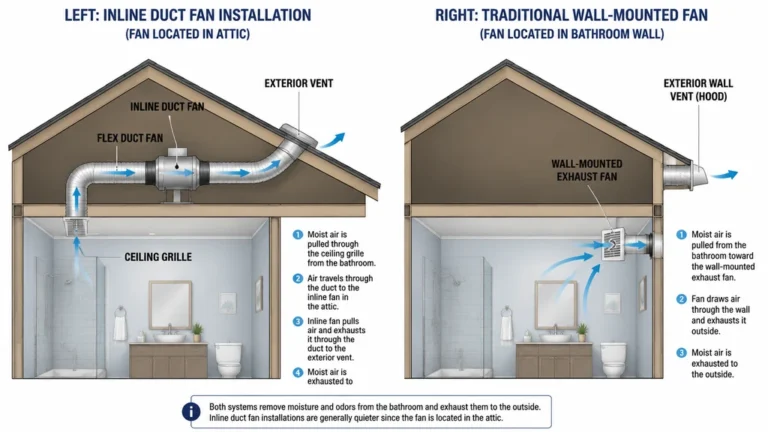
Plan intake and exhaust paths. Place the exhaust high where heat collects, provide a clean intake low down, and keep the carbon filter on the exhaust side for odor control.
What is the best temperature for cannabis plants? For most indoor crops, 68–77°F (20–25°C) during the day is the commonly recommended sweet spot. Vegetative plants tolerate up to about 85°F (29°C), while flowering plants prefer the cooler end, around 65–80°F (18–26°C), with nights a few degrees cooler than days.
What happens if humidity is too high in the grow room? High humidity slows transpiration and raises the risk of powdery mildew and bud rot, especially when airflow is weak and buds are dense. Bringing relative humidity into the 40–50% range during flowering and keeping air moving is the practical countermeasure.
Does an inline duct fan need to run 24 hours a day? Most growers run exhaust continuously at low-to-medium speed and let a controller ramp it up when temperature or humidity rises. Stopping airflow entirely during lights-off can allow humidity to spike — the period when mold risk is highest.
Can I use the same fan for intake and exhaust? Yes, with a reversible inline fan or two separate units. A common layout is one fan exhausting hot, humid air and a passive or low-power intake bringing in fresh air. For long runs or balanced setups, a reversible mixed-flow fan gives flexibility in duct layout.
Get a Free Sizing Recommendation
If you share your grow space dimensions, duct length, and target temperature and humidity, we will recommend a right-sized inline fan and a practical ventilation layout — filter placement, intake/exhaust path, and control strategy. Contact the KCVENTS team with your setup details, or browse the inline duct fan category to compare specifications directly.
Newsletter Updates
Enter your email address below and subscribe to our newsletter