Ventilation for Greenhouses and Indoor Grow Rooms: Temperature and Humidity Control
Greenhouse and indoor grow-room ventilation controls the environment plants grow in: temperature, humidity, and air exchange. A well-ventilated space removes heat, replaces humid air with fresh air, and keeps CO₂ available — while a poorly ventilated one swings in temperature and climbs in humidity until mold and heat stress take over. This guide explains the ventilation requirements and how to build a system that keeps conditions stable.
Why Greenhouse and Grow-Room Ventilation Is Different
A house needs ventilation for people; a grow space needs it for plants, and the demands are more aggressive. Plants transpire constantly, lights and pumps add heat, and CO₂ is consumed by photosynthesis. The result is that a growing space can swing from too humid to too hot within minutes if ventilation is undersized or off.
The three goals of grow-space ventilation:
Temperature control — remove heat from lighting (especially HPS/HID) and equipment.
Humidity control — remove transpired moisture so mold and mildew cannot take hold.
Air exchange — replenish CO₂ consumed by photosynthesis and remove ethylene/exhaust air.
The same ventilation system serves all three: exhaust fans pull out hot, humid, depleted air and draw in cooler, drier, fresher air.
What Plants Need: Temperature, Humidity, and Air Exchange
While exact ranges depend on crop and stage, the principles are consistent:
Temperature — most crops grow in a moderate range; heat stress appears fast when ventilation fails. Temperature control is the primary reason a greenhouse needs active ventilation in summer.
Relative humidity — high humidity promotes mold and reduces transpiration. Ventilation brings in drier air to keep humidity in a manageable band.
Air exchange / CO₂ — plants draw down CO₂ in a sealed space; fresh air keeps photosynthesis supplied.
Air movement matters too: leaf-level airflow (circulation fans) prevents stagnant microclimates where mildew starts, even when overall ventilation is adequate.
Natural vs Mechanical Ventilation
Natural ventilation (open roof vents, side vents, screens) works in a greenhouse in mild weather with wind. It is cheap and low-energy.
Its limits:
Stops working when there is no wind or temperature difference.
Brings in unfiltered, unpredictable air.
Cannot control humidity or temperature tightly.
In hot, still weather, natural ventilation alone is often not enough.
Mechanical ventilation (fans + intake) delivers controlled air exchange regardless of weather. It is the reliable option for a productive greenhouse and essential for sealed indoor grow rooms.
Indoor grow rooms (tents, rooms, basements) have no usable natural ventilation — they are essentially sealed boxes that must have mechanical exhaust and intake.
Mechanical Ventilation Components
A complete mechanical system has several parts:
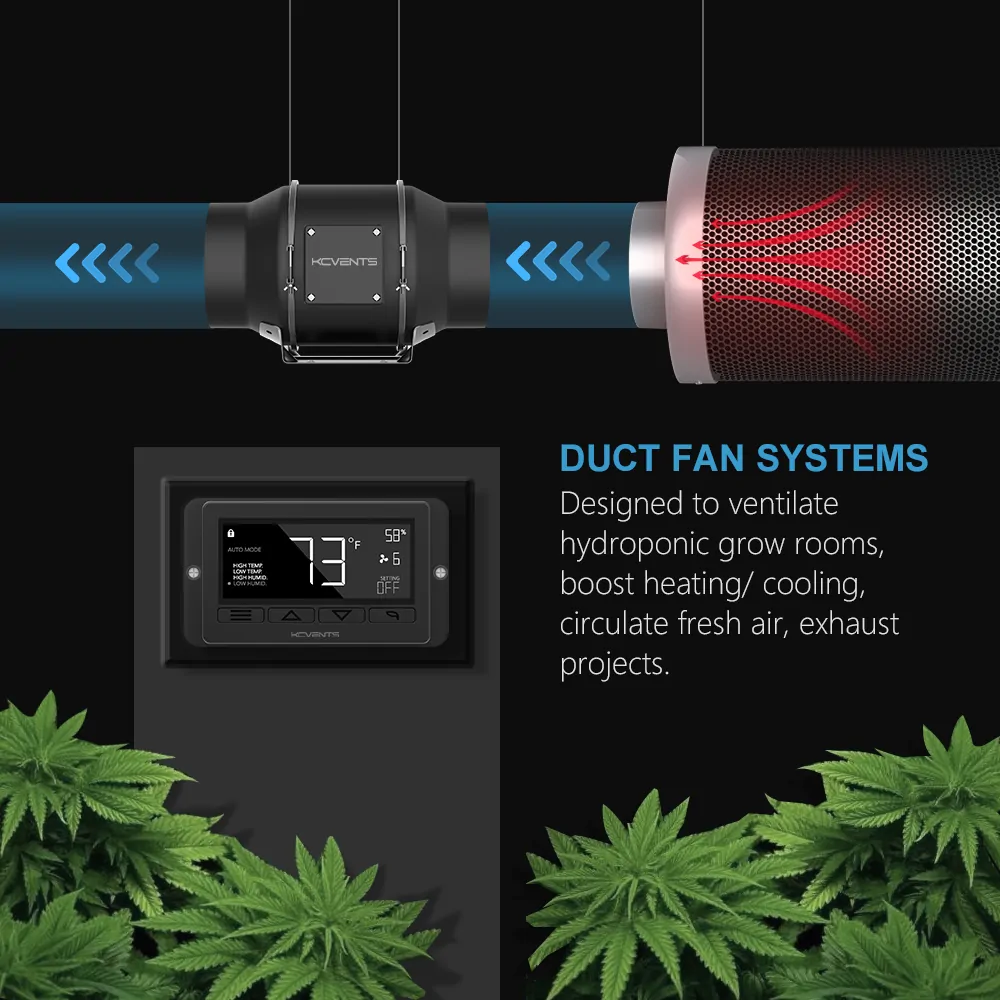
Exhaust fans — pull hot, humid air out (inline duct fans are the standard tool, see our inline duct fan guide).
Intake / fresh air supply — passive vents or an active intake fan.
Circulation fans — keep leaf-level air moving.
Filters — activated carbon for odor control on exhaust; intake filters where outdoor air is dusty (see our carbon filter guide).
Controls — temperature/humidity sensors and speed control (EC fans) so the system ramps up only when needed (see our EC motor guide).
For a greenhouse, exhaust is usually high on the gable or sidewall with intake low on the opposite side, creating cross-flow. For a grow tent, exhaust typically pulls through a carbon filter and out, with passive or active intake low on the tent.
Sizing a Ventilation System
Size the exhaust airflow from the space volume and heat/humidity load:
Calculate the volume — length × width × average height of the growing space.
Choose air changes per minute — grow spaces commonly target one volume exchanged per minute or more, depending on heat load, plant density, and filter resistance.
Add the filter and duct resistance — an inline fan’s airflow at the system’s static pressure is what counts, not the free-air rating.
Oversize slightly + control speed — a slightly larger EC fan running at reduced speed gives headroom for heat peaks while staying quiet and efficient normally.
Balance intake — the intake must be large enough that the fan is not starved (which would reduce airflow and increase filter wear).
Space
Typical airflow approach
Small tent (e.g., 1×1×2 m)
100–150 mm inline fan, one volume/min, carbon filter
Grow room (e.g., 3×3×2.5 m)
150–200 mm + intake, EC variable speed
Greenhouse
Fan wall / larger exhaust based on heat load, multiple units
Frequently Asked Questions
Q: How much ventilation does a grow room need? A: Start with one tent/room volume exchanged per minute and adjust for heat load, plant density, and filter resistance. The actual delivered airflow at operating static pressure is what matters.
Q: Should a greenhouse have mechanical ventilation? A: In mild, windy climates natural ventilation (vents) may suffice in spring/autumn, but for consistent crop conditions — especially in summer heat — mechanical exhaust is the reliable approach.
Q: What controls humidity in a grow space? A: Air exchange is the main tool: exhaust fans replace humid air with drier intake air. Circulation fans prevent local stagnant pockets. A dehumidifier is an additional tool for high-humidity crops or climates.
Q: Do I need a carbon filter? A: For odor control, yes — an inline fan pulling through a properly matched activated carbon filter treats the exhaust air. See our carbon filter guide.
Q: Can I use a regular house fan in a grow room? A: A house fan only circulates air; it does not exhaust heat or humidity or bring in fresh air. You need a proper exhaust/intake system (inline fans) plus circulation fans.
Q: How do I control the ventilation automatically? A: Use temperature/humidity sensors wired to the fan controller. An EC fan can ramp speed with conditions automatically; we cover this in our EC motor guide.
Building greenhouse or grow-room ventilation? KCvents manufactures EC inline duct fans, exhaust fans, and activated carbon filters for indoor growing and controlled environment agriculture, for wholesale, OEM, and private-label buyers. Request a quote with your space size and ventilation requirements.
Newsletter Updates
Enter your email address below and subscribe to our newsletter