Utilizamos cookies para garantizar que le brindamos la mejor experiencia en nuestra web.
Stay Updated with KCVENTS Ventilation & HVAC Solutions
Subscribe to our newsletter for the latest airflow engineering insights, energy-efficient ERV/HRV system updates, and eco-friendly HVAC solutions.
Be the first to receive exclusive technical guides, custom OEM/ODM capabilities, and global exhibition news directly from KCVENTS.
Which House Ventilation System Is Right for Your Home?
The four house ventilation systems — exhaust, supply, balanced, and HRV/ERV — compared on cost, heat recovery, filtration, and climate fit, plus how to choose.
Which House Ventilation System Is Right for Your Home?
The four basic house ventilation systems are exhaust-only, supply-only, balanced, and energy recovery (HRV/ERV), and the right one depends on your climate, your home’s airtightness, and whether you want heat recovery. If your home is airtight and you heat or cool it for long seasons, an HRV/ERV is usually the best long-term choice; if you just need to remove moisture and odors cheaply, an exhaust fan may be enough. This guide compares the four systems so you can see what each one does, what it costs, and when it fits.
Mechanical ventilation for a home comes down to four layouts. Each moves air differently, and each has strengths and limits.
Según la EPA de EE. UU., las personas pasan cerca del 90% de su tiempo en interiores, y las concentraciones de algunos contaminantes interiores pueden ser de dos a cinco veces mayores que los niveles exteriores. Fuente: U.S. EPA, The Inside Story: A Guide to Indoor Air Quality. Tight, energy-efficient homes trap moisture and pollutants, which is exactly why a deliberate ventilation system matters.
Exhaust-Only Ventilation
An exhaust-only system uses fans to pull stale air out of wet rooms (bathrooms, kitchens, laundry), and fresh air enters through gaps, vents, and natural leakage. It is the cheapest and most common layout in existing homes.
Pros
Low cost and easy to install.
Directly removes moisture, odors, and pollutants at the source.
Works well in mild weather.
Cons
Can pull in unfiltered outdoor air through gaps and crawl spaces.
Not ideal in hot, humid, rainy, or very windy climates where leakage brings in humidity or drafts.
Can increase heating and cooling costs in extreme weather by drawing in unconditioned air.
Can depressurize the home, which may affect combustion appliances (backdraft risk).
Best for: bathrooms, kitchens, laundry rooms, and mild climates where simple moisture and odor removal is the goal.
Supply-Only Ventilation
A supply-only system brings filtered outdoor air into the home, slightly pressurizing it, and stale air leaks out through gaps and vents.
Pros
Filtered, controlled fresh air in the main living areas.
Simple and relatively inexpensive to install.
Good in hot or mixed climates where the fresh air helps flush the home.
Cons
Does not remove moisture from incoming air.
Can absorb pollen and dust if the intake filter is not maintained.
Relies on the building leaking for exhaust, so moisture can be pushed into cold attic spaces (condensation risk).
Can increase heating and cooling costs in extreme seasons.
Best for: homes that are already leaky on the exhaust side, or situations where filtered supply air is the priority.
Balanced Ventilation
A balanced system uses two matched fans — one supplying fresh air, one exhausting stale air — so the home is neither pressurized nor depressurized.
Pros
Controlled, even airflow in and out.
Can be filtered on both streams.
The foundation for heat recovery.
Cons
Costs more to install and operate than exhaust or supply systems.
Without heat recovery, it still loses heating and cooling energy with the exhaust air.
Two sets of ducts take more space and planning.
Best for: whole-home ventilation where you want supply and exhaust under control, regardless of weather.
Energy Recovery (HRV/ERV)
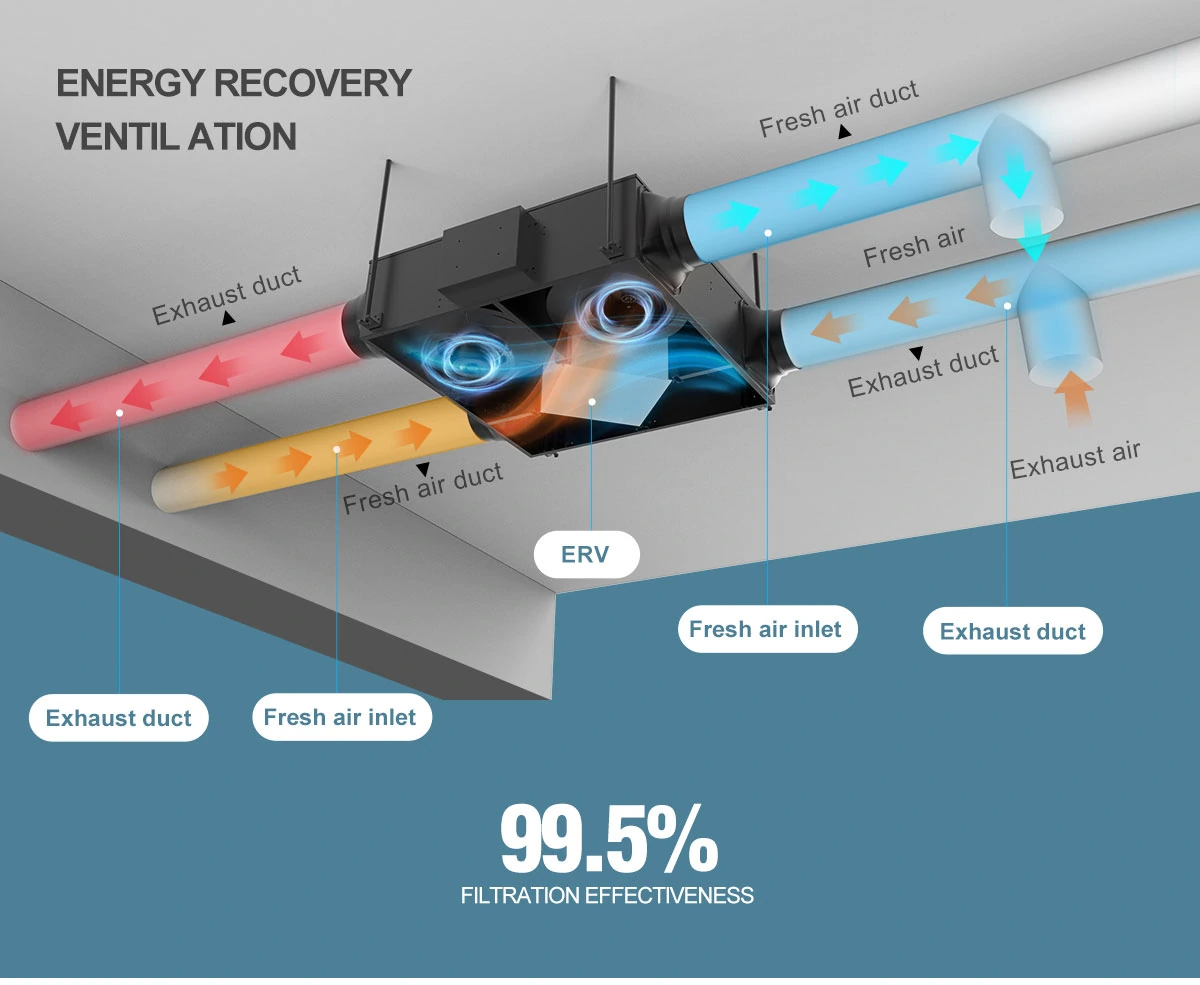
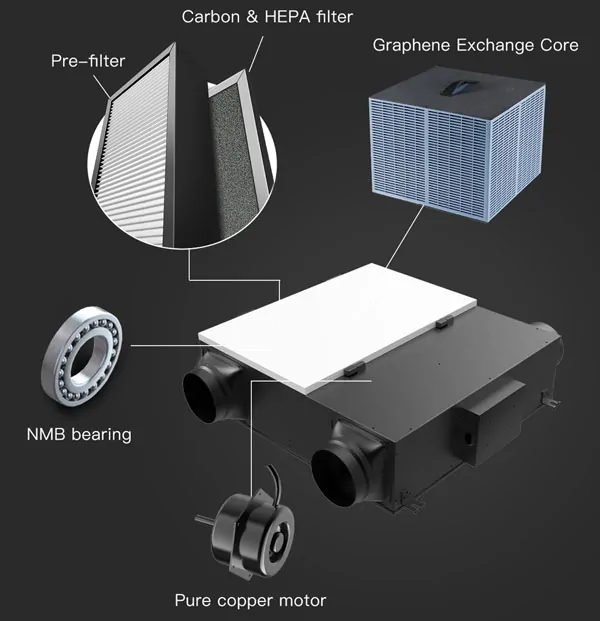
An energy recovery ventilator (ERV) or heat recovery ventilator (HRV) is a balanced system with a heat-exchange core that transfers heat (HRV) or heat and moisture (ERV) between the outgoing and incoming air.
Pros
Reduces heating and cooling costs by recovering energy from exhaust air.
Balances temperature and humidity of incoming air.
Filters the incoming air.
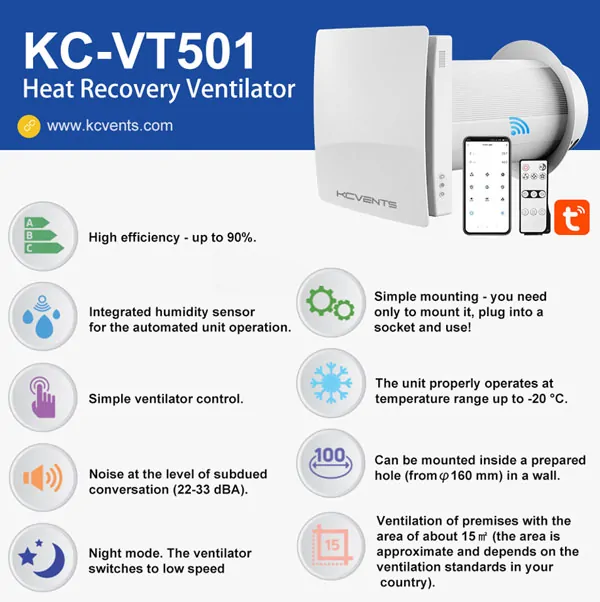
Compact wall- or window-mounted models are affordable for single rooms.
Cost-effective in climates with extreme winters or summers and high fuel costs.
Cons
Costs more to install than simpler systems.
May need an experienced installer.
Requires frost and freeze protection in very cold climates.
Which System Should You Choose?
System
Cost
Heat recovery
Filters air
Best climate
Best for
Exhaust-only
Low
No
No
Mild
Bathroom, kitchen, moisture removal
Supply-only
Low–medium
No
Yes
Hot/mild
Filtered fresh air priority
Balanced
Medium
No
Yes
All
Whole-home control
HRV/ERV
Medium–high
Yes
Yes
Cold winters / hot summers
Airtight homes, energy savings
Mild, leaky home, small budget → exhaust-only fans for wet rooms.
Want filtered fresh air without major work → supply-only.
Airtight home with long heating season → HRV (e.g. VT501 for one room, KCQR for whole home).
Hot, humid summers plus cold winters → ERV.
For a closer look at the difference between heat recovery options, see our HRV vs ERV guide. For how the underlying principles work, read How Ventilation Works.
Frequently Asked Questions
Q: Which house ventilation system is the best? A: There is no single best system. Exhaust-only is cheapest, balanced gives the most control, and HRV/ERV adds heat recovery. The right choice depends on your climate, airtightness, budget, and whether energy efficiency matters.
Q: Do I need an HRV or ERV? A: If your home is airtight and you heat or cool it for long seasons, an HRV (or ERV in humid climates) usually pays back through recovered energy. In a mild, leaky home, simpler ventilation may be enough.
Q: Can a ventilation system prevent mold? A: Ventilation controls the moisture that causes mold by removing humid air. It is an important part of mold prevention, along with fixing leaks and controlling indoor humidity sources.
Q: How much fresh air does a house need? A: ASHRAE Standard 62.2 specifies continuous mechanical ventilation of 7.5 cfm per person plus 3 cfm per 100 square feet for residential buildings. See our residential fresh air ventilation guide for sizing.
Q: What is the difference between a ventilation fan and an air purifier? A: A ventilation fan exchanges indoor and outdoor air to dilute pollutants and control moisture. An air purifier filters the air already in the room and does not supply fresh outdoor air.
Planning a house ventilation system? KCvents manufactures ventilation fans, single-room HRVs, and whole-home energy recovery units for wholesale, OEM, and private-label projects. Request a quote with your home size, climate, and airflow needs.
Actualizaciones del boletín
Introduce tu dirección de correo electrónico para suscribirte a nuestro boletín