Nous utilisons des cookies pour nous assurer que nous vous offrons la meilleure expérience possible sur notre site.
Restez informé avec KCVENTS Solutions de ventilation et CVC
Abonnez-vous à notre newsletter pour recevoir les dernières analyses en ingénierie aéraulique, les mises à jour sur les systèmes ERV/HRV écoénergétiques et les solutions CVC écologiques.
Soyez les premiers à recevoir des guides techniques exclusifs, à découvrir nos capacités OEM/ODM sur mesure et les actualités des salons mondiaux directement de KCVENTS.
Quel système de ventilation résidentielle convient le mieux à votre logement ?
Les quatre systèmes de ventilation résidentielle — extraction, insufflation, équilibré et HRV/ERV — comparés selon le coût, la récupération de chaleur, la filtration et l'adaptation au climat, avec des conseils pour choisir.
Quel système de ventilation résidentielle convient le mieux à votre logement ?
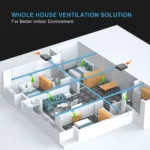
Les quatre systèmes de ventilation résidentielle de base sont la ventilation par extraction seule, par insufflation seule, équilibrée (double flux) et à récupération d'énergie (HRV/ERV). Le choix du bon système dépend de votre climat, de l'étanchéité à l'air de votre maison et de votre besoin de récupération de chaleur. Si votre logement est étanche à l'air et que vous le chauffez ou le climatisez pendant de longues périodes, une VMC double flux HRV/ERV constitue généralement le meilleur choix à long terme ; si vous cherchez simplement à évacuer l'humidité et les odeurs à moindre coût, un ventilateur d'extraction peut suffire. Ce guide compare les quatre systèmes pour vous aider à comprendre leur fonctionnement, leurs coûts et leurs applications idéales.
La ventilation mécanique pour une maison se résume à quatre configurations. Chacune fait circuler l'air différemment et présente ses propres avantages et limites.
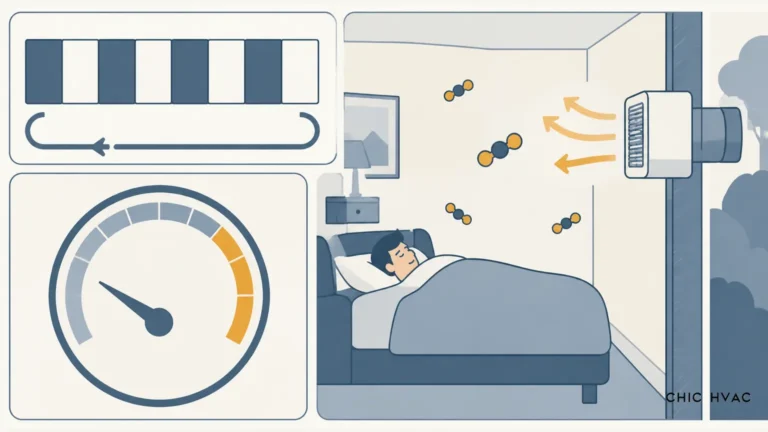
Selon l'EPA des États-Unis, les gens passent environ 90 % de leur temps à l'intérieur, et les concentrations de certains polluants intérieurs peuvent être de deux à cinq fois plus élevées que les niveaux extérieurs. Source : U.S. EPA, The Inside Story: A Guide to Indoor Air Quality. Les maisons étanches à haute efficacité énergétique retiennent l'humidité et les polluants, c'est précisément pourquoi un système de ventilation dédié est essentiel.
Ventilation par extraction seule
Un système d'extraction seule utilise des ventilateurs pour évacuer l'air vicié des pièces humides (salles de bains, cuisines, buanderies), tandis que l'air neuf pénètre par les fentes, les grilles d'aération et les infiltrations naturelles. Il s'agit de la configuration la plus économique et la plus courante dans les habitations existantes.
Avantages
Faible coût et facilité d'installation.
Évacuation directe de l'humidité, des odeurs et des polluants à la source.
Fonctionnement optimal sous des climats tempérés.
Inconvénients
Risque d'infiltration d'air extérieur non filtré par les interstices et les vides sanitaires.
Déconseillé sous les climats chauds, humides, pluvieux ou très venteux où les infiltrations apportent humidité ou courants d'air.
Risque d'augmentation des coûts de chauffage et de climatisation lors de températures extrêmes en aspirant de l'air non traité.
Peut mettre le bâtiment en dépression, ce qui présente un risque de refoulement pour les appareils à combustion (tirage inversé).
Idéal pour : les salles de bains, les cuisines, les buanderies et les climats tempérés où l'objectif principal est une simple évacuation de l'humidité et des odeurs.
Ventilation par insufflation seule
Un système d'insufflation seule insuffle de l'air extérieur filtré dans l'habitation en la mettant en légère surpression, et l'air vicié s'échappe par les interstices et les ouvertures d'évacuation.
Avantages
Air neuf filtré et contrôlé dans les pièces de vie principales.
Simple et relativement peu coûteux à installer.
Adapté aux climats chauds ou tempérés où l'air neuf contribue à purger l'air intérieur.
Inconvénients
Ne déshumidifie pas l'air entrant.
Peut accumuler du pollen et de la poussière si le filtre d'admission n'est pas entretenu.
Dépend des fuites du bâtiment pour l'évacuation, ce qui peut pousser l'humidité vers des combles froids (risque de condensation).
Risque d'augmentation des coûts de chauffage et de climatisation lors des saisons aux conditions extrêmes.
Idéal pour : les maisons présentant déjà des fuites d'air permettant l'évacuation, ou les situations où l'insufflation d'air filtré est la priorité.
Ventilation équilibrée (double flux)
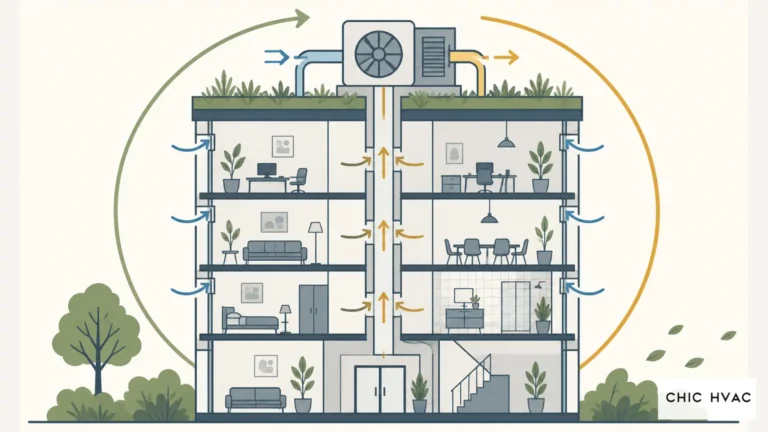
Un système équilibré utilise deux ventilateurs synchronisés — l'un insufflant de l'air neuf, l'autre extrayant l'air vicié — afin que l'habitation ne soit ni en surpression ni en dépression.
Avantages
Débit d'air maîtrisé et homogène à l'admission comme à l'extraction.
Filtration possible sur les deux flux d'air.
Sert de base aux systèmes avec récupération de chaleur.
Inconvénients
Coûts d'installation et de fonctionnement plus élevés que les systèmes à simple extraction ou insufflation.
Sans récupération de chaleur, l'énergie de chauffage et de climatisation est tout de même perdue avec l'air extrait.
Deux réseaux de conduits nécessitent plus d'espace et une planification plus complexe.
Idéal pour : ventilation de l'ensemble de l'habitation lorsque vous souhaitez maîtriser l'insufflation et l'extraction, quelles que soient les conditions météorologiques.
Récupération d'énergie (HRV/ERV)
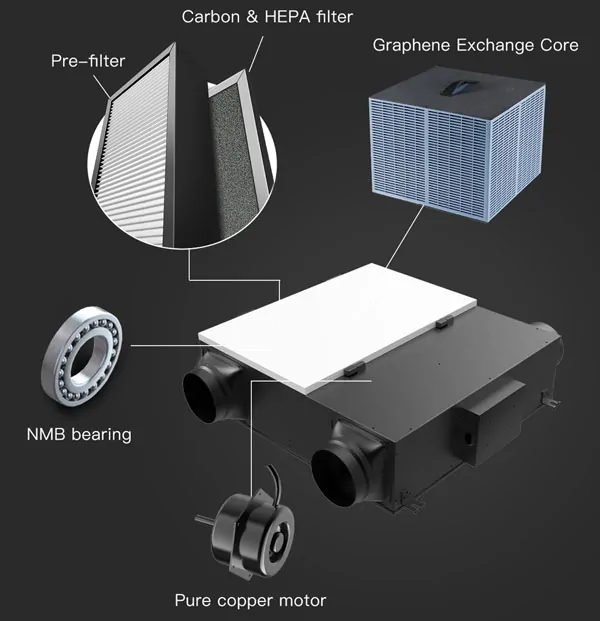
Un ventilateur à récupération d'énergie (ERV) ou un ventilateur à récupération de chaleur (HRV) est un système équilibré doté d'un échangeur thermique qui transfère la chaleur (HRV) ou la chaleur et l'humidité (ERV) entre l'air extrait et l'air neuf.
Avantages
Réduit les coûts de chauffage et de climatisation en récupérant l'énergie de l'air extrait.
Équilibre la température et l'humidité de l'air neuf.
Filtre l'air entrant.
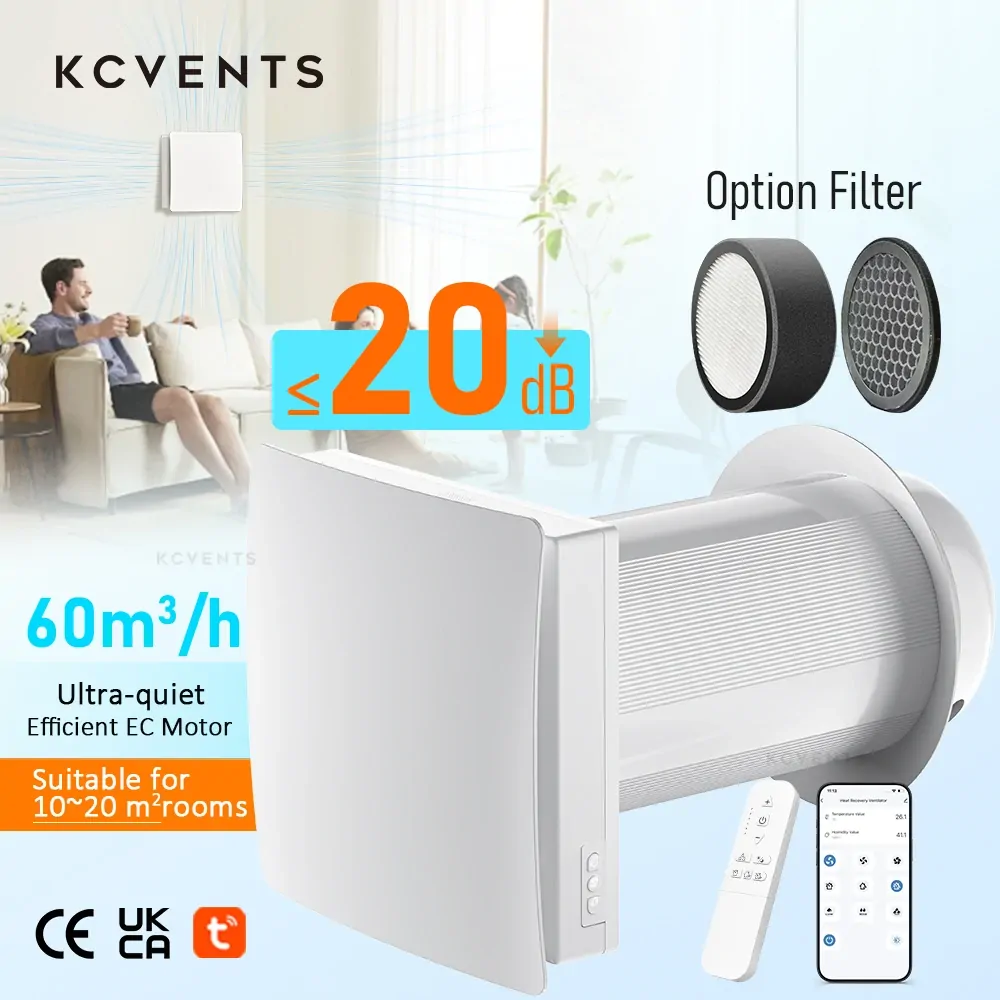
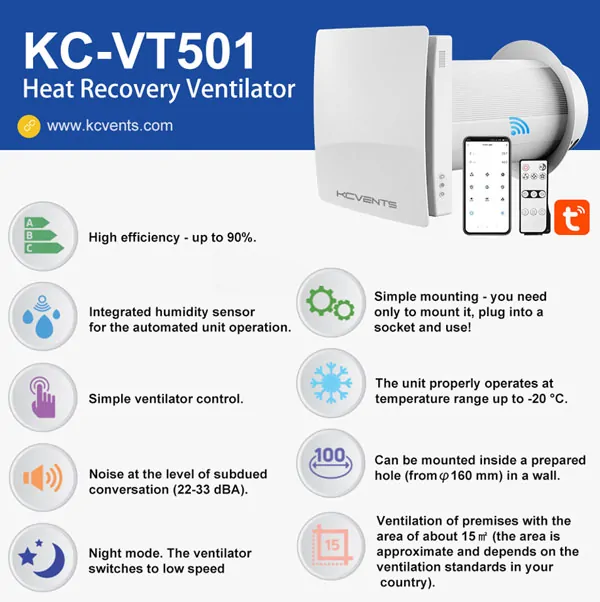
Les modèles compacts muraux ou de fenêtre sont abordables pour une pièce individuelle.
Rentable dans les climats aux hivers ou étés extrêmes et où les coûts énergétiques sont élevés.
Inconvénients
Coûte plus cher à installer que des systèmes plus simples.
Peut nécessiter l'intervention d'un installateur expérimenté.
Nécessite une protection contre le gel dans les climats très froids.
Quel système devez-vous choisir ?
Système
Cost
récupération de chaleur
Filtre l'air
Climat idéal
Best for
Extraction seule ;
Low
No
No
Tempéré
Salle de bain, cuisine, élimination de l'humidité
Insufflation seule
Faible à moyen
No
Yes
Chaud/tempéré
Priorité à l'air neuf filtré
Équilibré
Moyen
No
Yes
Tous
Contrôle pour l'ensemble du logement
HRV/ERV
Moyen à élevé
Yes
Yes
Hivers froids / étés chauds
Maisons étanches à l'air, économies d'énergie
Climat tempéré, maison peu étanche, petit budget → ventilateurs d'extraction seule pour pièces humides.
Besoin d'air neuf filtré sans travaux majeurs → insufflation seule.
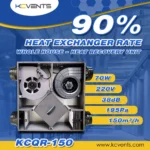
Maison étanche à l'air avec longue saison de chauffe → HRV (ex. VT501 pour une seule pièce, KCQR pour toute la maison).
Étés chauds et humides et hivers froids → ERV.
Pour examiner plus en détail les différences entre les options de récupération de chaleur, consultez notre guide HRV vs ERV. Pour comprendre le fonctionnement des principes sous-jacents, lisez Comment fonctionne la ventilation.
Foire aux questions
Q : Quel est le meilleur système de ventilation résidentielle ? R : Il n'existe pas de système unique idéal. L'extraction seule est la plus économique, le système équilibré offre le meilleur contrôle, et les systèmes HRV/ERV intègrent la récupération d'énergie. Le bon choix dépend de votre climat, de l'étanchéité à l'air, de votre budget et de l'importance accordée à l'efficacité énergétique.
Q : Ai-je besoin d'un HRV ou d'un ERV ? R : Si votre logement est étanche à l'air et que vous le chauffez ou le climatisez pendant de longues saisons, un HRV (ou un ERV en climat humide) est généralement amorti grâce à l'énergie récupérée. Dans une maison peu étanche sous climat tempéré, une ventilation plus simple peut suffire.
Q : Un système de ventilation peut-il prévenir les moisissures ? R : La ventilation régule l'humidité responsable des moisissures en évacuant l'air humide. Elle constitue un élément clé de la prévention des moisissures, au même titre que la réparation des fuites et la maîtrise des sources d'humidité intérieure.
Q : De quelle quantité d'air neuf une maison a-t-elle besoin ? R : La norme ASHRAE 62.2 préconise une ventilation mécanique continue de 7,5 cfm par personne plus 3 cfm par 100 pieds carrés pour les bâtiments résidentiels. Consultez notre guide de ventilation résidentielle d'air neuf pour le dimensionnement.
Q : Quelle est la différence entre un ventilateur d'aération et un purificateur d'air ? R : Un ventilateur d'aération assure le renouvellement d'air entre l'intérieur et l'extérieur afin de diluer les polluants et de réguler l'humidité. Un purificateur d'air filtre l'air déjà présent dans la pièce et n'apporte pas d'air neuf extérieur.
Vous planifiez un système de ventilation résidentielle ? KCvents fabrique des ventilateurs de ventilation, des unités HRV pièce par pièce et des centrales de récupération d'énergie pour l'ensemble du bâtiment, destinés aux projets de vente en gros, OEM et marque blanche. Request a quote avec la superficie de votre logement, votre climat et vos besoins en débit d'air.
Mises à jour de la newsletter
Saisissez votre adresse e-mail ci-dessous et abonnez-vous à notre newsletter