Does a HEPA Air Purifier Help? What It Can and Cannot Do
A HEPA air purifier helps with particle filtration: it captures airborne particles such as dust, pollen, pet dander, and PM2.5, and can noticeably reduce them in a room. But a HEPA purifier does not supply fresh air, does not remove gases or odors (unless it has a carbon stage), and is not a treatment or a guarantee against any illness. This guide explains what a HEPA purifier actually does, where it helps, and where you still need ventilation.
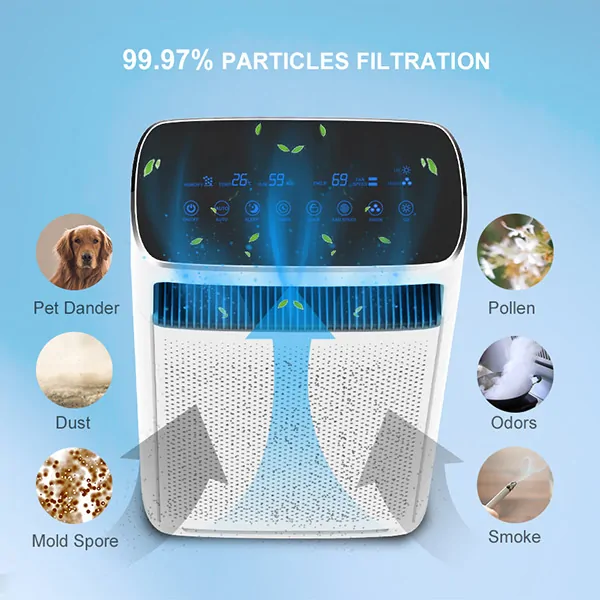
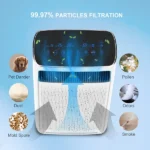
HEPA (High-Efficiency Particulate Air) is a standard for mechanical filter media that captures particles by interception, impaction, and diffusion — not by an electrostatic charge or chemical action. A true HEPA filter is rated to capture 99.97% of particles at the most penetrating size (0.3 microns) and effectively removes:
Dust and dust mites
Pollen
Pet dander
Mold spores (already airborne)
PM2.5 and fine smoke/soot particles
Some virus-carrying aerosols (as particles; see limits below)
A HEPA filter captures particles. That is its entire job. It does not capture gases, vapors, or odors by itself.
Where a HEPA Purifier Helps
A HEPA air purifier is most useful when the problem is particles in the air of an already-enclosed space:
Allergy season — pollen and dust indoors.
Pet households — dander.
Smoke or haze days — fine particulate infiltration from outside.
Rooms where someone is sensitive to airborne particles.
Supplement to ventilation on high-pollution days.
For a purifier to help a whole room, its clean air delivery rate (CADR) must match the room size, and it must run continuously — a small purifier doing one room a day does little.
What a HEPA Purifier Cannot Do
Be clear about the limits:
It does not bring in fresh air. A purifier recirculates and filters the air already in the room. It does not lower CO₂ or replace stale air.
It does not remove gases or odors (unless it also has an activated carbon stage). Cooking smells, VOCs, and chemical vapors need carbon or ventilation.
It does not control humidity or mold growth. It can capture spores that are airborne, but it does not stop the moisture that lets mold grow.
It is not a medical device and does not prevent illness. Filtering particles can reduce airborne particle load, but no purifier guarantees protection from viruses or disease. Avoid health claims.
A purifier is a particle-filtration tool, not a ventilation or health solution.
HEPA Purifier vs Ventilation
Need
HEPA purifier
Ventilation
Remove particles (dust, pollen, PM2.5)
Yes
Partly (if filtered supply)
Bring in fresh outdoor air
No
Yes
Reduce CO₂
No
Yes
Remove humidity/moisture
No
Yes
Remove gases and odors
No (needs carbon)
Yes (by dilution/exhaust)
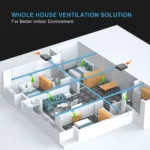
The practical answer: a maioria dos ambientes precisa de ambos. A ventilação (entrada de ar fresco, saída de ar viciado) é a base para um ar saudável; um purificador HEPA adiciona filtragem de partículas ao ar já presente no interior. Em dias de alta poluição, quando não se deve abrir janelas, a combinação de um purificador com um sistema de ventilação com filtragem é a solução mais eficaz — consulte o nosso guia de ventilação de ar novo residencial.
How to Choose a HEPA Purifier
Adequar o CADR ao tamanho do ambiente. Uma regra prática é buscar um CADR alto o suficiente para renovar o ar do ambiente várias vezes por hora. A orientação do fabricante quanto à área de cobertura é o ponto de partida.
Verifique o tipo de filtro. True HEPA para partículas; adicione carvão ativado caso odores/gases sejam relevantes. Elementos filtrantes do “tipo HEPA” ou laváveis não equivalem ao True HEPA.
Considere o nível de ruído e o custo operacional. Um purificador só funciona se estiver em operação; uma unidade silenciosa e de baixo consumo elétrico na velocidade adequada é muito mais eficiente na prática.
Substitua os filtros no prazo recomendado. Um filtro saturado reduz a vazão de ar e o desempenho — siga o intervalo indicado pelo fabricante.
Frequently Asked Questions
P: Um purificador de ar HEPA realmente funciona? R: Sim, para partículas. Um purificador True HEPA com CADR adequado para o ambiente reduzirá de forma mensurável as partículas em suspensão no ar. Ele não realiza as funções da ventilação nem dos filtros de carvão ativado.
P: Um purificador HEPA consegue eliminar odores? R: Isoladamente, não — o HEPA retém partículas, não gases. Apenas um purificador (ou filtro) com estágio de carvão ativado remove odores e COVs.
P: Um purificador HEPA ajuda no combate a alergias? R: Pode ajudar contra alérgenos suspensos no ar, como pólen, ácaros e pelos de animais, reduzindo sua concentração no ar ambiente.
P: Um purificador de ar previne COVID-19 ou gripe? R: Nenhum purificador pode garantir a prevenção de doenças. A redução da carga de partículas no ar é uma camada de proteção, mas ventilação, higiene e medidas sanitárias são os controles definitivos.
P: Um purificador HEPA é o mesmo que ventilação? R: Não. O purificador filtra o ar já existente no ambiente; a ventilação realiza a troca entre o ar interno e o externo. Eles desempenham papéis diferentes e operam melhor em conjunto.
P: Qual a capacidade necessária de um purificador para um quarto? R: Dimensione o CADR de acordo com o tamanho do ambiente e dê preferência a uma unidade que possa operar em uma velocidade silenciosa e eficiente. Consulte as especificações do fabricante sobre a área de cobertura para partículas.
Deseja purificar o ar do seu ambiente? A KCvents fabrica ventiladores de ventilação HEPA para montagem em parede, unidades de ar fresco e sistemas de ventilação que combinam filtragem com insuflamento de ar fresco para projetos de distribuição atacadista, OEM e private-label. Solicite um orçamento com as dimensões do seu ambiente e suas metas de qualidade do ar.
Atualizações da newsletter
Enter your email address below and subscribe to our newsletter