Axial vs Centrifugal Fan: Complete Comparison Guide [2026]
Choosing between an axial fan and a centrifugal fan is one of the most critical decisions in ventilation system design. While both types move air effectively, they operate on fundamentally different principles and excel in distinct applications. This axial vs centrifugal fan comparison guide examines the key differences, performance characteristics, cost considerations, and selection criteria to help you make an informed decision.
Whether you’re designing an HVAC system, planning industrial ventilation, or selecting cooling equipment, understanding the difference between axial and centrifugal fan types will ensure optimal performance, energy efficiency, and cost-effectiveness for your specific application.
What is an Axial Fan?
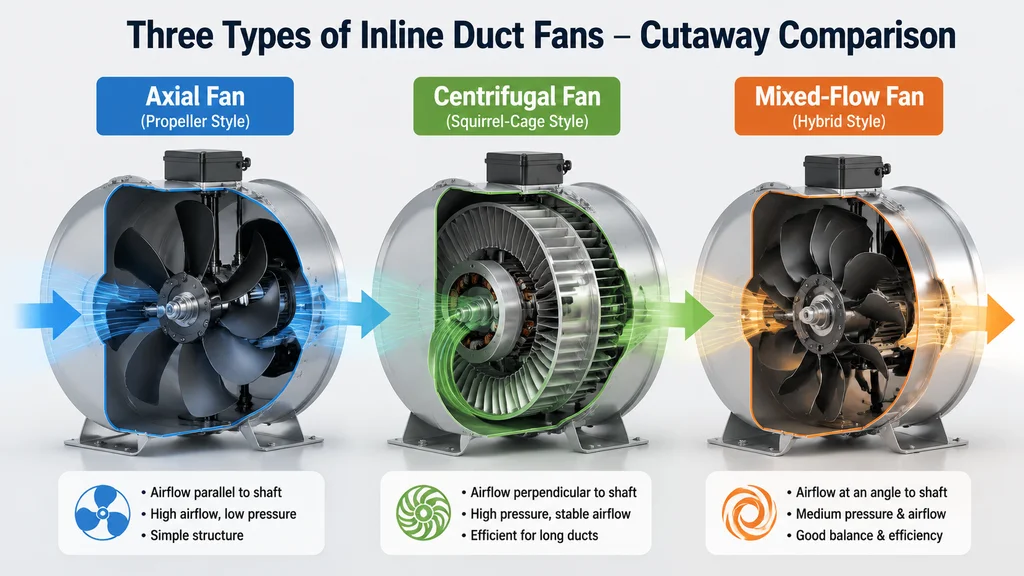
An axial fan, sometimes called a propeller fan, moves air parallel to its rotating shaft (axis). The fan blades are mounted on a central hub, and as they spin, they pull air in from one side and push it out the other side in the same direction.
How Axial Fans Work
The operating principle is straightforward: angled blades cut through the air, creating a pressure differential that moves large volumes of air along the axis of rotation. The blade pitch (angle) determines the airflow rate and pressure capability. Steeper blade angles produce higher pressure but lower flow rates, while shallower angles maximize flow at lower pressures.
Key Characteristics
Airflow Direction: Straight-through, parallel to the shaft
Typical Flow Rate: 1,000 to 830,000 m³/h (590 to 488,000 CFM)
Static Pressure Range: 50 to 5,000 Pa (0.2 to 20 inches H₂O)
Efficiency: 65-85% at optimal operating point
Construction: Simple, compact design with exposed blades
Types of Axial Fans
Propeller Fans: Basic open-blade design for free air delivery
Tubeaxial Fans: Mounted in a cylindrical housing for ductwork, suitable for inline duct fan installations
Vaneaxial Fans: Include guide vanes for higher pressure and efficiency
What is a Centrifugal Fan?
A centrifugal fan, also known as a centrifugal blower or radial fan, uses centrifugal force to move air. Air enters the fan housing near the shaft, gets accelerated by the spinning impeller, and exits at a 90-degree angle through the fan outlet.
How Centrifugal Fans Work
Centrifugal fans operate on the principle of centrifugal force. As the impeller (wheel) rotates, air is drawn into the center and accelerated outward by centrifugal force. The scroll-shaped housing (volute) collects and directs this high-velocity air to the outlet, converting kinetic energy into static pressure.
Key Characteristics
Airflow Direction: Perpendicular to the shaft (90-degree discharge)
Typical Flow Rate: 500 to 500,000 m³/h (295 to 294,000 CFM)
Static Pressure Range: 500 to 25,000 Pa (2 to 100 inches H₂O)
Efficiency: 70-90% at optimal operating point
Construction: Enclosed housing with impeller wheel
Types of Centrifugal Fans
Forward-Curved Blades: High flow, low pressure, quieter operation
Backward-Curved/Airfoil Blades: High efficiency, self-limiting power draw
Radial Blades: Handles particulates, robust for harsh environments
Axial vs Centrifugal Fan: Key Differences
When performing an axial vs centrifugal fan comparison, the differences go far beyond just how the air moves. Understanding these fundamental distinctions is essential for proper selection in any ventilation system.
Airflow Direction and Mechanism
Axial fans move air in a straight line parallel to the fan shaft. This design is inherently simpler and more compact, making axial fans ideal for applications where space is limited and airflow can be directed without significant changes in direction.
Centrifugal fans change the air direction by 90 degrees. Air enters axially through the inlet and exits radially through a discharge opening. This design allows for higher pressure generation and better control of airflow direction.
Volume vs. Pressure Trade-off
The most significant operational difference in any axial vs centrifugal fan comparison lies in the volume-pressure relationship:
Axial fans excel at moving high volumes of air at low pressures. A typical 24-inch axial fan can move 10,000-15,000 CFM efficiently, but its performance degrades rapidly when system resistance exceeds 1-1.5 inches H₂O. This makes the axial vs centrifugal fan decision straightforward for low-resistance applications — axial fans win decisively on both cost and efficiency.
Centrifugal fans are designed for pressure. A similar-capacity centrifugal fan maintains stable airflow even when facing 3-5 inches H₂O of resistance, though at lower overall volume for the same physical size. For ducted systems with significant resistance, the axial vs centrifugal fan comparison tilts heavily toward centrifugal designs.
Comparison Table
Feature
Axial Fan
Centrifugal Fan
Airflow Direction
Parallel to shaft
Perpendicular (90°)
Volume vs Pressure
High volume, low pressure
Lower volume, high pressure
Size
More compact
Larger, heavier
Nível de Ruído
Typically louder (60-85 dB)
Generally quieter (50-75 dB)
Efficiency at Low Pressure
Excellent (80-85%)
Moderate (65-75%)
Efficiency at High Pressure
Poor (drops significantly)
Excellent (85-90%)
Manutenção
Easier, fewer parts
More complex
Power Consumption (same CFM)
Lower at low pressure
Lower at high pressure
Initial Cost
$500-$3,000
$1,000-$8,000
Durability in Dirty Conditions
Limited
Excellent (with proper design)
Noise Considerations
Noise generation differs significantly between the two designs:
Axial fans produce broadband noise primarily from:
Blade tip vortex shedding
Turbulence at blade trailing edges
Motor noise (especially in direct-drive units)
Sound levels typically range from 55-85 dB(A) at 3 feet, depending on blade design, speed, and diameter. Larger, slower-turning fans are quieter than smaller, faster ones delivering the same CFM.
Centrifugal fans generate noise from:
Impeller blade-pass frequency (tonal noise)
Air turbulence in the housing
Bearing noise
The enclosed design helps contain noise, with typical levels of 50-75 dB(A). Airfoil and backward-curved designs are quietest, while forward-curved and radial blade designs produce more noise.
Energy Efficiency Analysis
Energy efficiency is where the axial vs centrifugal fan comparison reveals the most dramatic cost implications over time. The fan type you choose directly impacts electricity bills for years to come, making efficiency analysis a critical part of the selection process. The fan selection directly impacts electricity bills for years to come.
AC Motors vs EC Motors
Traditional fans use AC induction motors, which typically operate at 60-75% efficiency depending on load. Modern EC (Electronically Commutated) motors achieve 85-93% efficiency across a much wider operating range.
Tipo de Motor
Efficiency Range
Speed Control
Typical Cost Premium
AC Induction (single-speed)
60-70%
None
Linha de base (Baseline)
AC Induction (VFD-controlled)
65-75%
Variable
+20-30%
EC Motor (integrated)
85-93%
Built-in variable
+40-60%
Key advantage of EC motors: They maintain high efficiency even at reduced speeds. An AC motor with a VFD running at 50% speed may drop to 50-55% efficiency, while an EC motor at 50% speed retains 85%+ efficiency.
Efficiency at Different Operating Pressures
Understanding how efficiency changes with operating pressure is central to any axial vs centrifugal fan comparison:
Low Pressure Systems (< 0.5" H₂O):
Axial fans: 70-85% efficient
Centrifugal fans: 60-70% efficient
Winner: Axial (20-40% less energy)
Medium Pressure (0.5-2″ H₂O):
Axial fans: 50-70% efficient
Centrifugal fans: 70-80% efficient
Winner: Comparable, case-dependent
High Pressure (> 2″ H₂O):
Axial fans: < 40% efficient (often inadequate)
Centrifugal fans: 75-85% efficient
Winner: Centrifugal (30-50% less energy)
Real-World Energy Cost Example
For a 10,000 CFM system running 6,000 hours/year at $0.12/kWh:
Application
Axial Fan Cost/Year
Centrifugal Cost/Year
Annual Savings
Low pressure (0.5″ H₂O)
$2,664
$4,032
$1,368 (axial wins)
Medium pressure (1.5″ H₂O)
$5,230
$5,150
~$80 (similar)
High pressure (3″ H₂O)
N/A (not suitable)
$10,728
N/A (centrifugal only)
Over a 10-year lifespan, choosing the right fan type for the pressure range saves $10,000-$20,000 in electricity alone.
General Ventilation: Open spaces like warehouses, factories, and gymnasiums where large air volumes are needed without significant ductwork
Sistemas HVAC: Cooling towers, air handling unit fresh air intake sections, and economizer sections where pressure drop is minimal
Electronics Cooling: Server rooms, telecom facilities, and computer equipment where direct airflow is beneficial
Agricultural Ventilation: Barns, greenhouses, and storage buildings requiring economical high-volume air exchange
Spot Cooling: Direct cooling of machinery, work areas, or processes where air can flow freely
Detailed Application Examples
Data Center Hot Aisle Containment: Large 36-48″ diameter axial fans mounted at the end of hot aisles effectively exhaust heat while consuming minimal energy. With typical static pressure under 0.3″ H₂O, these installations achieve 80%+ efficiency while moving 50,000-100,000 CFM per fan.
Industrial Warehouse Cross-Ventilation: Wall-mounted axial fans create effective air exchange by working in pairs—supply fans on one wall, exhaust fan units on the opposite wall. This arrangement requires no ductwork and provides natural ventilation at a fraction of the cost of a ducted HVAC system.
Tunnel Ventilation: Large axial fans (up to 72″ diameter) provide efficient ventilation in tunnels, mines, and underground facilities where straight-line airflow is possible and duct losses are minimal.
Selection Guidelines for Axial Fans
Choose an axial fan when:
System static pressure is below 1″ H₂O
Ductwork is minimal or non-existent
Space allows for adequate fan diameter
Budget is constrained
Maintenance simplicity is important
Avoid axial fans when:
System has significant ductwork with multiple bends
High-efficiency filtration is required
Precise pressure control is needed
Operating environment is dirty or corrosive
Noise must be minimized in occupied spaces
When to Use Centrifugal Fans
Ideal Applications
Complex Duct Systems: Any HVAC installation with multiple branches, long duct runs, or numerous direction changes
High-Pressure Applications: Fume extraction, dust collection, spray booths, and process ventilation requiring consistent airflow against high resistance
Filtration Systems: Applications with HEPA filters, bag filters, or any system where filter loading creates significant pressure drop
Cozinhas Comerciais: Exhaust systems handling grease-laden vapors through hoods, ductwork, and fire suppression systems
Industrial Process: Pneumatic conveying, drying ovens, paint spray booths, and material handling systems
Detailed Application Examples
Hospital Operating Room Ventilation: These critical environments require precise airflow control with HEPA filtration (2-4″ H₂O pressure drop). Centrifugal fans maintain stable airflow despite filter loading, ensuring consistent air changes per hour (15-25 ACH) and proper room pressurization.
Industrial Dust Collection: A central dust collection system serving multiple machines requires a centrifugal fan capable of overcoming 8-12″ H₂O static pressure from ductwork, cyclone separators, and bag filters. Radial blade centrifugal fans handle the particulate-laden airstream while maintaining constant CFM.
Pharmaceutical Clean Room: Centrifugal fans with backward-curved blades provide the high-efficiency filtration needed for clean rooms (ISO 5-7 classifications). These systems maintain precise pressure cascades between rooms while handling the 4-6″ H₂O pressure drop from HEPA filters.
Commercial Laundry Exhaust: High-temperature, moisture-laden exhaust requires corrosion-resistant centrifugal fans (often stainless steel construction) capable of handling 400-600°F temperatures and 2-3″ H₂O system resistance.
Selection Guidelines for Centrifugal Fans
Choose a centrifugal fan when:
System static pressure exceeds 2″ H₂O
Ductwork is extensive or complex
Filtration creates significant pressure drop
Airflow must be precisely controlled
Operating environment is harsh (high temperature, corrosive, or particulate-laden)
Noise reduction is critical
Mixed-Flow Fans: Best of Both Worlds
While the traditional axial vs centrifugal fan debate frames them as opposites, modern mixed-flow fan technology bridges the gap between both types. For applications that fall between the ideal operating ranges of pure axial and pure centrifugal designs, mixed-flow fans offer a compelling middle path.
This third category doesn’t replace either traditional design but expands the options available to engineers. The axial vs centrifugal fan comparison is no longer a binary choice — mixed-flow technology means you can have high volume, respectable pressure, and compact duct-mountable form factor all in one unit. Mixed-flow fans combine the high-volume capability of axial designs with the pressure generation of centrifugal designs.
How Mixed-Flow Fans Work
A mixed-flow fan uses an impeller with conical geometry that pushes air both axially and radially. The result is a fan that delivers higher pressure than a comparable axial fan while maintaining higher volume than a centrifugal fan of the same size.
Advantages Over Traditional Designs
Higher pressure than axial: Develops 2-5x the static pressure of comparable axial fans
Higher volume than centrifugal: Moves 30-50% more air than a similarly-sized centrifugal
Compact installation: Inline duct fan form factor mounts directly in ductwork
Lower energy consumption: 15-25% more efficient at medium pressures than either traditional type
Quieter operation: Reduced turbulence compared to pure axial designs
KC Vents offers mixed-flow inline fans in the MF, KC, and KC-A series, designed for commercial ventilation applications where the axial vs centrifugal fan trade-off is most painful — you need pressure, but you also need the compact form factor and high volume of an inline duct fan. These EC motor-driven mixed-flow fans integrate directly into round ductwork while delivering pressure performance that previously required larger centrifugal units. For HRV system integration or commercial duct boosting, mixed-flow designs often provide the optimal balance between installation simplicity and performance capability.
Cost Analysis: Total Cost of Ownership
Understanding the full financial impact of the axial vs centrifugal fan decision requires analyzing all costs over the equipment’s lifespan, not just the purchase price.
Energy Consumption (6,000 hours/year at $0.12/kWh):
Low-pressure application (0.5″ H₂O, 10,000 CFM):
Axial: 5 HP motor → 3.7 kW → $2,664/year → $26,640 over 10 years
Centrifugal: 7.5 HP motor → 5.6 kW → $4,032/year → $40,320 over 10 years
High-pressure application (3″ H₂O, 10,000 CFM):
Axial: Not suitable (or requires 15+ HP, very inefficient)
Centrifugal: 20 HP motor → 14.9 kW → $10,728/year → $107,280 over 10 years
Maintenance Costs
Manutenção Anual:
Axial fan: $150-$400
Bearing lubrication/replacement: $100-$200
Belt replacement (if applicable): $50-$100
Annual cleaning: $50-$100
Centrifugal fan: $250-$700
Bearing maintenance: $150-$300
Belt/pulley service: $100-$200
Impeller cleaning and balance: $100-$200
Housing inspection: $50-$100
10-Year Maintenance:
Axial: $2,000-$4,000
Centrifugal: $3,000-$7,000
Total Cost of Ownership Example
Low-Pressure Application (10,000 CFM at 0.5″ H₂O):
Axial Fan:
Purchase: $1,800
Installation: $1,000
Energy (10 years): $26,640
Maintenance (10 years): $3,000
Total 10-Year TCO: $32,440
Centrifugal Fan:
Purchase: $3,500
Installation: $2,500
Energy (10 years): $40,320
Maintenance (10 years): $5,000
Total 10-Year TCO: $51,320
Savings with axial: $18,880 (37% lower TCO)
Compliance & Certifications
When selecting fans for commercial or industrial applications, certification and code compliance are non-negotiable — regardless of whether you choose an axial or centrifugal fan. The following standards apply to both types and must be verified before specification. The following standards govern fan performance, efficiency, and safety in North America and Europe.
North American Standards
AMCA 210 — Laboratory Methods of Testing Fans: Defines standardized testing procedures for airflow, pressure, power, and efficiency. AMCA-certified fan ratings (amca.org) are independently verified, ensuring that published performance data matches real-world operation.
AMCA 205 — Energy Efficiency Classification: Introduces the Fan Efficiency Grade (FEG) and Fan Energy Index (FEI) metrics:
FEG: Rates fan aerodynamic efficiency on a scale of 0-100, independent of motor and drive
FEI: Overall system efficiency score; FEI ≥ 1.0 is required by ASHRAE 90.1-2019 for many commercial fan applications
ANSI/ASHRAE Standard 62.2: Sets minimum ventilation requirements for residential buildings. Commercial equivalents fall under ASHRAE Standard 62.1 and 90.1 (energy efficiency requirements).
European Standards
Eurovent ECP (Energy Certification Program): European certification program that rates fan energy efficiency, similar to Energy Star for appliances. Eurovent-certified fans are independently tested for performance compliance.
ErP Directive 2009/125/EC (EU): The Energy-related Products directive sets minimum efficiency requirements for fans sold in the EU market. From 2015, all fans between 125W and 500kW must meet minimum efficiency grades.
CE Marking: Mandatory for all fans sold in the European Economic Area, covering safety (Machinery Directive 2006/42/EC), electromagnetic compatibility (EMC Directive 2014/30/EU), and low voltage (LVD 2014/35/EU).
HVI Certification
For residential ventilation products, the Home Ventilating Institute (HVI) provides independent performance certification. HVI-certified fans are tested for:
Airflow (CFM) at specified static pressures
Sound levels (sones)
Energy efficiency (CFM/Watt)
HVI certification ensures that labeled performance data is reliable, preventing the common issue of inflated manufacturer claims.
Is static pressure < 1" H₂O?
  ├─ YES → Axial fan likely optimal (verify TCO)
  │
  └─ NO → Is static pressure 1-2" H₂O?
      ├─ YES → Evaluate both + mixed-flow options
      │         - Compare efficiency curves
      │         - Calculate 10-year TCO
      │         - Consider noise requirements
      │
      └─ NO → Static pressure > 2" H₂O
              → Centrifugal fan required
Step 4: Verify Operating Point
The selected fan must operate near its peak efficiency point (BEP – Best Efficiency Point). Operating significantly left or right of BEP results in:
Reduced efficiency
Increased noise
Shortened equipment life
Potential motor overload or underutilization
Common Selection Mistakes
Undersizing for future filter loading: Filters become more restrictive over time
Ignoring actual duct losses: Theoretical calculations often underestimate real-world friction
Selecting based on price alone: TCO analysis often reveals the “cheaper” option costs more long-term
Using axial fans in high-pressure systems: Results in poor performance and high energy waste
Oversizing fans: Leads to throttling losses, noise, and energy waste
Not considering noise: Can require expensive remediation in occupied spaces
Conclusão
The fundamental decision between axial and centrifugal fans hinges on your system’s static pressure requirements and application constraints. As this axial vs centrifugal fan comparison demonstrates, axial fans dominate in high-flow, low-pressure applications where simplicity, lower cost, and compact installation are priorities. Centrifugal fans are essential—and often the only viable option—for ducted systems, filtration applications, and any process requiring stable performance against system resistance.
For applications with static pressure below 1″ H₂O, axial fans typically offer 30-40% lower total cost of ownership compared to centrifugal alternatives. However, for systems requiring more than 2″ H₂O, only centrifugal fans can deliver both adequate performance and acceptable efficiency. For the middle ground (1-2″ H₂O), mixed-flow inline fans offer a compelling third option that combines the best characteristics of both traditional designs.
The key to successful fan selection is accurate system analysis. Invest time in proper static pressure calculations, consider the full equipment lifecycle, and evaluate total cost of ownership rather than just initial price. When in doubt, consult with ventilation engineers or fan manufacturers who can provide application-specific guidance.
Next Steps
Need help selecting the right fan for your application? KC Vents offers a comprehensive range of axial, centrifugal, and mixed-flow fans for commercial and industrial ventilation. Our engineering team provides:
Free system analysis and CFM calculations
Fan selection and sizing services
Custom solutions for special applications
Energy efficiency audits
Installation support
Contact our technical team for a consultation and let us help you choose the optimal ventilation system for your specific requirements.
*Last updated: June 2026. Performance data sourced from AMCA-certified fan ratings and industry-standard engineering references.*