Air Curtains for Flying Insect Control: What Works and What Doesn’t
An air curtain can help control flying insects at a door by directing a continuous high-velocity air stream across the opening, which disrupts the airflow insects use to enter and makes it harder for them to fly through. But an air curtain is not a barrier that “kills” or perfectly seals insects — real-world performance depends on the door height, the air velocity at the floor, installation quality, and the environment. This guide explains what air curtains can really do for insect control, how to select one, and where they fall short.
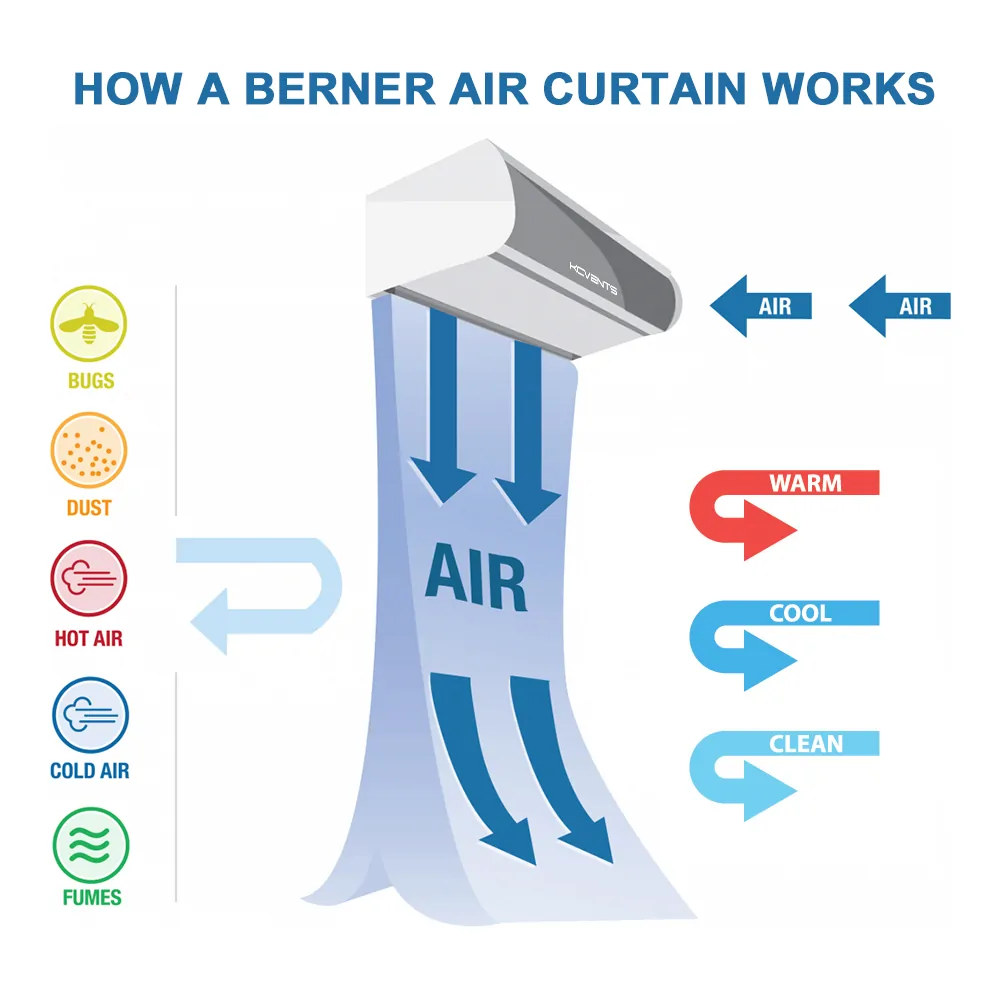
An air curtain is a fan unit mounted above a door that blows a downward air stream across the full width of the opening. This jet of air serves two purposes indoors:
It separates the indoor and outdoor climates (the main job — keeping conditioned air in and outside air out).
It disrupts flying insects’ entry path. Many flying insects are weak fliers; a steady high-velocity air stream across the doorway is uncomfortable or impossible for them to fly through.
For insects, the air curtain works by creating an airflow barrier: rather than continuously being blown away one by one, insects themselves avoid the crossflow. It is most effective for the random, opportunistic flying insects that drift through open doors, not for swarms or strong fliers.
What Actually Determines Insect-Control Performance
The effectiveness of an air curtain for insect control is not guaranteed by the unit’s presence. It depends on:
Air velocity at floor level — the jet must carry across the full door height with enough velocity to disrupt insects near the ground. If the velocity dies out before reaching the floor, insects fly under the jet.
Door height — higher doors need higher unit air velocity or more powerful units to maintain the floor-level jet.
Width coverage — the air stream must span the full door width. Multiple units or a matched-width unit are needed for wide openings.
Wind and pressure differences — a strong outdoor wind or building pressure difference can overpower the jet.
Installation and maintenance — a dirty filter or fan, or a blocked intake, cuts the effective air velocity.
Air Velocity and Door Height Matter Most
The rule of thumb in air curtain selection is that the air velocity at the floor should be high enough to break an insect’s flight — commonly 16 m/s or more is cited for insect-control-focused units, and the unit’s rated velocity must carry across the door height.
What this means in practice:
Door height
What to check
Up to ~2.5 m
Standard commercial units with adequate floor velocity
Industrial units, multiple units, or accept partial effectiveness
Always check the unit’s velocity rating at the floor, not only at the nozzle. A unit that blows 16 m/s at the outlet but 5 m/s at the floor is not doing an insect-control job.
Selecting an Air Curtain for Insect Control
Measure the door width and height. The unit (or combination) must cover the full opening.
Check floor-level air velocity for your door height. This is the single most important spec for insect control.
Choose cross-flow or centrifugal based on your needs — centrifugal (high-pressure) units generally deliver higher floor velocity; cross-flow units are quieter for standard entrances.
Consider a heating version for cold climates, or an unheated version for insect control in mild seasons. A heated air curtain also discourages insects with its airflow direction patterns, but heating is not the insect-control mechanism itself.
Check mounting height — units are designed for a specific installation height; exceeding it reduces performance.
Use it correctly — the air curtain helps when the door is open (delivery, entry), but it does not make leaving the door standing open safe. Pair it with a quick-acting door.