Utilizamos cookies para garantizar que le brindamos la mejor experiencia en nuestra web.
Manténgase al día con KCVENTS Soluciones de ventilación & HVAC
Suscríbase a nuestro boletín para recibir los últimos avances en ingeniería de flujo de aire, actualizaciones de sistemas ERV/HRV energéticamente eficientes y soluciones HVAC ecológicas.
Sea el primero en recibir guías técnicas exclusivas, información sobre capacidades personalizadas de OEM/ODM y noticias sobre ferias internacionales directamente de KCVENTS.
Ventilation for Greenhouses and Indoor Grow Rooms: Temperature and Humidity
Cómo ventilar invernaderos y salas de cultivo interior para temperatura, humedad y renovación de aire.
Ventilación para invernaderos y salas de cultivo interior: control de temperatura y humedad
La ventilación en invernaderos y salas de cultivo interior controla el entorno en el que crecen las plantas: temperatura, humedad y renovación del aire. Un espacio bien ventilado disipa el calor, reemplaza el aire húmedo por aire fresco y mantiene la disponibilidad de CO₂; por el contrario, un espacio mal ventilado sufre oscilaciones térmicas e incrementos de humedad que favorecen el moho y el estrés térmico. Esta guía explica los requisitos de ventilación y cómo diseñar un sistema que mantenga condiciones estables.
Por qué la ventilación de invernaderos y salas de cultivo es diferente
Una vivienda requiere ventilación para las personas; un espacio de cultivo la necesita para las plantas, y los requerimientos son mucho más exigentes. Las plantas transpiran continuamente, las luminarias y bombas aportan calor, y la fotosíntesis consume el CO₂. En consecuencia, un espacio de cultivo puede pasar de un exceso de humedad a un sobrecalentamiento en cuestión de minutos si la ventilación está subdimensionada o apagada.
Los tres objetivos de la ventilación en espacios de cultivo:
Control de temperatura — disipar el calor generado por la iluminación (especialmente HPS/HID) y los equipos.
Control de humedad — evacuar la humedad procedente de la transpiración para impedir la proliferación de hongos y moho.
Renovación del aire — reponer el CO₂ consumido por la fotosíntesis y extraer el etileno y el aire viciado.
El mismo sistema de ventilación cubre estos tres objetivos: los extractores evacuan el aire caliente, húmedo y viciado, introduciendo aire más fresco, seco y limpio.
Necesidades de las plantas: temperatura, humedad y renovación del aire
Aunque los rangos exactos dependen del tipo de cultivo y su fase de desarrollo, los principios fundamentales se mantienen:
Temperatura — la mayoría de los cultivos se desarrollan en un rango moderado; el estrés térmico surge con rapidez ante fallos de ventilación. El control térmico es el motivo principal por el que un invernadero requiere ventilación activa en verano.
Humedad relativa — una humedad relativa elevada favorece el moho y reduce la transpiración. La ventilación suministra aire más seco para mantener la humedad dentro de márgenes controlados.
Renovación del aire / CO₂ — las plantas agotan el CO₂ en recintos cerrados; el aporte de aire fresco garantiza el suministro necesario para la fotosíntesis.
La circulación del aire también es clave: el flujo de aire a la altura de la canopia (mediante ventiladores de recirculación) evita microclimas estancados donde se genera el mildiú, incluso con una ventilación general adecuada.
Ventilación natural frente a ventilación mecánica
Ventilación natural (cenitales practicables, aperturas laterales, mallas) funciona en invernaderos bajo clima templado y con viento. Representa una solución económica y de bajo consumo energético.
Sus limitaciones:
Deja de ser eficaz sin viento o sin gradiente térmico.
Introduce aire no filtrado e impredecible.
No permite un control riguroso de la humedad o la temperatura.
En climas cálidos y sin viento, la ventilación natural por sí sola suele ser insuficiente.
Ventilación mecánica (ventiladores + admisión) garantiza un caudal de renovación de aire controlado independientemente de las condiciones meteorológicas. Es la solución fiable para un invernadero de alto rendimiento e indispensable en salas de cultivo interior estancas.
Las salas de cultivo interior (armarios, cuartos, sótanos) carecen de ventilación natural viable: son básicamente recintos estancos que deben contar con sistemas mecánicos de extracción e impulsión de aire.
Componentes de la ventilación mecánica
Un sistema mecánico completo consta de varios componentes:
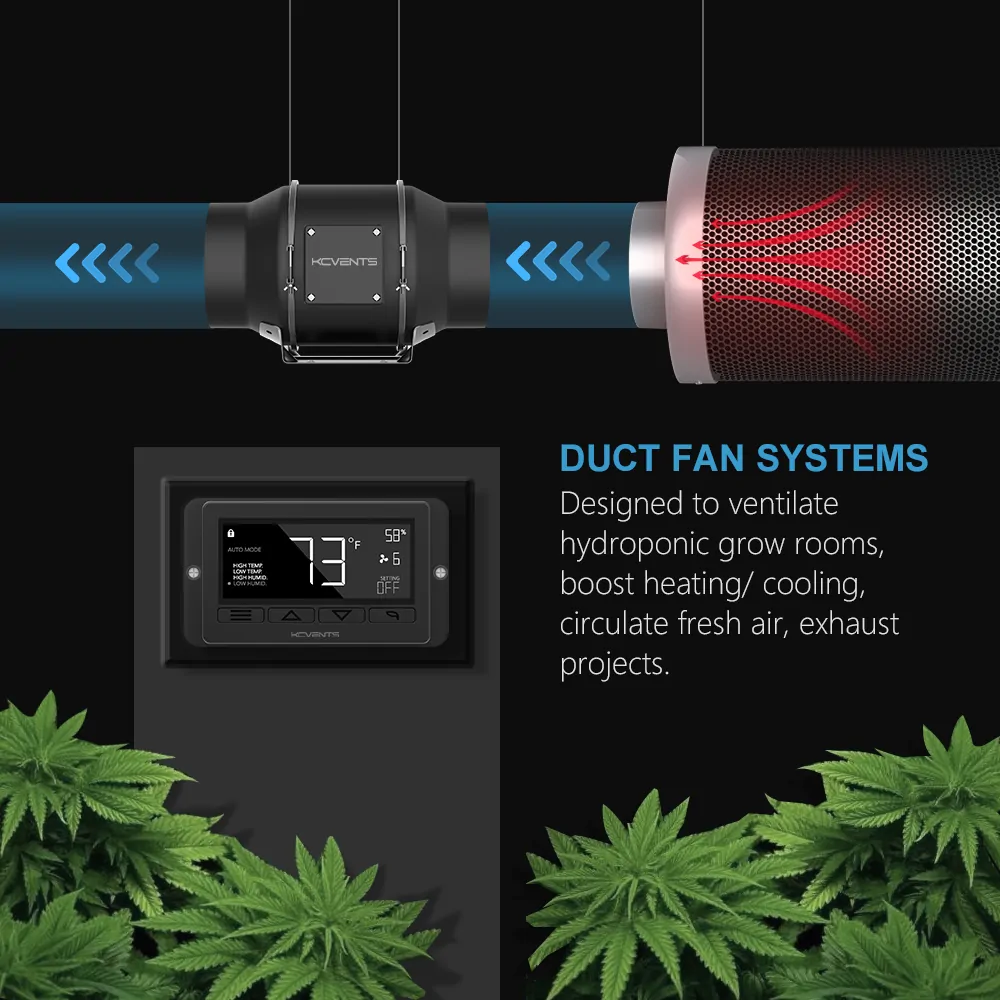
Ventiladores de extracción — extraen el aire caliente y húmedo (los ventiladores de conducto en línea son la herramienta estándar; consulte nuestra guía de ventiladores en línea para conductos).
Admisión / suministro de aire fresco — rejillas de ventilación pasivas o un ventilador de admisión activo.
Ventiladores de recirculación — mantienen el aire en movimiento a nivel del dosel foliar.
Filtros — carbón activado para el control de olores en la extracción; filtros de admisión donde el aire exterior contenga polvo (consulte nuestra guía de filtros de carbón).
Controles — sensores de temperatura/humedad y control de velocidad (ventiladores EC) para que el sistema aumente su rendimiento solo cuando sea necesario (consulte nuestra guía de motores EC).
En un invernadero, la extracción suele situarse en la parte superior del hastial o de la pared lateral, con la admisión en la parte inferior del lado opuesto, generando un flujo cruzado. En un armario de cultivo, la extracción normalmente aspira a través de un filtro de carbón hacia el exterior, con admisión pasiva o activa en la parte baja del armario.
Dimensionamiento de un sistema de ventilación
Dimensione el caudal de aire de extracción a partir del volumen del espacio y de la carga térmica/humedad:
Calcule el volumen — longitud × anchura × altura promedio del espacio de cultivo.
Seleccione las renovaciones de aire por minuto — los espacios de cultivo suelen requerir un cambio de volumen por minuto o más, según la carga térmica, la densidad de las plantas y la resistencia del filtro.
Añada la resistencia del filtro y los conductos — lo que importa es el caudal de aire del ventilador en línea a la presión estática del sistema, no el valor de descarga libre.
Sobredimensione ligeramente + regule la velocidad — un ventilador EC ligeramente más grande funcionando a velocidad reducida ofrece margen para picos térmicos, manteniéndose silencioso y eficiente en condiciones normales.
Equilibre la admisión de aire — la entrada de aire debe ser lo suficientemente grande para no estrangular el ventilador (lo que reduciría el caudal de aire y aumentaría el desgaste del filtro).
Espacio
Enfoque típico de caudal de aire
Armario pequeño (p. ej., 1×1×2 m)
Ventilador en línea de 100–150 mm, un volumen/min, filtro de carbón
Sala de cultivo (p. ej., 3×3×2,5 m)
150–200 mm + admisión, velocidad variable EC
Invernadero
Pared de ventilación / extracción mayor según la carga térmica, múltiples unidades
Frequently Asked Questions
P: ¿Cuánta ventilación necesita una sala de cultivo? R: Comience con una renovación del volumen del armario/sala por minuto y ajuste en función de la carga térmica, la densidad vegetal y la resistencia del filtro. Lo que cuenta es el caudal de aire real suministrado a la presión estática de funcionamiento.
P: ¿Debe tener un invernadero ventilación mecánica? R: En climas templados y con viento, la ventilación natural (ventanas/aperturas) puede bastar en primavera/otoño, pero para mantener condiciones de cultivo uniformes —especialmente con el calor del verano—, la extracción mecánica es el método más fiable.
P: ¿Cómo se controla la humedad en un espacio de cultivo? R: La renovación de aire es la herramienta principal: los extractores sustituyen el aire húmedo por aire exterior más seco. Los ventiladores de recirculación evitan bolsas de aire estancado locales. Un deshumidificador es un complemento útil para cultivos o climas con alta humedad.
P: ¿Necesito un filtro de carbón? R: Para el control de olores, sí: un ventilador en línea que extrae a través de un filtro de carbón activado dimensionado adecuadamente trata el aire de extracción. Consulte nuestra guía de filtros de carbón.
P: ¿Puedo usar un ventilador doméstico convencional en una sala de cultivo? R: Un ventilador doméstico solo recircula el aire; no extrae calor ni humedad ni introduce aire fresco. Se necesita un sistema adecuado de extracción/admisión (ventiladores en línea) además de ventiladores de recirculación.
P: ¿Cómo controlo la ventilación de forma automática? R: Utilice sensores de temperatura/humedad conectados al controlador del ventilador. Un ventilador EC puede modular su velocidad automáticamente según las condiciones; tratamos esto en nuestra guía de motores EC.
¿Diseñando la ventilación para un invernadero o sala de cultivo? KCvents fabrica ventiladores en línea para conductos EC, extractores y filtros de carbón activado para cultivo en interiores y agricultura en entornos controlados, dirigidos a distribuidores mayoristas, OEM y compradores de marca propia. Solicitar presupuesto con las dimensiones de su espacio y sus requisitos de ventilación.
Actualizaciones del boletín
Introduce tu dirección de correo electrónico para suscribirte a nuestro boletín