Nous utilisons des cookies pour nous assurer que nous vous offrons la meilleure expérience possible sur notre site.
Restez informé avec KCVENTS Solutions de ventilation et CVC
Abonnez-vous à notre newsletter pour recevoir les dernières analyses en ingénierie aéraulique, les mises à jour sur les systèmes ERV/HRV écoénergétiques et les solutions CVC écologiques.
Soyez les premiers à recevoir des guides techniques exclusifs, à découvrir nos capacités OEM/ODM sur mesure et les actualités des salons mondiaux directement de KCVENTS.
DC Axial Fan Manufacturer: Complete Selection Guide for OEM Engineers [2026]
DC Axial Fan Manufacturer: Complete Selection Guide for OEM Engineers [2026]
Choosing the right DC axial fan manufacturer is one of the most consequential supply chain decisions for OEM engineers and procurement managers in electronics, industrial automation, telecom, and HVAC industries. The manufacturer you select determines not just the fan’s performance and reliability, but your product’s thermal management integrity, regulatory compliance, and long-term production stability. This guide covers every criterion you need to evaluate when selecting a DC axial fan manufacturer—from technical specifications and quality control to customization capabilities and total cost of ownership.
Why the Right DC Axial Fan Manufacturer Matters
A DC axial fan may seem like a commodity component, but in mission-critical applications it absolutely is not. A fan failure in a server rack, telecom base station, medical device, or industrial control cabinet can cascade into system failure, data loss, or production downtime costing thousands per minute. The difference between a reliable and unreliable DC axial fan manufacturer often comes down to factors invisible on a datasheet: bearing quality, motor winding consistency, IP rating integrity, and quality control processes.
Working with a reputable DC axial fan manufacturer ensures:
Consistent airflow and static pressure performance across production batches
Verified bearing life (L10) ratings backed by accelerated life testing
Compliance with CE, UL, RoHS, and industry-specific certifications
Reliable supply chain with stable lead times—critical for OEM production planning
Engineering support for thermal design optimization and custom specifications
Key Technical Specifications to Evaluate
Airflow (CFM) and Static Pressure
The two most fundamental performance parameters for any DC axial fan:
Airflow (CFM or m³/h): The volume of air the fan moves at zero static pressure (free air). Always verify whether the manufacturer’s published CFM rating is at free-air conditions or at a specific operating point. Airflow numbers without context are marketing, not engineering.
Static Pressure (mmH₂O or in. H₂O): The fan’s ability to push air against resistance. Critical for applications involving heatsinks, filters, dense enclosures, or ducted airflow paths. A quality DC axial fan manufacturer provides complete P-Q (pressure-flow) curves, not just maximum values.
Selection rule: For open enclosures with unobstructed airflow, prioritize CFM. For filtered or restricted air paths, prioritize static pressure at the expected operating point.
Voltage Options
Industrial DC axial fans are available in four standard voltages:
Voltage
Typical Applications
Advantages
12V DC
Consumer electronics, small embedded systems
Most common, widest availability
24V DC
Industrial control, automation, general OEM
Best balance of efficiency and availability
48V DC
Telecom, server, power systems
Lower current draw, longer cable runs
5V DC
USB-powered devices, compact electronics
Low power, limited airflow
For industrial applications, 24V and 48V DC axial fans dominate. A capable DC axial fan manufacturer should offer multiple voltage variants within the same frame size to accommodate different system architectures.
Frame Size and Depth
Standard DC axial fan frame sizes range from 25mm to 280mm:
Within a given frame size, depth matters: a 120×120×38mm fan moves significantly more air than a 120×120×25mm fan at the same RPM. When space allows, specify the deeper variant for better thermal performance.
Bearing Types: The Single Most Important Decision
Bearing technology determines fan lifespan, noise, operating temperature range, and mounting orientation limitations. This is where the quality of your DC axial fan manufacturer becomes most apparent.
Sleeve Bearings
L10 life: 30,000–50,000 hours at 25°C
Noise: Quietest (lowest mechanical noise)
Temperature limit: 40–50°C continuous
Orientation: Horizontal only (shaft vertical)
Cost: Lowest
Sleeve bearings are adequate for consumer products with low duty cycles and controlled environments. For any industrial or continuous-operation application requiring a DC axial fan manufacturer, sleeve bearings are rarely sufficient.
Hydraulic Bearings (Hydro-Dynamic)
L10 life: 50,000–80,000 hours at 40°C
Noise: Quiet (2–4 dBA louder than sleeve)
Temperature limit: 60–70°C continuous
Orientation: All positions
Cost: Moderate
Hydraulic bearings offer an excellent balance of quiet operation, long life, and reasonable cost. A quality DC axial fan manufacturer’s hydraulic bearing fans are ideal for most OEM electronics where both noise and reliability matter—office equipment, medical devices, and commercial electronics.
Dual Ball Bearings
L10 life: 70,000–100,000+ hours at 40°C
Noise: Slightly louder (2–4 dBA above hydraulic)
Temperature limit: 70–85°C continuous
Orientation: All positions, any angle
Cost: Highest
Dual ball bearings are the gold standard for industrial and mission-critical applications. When evaluating a DC axial fan manufacturer, pay close attention to their ball bearing sourcing—bearings from NMB, NSK, or NTN indicate a quality-focused manufacturer. Ball bearing fans handle 24/7 continuous operation, high temperatures, and all mounting orientations without degradation.
L10 Life and the Temperature Rule
Critical caveat: Bearing L10 life ratings roughly halve for every 15°C increase in operating temperature. A fan rated for 80,000 hours at 25°C may only deliver 20,000 hours at 55°C. Always specify the expected operating temperature when requesting life ratings from your DC axial fan manufacturer.
Control and Signal Options
Modern DC axial fans offer several control interfaces that a quality manufacturer should support:
Signal Type
Pins
Fonctionnalité
Basic (2-pin)
Power + Ground
On/off only, no feedback
Tachometer (3-pin)
Power + Ground + FG
RPM feedback signal
PWM (4-pin)
Power + Ground + FG + PWM
Variable speed control + feedback
RD/FG (3-pin variants)
Configurable
Locked rotor detection, alarm output
For any application where system reliability matters, a 3-pin fan with tachometer feedback is the minimum sensible choice—it allows the host system to detect fan failure. A 4-pin PWM fan adds precise speed control, enabling thermal management firmware to balance cooling, noise, and energy efficiency across operating conditions.
IP Ratings and Environmental Protection
For outdoor, washdown, or harsh environment applications, verify the DC axial fan manufacturer’s IP rating credentials:
IP Rating
Protection Level
Applications
IP54
Dust-protected, splash-resistant
General outdoor cabinets
IP55
Dust-protected, water jet resistant
Outdoor telecom, industrial
IP67
Dust-tight, temporary immersion
Washdown areas, marine
IP68
Dust-tight, continuous immersion
Submerged, extreme environments
Warning: Some manufacturers claim IP ratings without independent verification. A reputable DC axial fan manufacturer provides IP test certification from accredited laboratories, not self-declared ratings.
Certifications and Compliance
A legitimate DC axial fan manufacturer provides full compliance documentation:
CE (Conformité Européenne): Required for EU market access
RoHS (Restriction of Hazardous Substances): Required for EU, increasingly global
REACH: EU chemical safety regulation compliance
ISO 9001: Quality management system certification
For specialized markets:
IATF 16949: Required for automotive supply chain
EN 12101-3: Smoke and heat control fans (building safety)
ATEX: Explosive atmosphere applications
OEM, ODM, and Customization Capabilities
The ideal DC axial fan manufacturer relationship depends on your production model:
Off-the-Shelf (Standard Catalog)
Best for: Low-volume production, prototyping, replacement parts
Quick availability from distributor stock
Lower per-unit cost at small volumes
Limited to manufacturer’s standard specifications
OEM Customization
Best for: Medium to high-volume production with specific requirements
Customized to your voltage, connector, cable length, and speed specifications
Your branding and part number
The DC axial fan manufacturer builds to your specification
ODM (Original Design Manufacturing)
Best for: High-volume products where the fan is a core differentiator
The manufacturer designs a fan around your complete thermal requirements
Custom blade geometry, motor windings, and housing
Higher NRE (non-recurring engineering) costs but optimized performance
When evaluating DC axial fan manufacturer candidates, ask about:
Minimum order quantities (MOQ) for customization
Tooling costs and lead times for custom designs
Engineering support for thermal simulation and P-Q curve optimization
Sample availability and testing support before production commitment
Quality Control and Testing
A professional DC axial fan manufacturer’s quality program should include:
Incoming Material Inspection
Bearing supplier qualification and incoming inspection
Magnet material verification
PCB and component quality checks
In-Process Testing
100% functional test on every fan: RPM, current draw, noise threshold
Winding resistance and insulation testing
Dynamic balance verification
Final Quality Assurance
AQL (Acceptable Quality Level) sampling per ISO 2859
Accelerated life testing (ALT) at elevated temperatures
Environmental stress screening for critical applications
Full P-Q curve verification on statistical samples
Documentation
Certificate of Conformance (CoC) with each shipment
Full material declarations for RoHS/REACH compliance
PPAP (Production Part Approval Process) documentation for automotive
How to Evaluate a DC Axial Fan Manufacturer Before Placing Orders
Before committing to a production order, verify your DC axial fan manufacturer candidates with these practical steps:
Request Engineering Samples
Never evaluate a DC axial fan manufacturer from datasheets alone. Request 5-10 production-intent samples and conduct:
P-Q curve verification: Test airflow at multiple static pressure points. Compare against the manufacturer’s published curve. Deviations exceeding 10% at the operating point indicate either optimistic marketing or poor production consistency.
Noise measurement: Measure sound pressure level at 1 meter in a semi-anechoic environment. Compare to published dB(A) ratings.
Accelerated life testing: Run samples continuously at maximum rated temperature for 500 hours. Monitor RPM, current draw, and noise weekly. Any degradation indicates bearing or motor quality issues.
Start-stop cycling: Cycle power on/off at 30-second intervals for 1,000 cycles. Some bearing types (especially sleeve) show early failure under frequent cycling.
Audit the Production Facility
For high-volume OEM programs, a factory audit reveals what datasheets cannot:
Cleanliness of motor winding and assembly areas (dust contamination is a leading cause of premature bearing failure)
Quality of incoming bearing stock (identify the bearing manufacturer and grade)
Testing equipment calibration status (manometer, sound meter, tachometer)
In-line testing procedures: Is every fan tested or only statistical samples?
Production line organization and material traceability
Verify References
A reputable DC axial fan manufacturer should provide:
Reference customers in your industry with similar volume requirements
Case studies of long-running programs (3+ years of continuous supply)
Failure rate data from field returns, not just laboratory testing
Global Supply Chain Considerations
Lead Times and Logistics
DC axial fan manufacturing is concentrated in East Asia (China, Taiwan, Japan). Supply chain factors affecting your DC axial fan manufacturer choice:
Critère
China-based
Taiwan-based
Japan/Europe-based
Typical lead time
4-8 weeks
6-10 weeks
8-14 weeks
Minimum order quantity
Flexible (500-1K)
Moderate (1K-5K)
Higher (5K+)
Unit cost
Lowest
Moderate
Highest
Quality consistency
Variable (audit essential)
Good
Excellent
IP protection risk
Highest
Low
Very low
Engineering support
Variable
Good
Excellent
Tariffs and Trade Compliance
For North American OEMs importing from Asian DC axial fan manufacturers:
Section 301 tariffs on Chinese-origin fans: 25% additional duty on most classifications (HTS 8414.59)
USMCA-compliant supply chains may qualify for duty-free treatment if final assembly occurs in North America
Verify the manufacturer’s country of origin documentation—transshipment through third countries to evade tariffs carries severe penalties
Supply Continuity
Qualify at least two DC axial fan manufacturers for any program exceeding 10,000 units/year. Single-sourcing creates unacceptable risk:
Natural disasters (flooding in Guangdong province disrupted fan production for weeks in 2024)
Geopolitical disruptions
Factory-specific quality issues requiring production suspension
Sudden MOQ increases or price changes
Common Selection Mistakes
Selecting by price per unit alone: The cheapest DC axial fan manufacturer often delivers fans with sleeve bearings rated for 30,000 hours—inadequate for any product with a 3+ year warranty. The field failure cost dwarfs the BOM savings.
Ignoring bearing temperature derating: A fan rated at 80,000 hours L10 at 25°C may deliver only 15,000 hours at 55°C. If your enclosure runs hot, this gap matters enormously.
Overlooking PWM frequency compatibility: Some DC axial fans generate audible tonal noise at certain PWM frequencies (typically 100Hz-1kHz). Always test the fan with your actual PWM controller across the full duty cycle range.
Neglecting connector and harness specifications: A fan that meets every performance spec but uses an incompatible connector adds weeks of rework and supply chain complexity. Specify connector type, wire gauge, and harness length in your purchase specification.
Assuming IP ratings equal real-world protection: A fan labeled IP55 may pass laboratory testing but fail in field conditions with pressure washing, freeze-thaw cycles, and UV exposure. Request IP test certification, not just a label.
Not planning for end-of-life: What happens when your DC axial fan manufacturer discontinues the model you designed in? Qualify a pin-compatible alternative during development, not when the discontinuation notice arrives.
Top DC Axial Fan Manufacturers
Manufacturer
Headquarters
Specialty
Key Advantage
Delta Electronics
Taiwan
High-volume OEM, telecom
Largest global capacity, broadest range
ebm-papst
Germany
Industrial, EC technology
Premium quality, GreenTech EC motors
Sanyo Denki
Japan
Servers, industrial
Long-life ball bearing expertise
NMB (Minebea)
Japan
Precision, miniature
Bearing technology innovation
Sunon
Taiwan
General OEM, cost-effective
Wide range, competitive pricing
Nidec
Japan
Ultra-quiet, automotive
Advanced motor technology
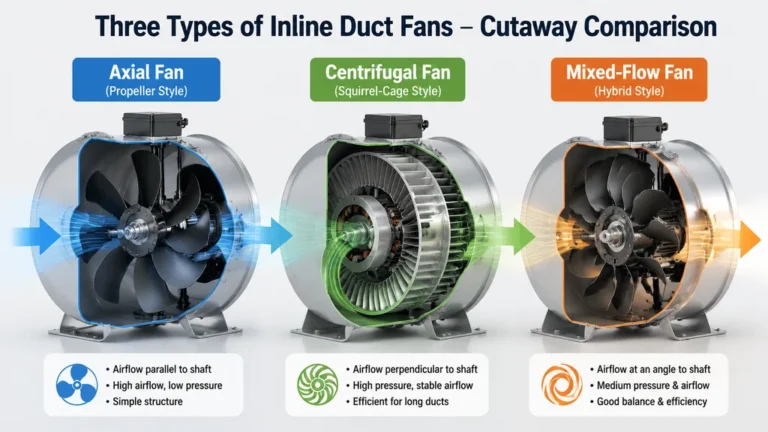
For applications related to inline duct fan and exhaust fan systems, many ventilation OEMs source DC axial fans from manufacturers with EC motor integration capabilities, combining axial fan airflow with brushless DC motor efficiency.
Building a Long-Term Manufacturer Relationship
The best DC axial fan manufacturer relationships go beyond transactional purchasing. Here is how to build a partnership that improves over time:
Start with a Pilot Program
Before committing to a multi-year supply agreement, run a 3-6 month pilot:
Order 500-1,000 production units and deploy them in the field
Track failure rates, noise complaints, and performance drift monthly
Conduct teardown analysis on 5-10 units after 2,000 hours of operation to inspect bearing wear, winding condition, and blade balance retention
Establish a Quality Agreement
A formal quality agreement with your DC axial fan manufacturer should specify:
AQL (Acceptable Quality Level) sampling plan per ISO 2859
Permissible failure rate and consequences (chargebacks, line-down penalties)
Process change notification requirements (any change to bearing supplier, motor winding process, or blade material requires 90-day advance notice and re-qualification samples)
Annual audit rights—both paper (documentation review) and on-site (production line observation)
Plan for Continuous Improvement
Schedule quarterly business reviews covering:
Field failure data and root cause analysis on any failures
Lead time performance and on-time delivery metrics
New technology roadmap (EC motor integration, IoT-enabled smart fans, higher-efficiency blade designs)
The best DC axial fan manufacturer relationships evolve from supplier to partner—where the manufacturer proactively suggests design improvements and the OEM shares long-term product roadmap visibility.
Total Cost of Ownership
Price per unit tells only part of the story. A full TCO analysis reveals the true cost:
Cost Factor
Low-Cost Manufacturer
Quality Manufacturer
Unit price (10K qty)
$3.50
$8.00
Failure rate (3 years)
5–8%
<1%
Warranty claims cost/yr
$12,000
$2,000
Field service calls/yr
15–25
2–5
Brand reputation risk
High
Low
Engineering support
Minimal
Dedicated FAE
3-year TCO (10K units)
$72,000+
$85,000
The quality DC axial fan manufacturer costs $13,000 more over three years but eliminates warranty claims, service calls, and reputation damage. For mission-critical applications, the quality premium pays for itself many times over.
Conclusion
Selecting the right DC axial fan manufacturer involves far more than comparing CFM ratings and unit prices. It requires evaluating bearing technology for your operating temperature, verifying IP ratings for your environment, confirming certifications for your target markets, and assessing the manufacturer’s quality control, customization, and engineering support capabilities.
For OEM engineers, the decision framework is clear: prioritize manufacturers with proven bearing quality (dual ball bearings from NMB/NSK for industrial, hydraulic for quieter commercial applications), verified compliance documentation (CE, UL, RoHS with test reports), and demonstrated quality control (100% functional testing, ALT data). The per-unit price difference between a quality and commodity DC axial fan manufacturer is small compared to the cost of field failures, warranty claims, and lost customer trust.
*Last updated: June 2026. Manufacturer listings reflect publicly available information as of publication date. Performance specifications should be verified with current manufacturer datasheets.*