Nous utilisons des cookies pour nous assurer que nous vous offrons la meilleure expérience possible sur notre site.
Restez informé avec KCVENTS Solutions de ventilation et CVC
Abonnez-vous à notre newsletter pour recevoir les dernières analyses en ingénierie aéraulique, les mises à jour sur les systèmes ERV/HRV écoénergétiques et les solutions CVC écologiques.
Soyez les premiers à recevoir des guides techniques exclusifs, à découvrir nos capacités OEM/ODM sur mesure et les actualités des salons mondiaux directement de KCVENTS.
Commercial Energy Recovery Ventilator: Complete Guide [2026]
Commercial Energy Recovery Ventilator: Complete Guide [2026]
Modern commercial buildings face a fundamental tension: energy codes demand tighter envelopes and higher efficiency, while ventilation standards require more fresh outdoor air than ever before. A commercial energy recovery ventilator (ERV) resolves this conflict by capturing up to 85% of the energy from exhaust air and transferring it to incoming fresh air—slashing HVAC loads while maintaining code-compliant ventilation. This guide covers everything from core technologies and sizing methodology to ROI analysis and maintenance best practices for commercial ERV systems.
Whether you’re designing a new office tower, retrofitting a school, or specifying ventilation for a healthcare facility, understanding commercial energy recovery ventilator technology is essential to meeting ASHRAE 62.1 requirements without blowing your energy budget.
What Is a Commercial Energy Recovery Ventilator?
A commercial energy recovery ventilator is an air-to-air heat exchanger designed for larger buildings (typically 500–11,000+ CFM) that transfers both sensible heat (temperature) and latent energy (moisture) between exhaust and outdoor air streams. Unlike a heat recovery ventilator (HRV) which transfers only sensible heat, a commercial energy recovery ventilator conditions incoming air by pre-cooling and dehumidifying it in summer, and pre-heating and humidifying it in winter.
How It Works
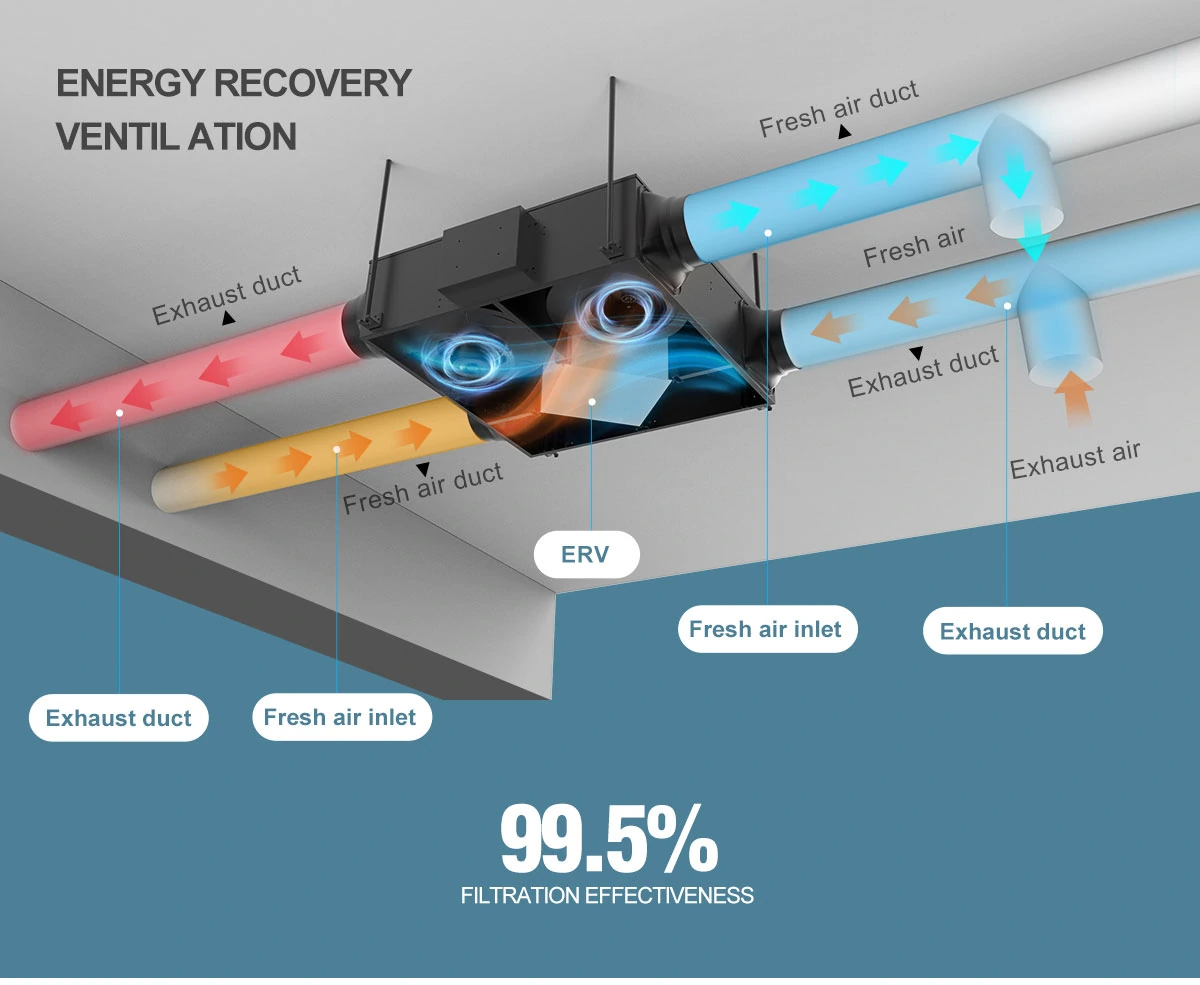
The commercial ERV sits at the intersection of exhaust and outdoor air ducts. As stale indoor air is expelled and fresh outdoor air is drawn in, the two streams pass through an energy exchange core without mixing. The core transfers temperature and moisture from the higher-energy stream to the lower-energy stream:
Summer operation: Hot, humid outdoor air (95°F, 60% RH) passes through the core while cool, dry exhaust air (75°F, 50% RH) flows the other way. The outdoor air is pre-cooled to approximately 79°F and partially dehumidified before reaching the cooling coil.
Winter operation: Cold, dry outdoor air (20°F, 30% RH) is pre-heated by warm exhaust air (72°F, 40% RH), recovering up to 80% of the heat that would otherwise be lost.
This pre-conditioning dramatically reduces the load on downstream heating and cooling equipment, allowing engineers to downsize chillers, boilers, and air handling units.
Types of Commercial Energy Recovery Ventilators
Commercial ERVs come in four primary configurations, each with distinct advantages depending on the application. Choosing the right commercial energy recovery ventilator type is often the most consequential specification decision.
1. Rotary Enthalpy Wheels
Rotary wheels are the most efficient commercial ERV technology, achieving 70–85% total effectiveness.
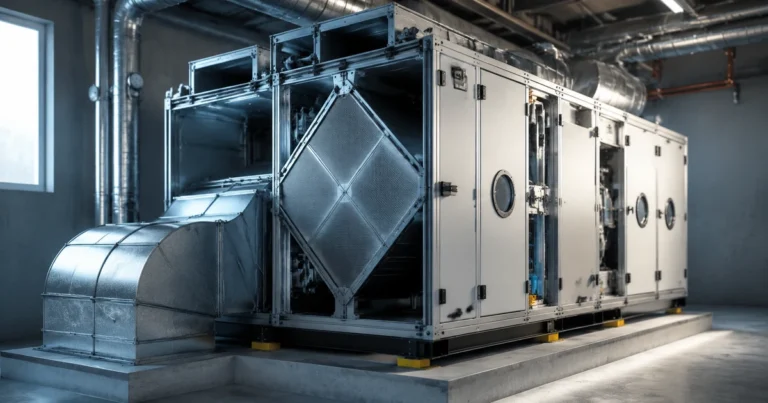
How they work: A rotating wheel coated with desiccant material (typically silica gel or molecular sieve) passes alternately through exhaust and outdoor air streams. The desiccant adsorbs moisture and heat from the higher-enthalpy stream and releases it into the lower-enthalpy stream.
Feature
Performance
Total effectiveness
70–85%
Pressure drop
0.4–0.9 in. w.g.
Cross-leakage
1–5% (with purge sector)
Frost resistance
Good (variable speed control)
Best for
High-volume, high-humidity applications
Avantages: Highest efficiency, compact, good latent transfer, frost-resistant with speed control
Inconvénients: Small amount of cross-contamination between air streams (purge sector reduces to <3%), moving parts require maintenance
2. Fixed-Plate Exchangers
Fixed-plate commercial ERVs use alternating layers of plates to separate air streams, with no moving parts in the core.
Feature
Performance
Total effectiveness
60–75%
Pressure drop
0.3–0.7 in. w.g.
Cross-leakage
<0.5%
Frost resistance
Moderate (may need defrost in cold climates)
Best for
Healthcare, labs, odor-sensitive applications
Avantages: Zero cross-contamination, no moving parts in core, low maintenance
Inconvénients: Lower efficiency than wheels, higher pressure drop at equal capacity, larger physical footprint
3. Heat Pipe Exchangers
Heat pipes use a sealed refrigerant circuit to transfer energy passively between air streams.
Feature
Performance
Sensible effectiveness
45–65%
Latent transfer
None (sensible only)
Pressure drop
Very low (<0.3 in. w.g.)
Cross-leakage
Zero
Best for
Retrofit applications, sensible-only needs
Avantages: Zero cross-contamination, no moving parts, extremely low maintenance, very low pressure drop
Inconvénients: Sensible-only (no humidity control), lower efficiency, larger size for given capacity
4. Run-Around Coil Systems
Run-around loops use separate coils in exhaust and supply air streams, connected by a pumped glycol/water circuit.
The commercial energy recovery ventilator (ERV) vs heat recovery ventilator (HRV) distinction has major implications for system design:
Aspect
ERV
HRV
Transfert thermique
Sensible + Latent
Sensible only
Avantage en été
Pre-cools + dehumidifies
Pre-cools only
Avantage en hiver
Pre-heats + recovers humidity
Pre-heats only
Climat idéal
Humid, mixed, hot
Froid, sec
Typical cost premium
15–25%
Référence de base
Payback period
2–5 years (humid climates)
3–7 years (cold climates)
In most U.S. commercial applications, a commercial energy recovery ventilator (ERV) is preferred over an HRV because humidity control is a major HVAC energy consumer. By recovering latent energy, an ERV reduces both cooling coil load and reheat requirements—a double savings HRVs cannot match. ASHRAE 90.1 energy standards increasingly favor total energy recovery in climate zones 1A through 6A.
Sizing and Selection
Proper sizing is critical—an oversized commercial energy recovery ventilator wastes capital and energy, while an undersized unit fails to meet ventilation requirements.
Step 1: Calculate Ventilation Airflow
Use ASHRAE 62.1 methodology to determine minimum outdoor air:
Adjust for zone air distribution effectiveness (Ez), diversity (D), and system population:
Vot = Vou / Ev
Where Vou = sum of zone outdoor airflows and Ev = system ventilation efficiency (typically 0.6–1.0).
Step 3: Select ERV Size
Size the commercial energy recovery ventilator for the design outdoor airflow, NOT total supply airflow:
Correct: ERV handles 2,200 CFM of dedicated outdoor air
Incorrect: ERV sized for 8,000 CFM total supply air (massively oversized)
Add 10–15% margin for future flexibility, but avoid excessive oversizing—ERV effectiveness degrades at part-load conditions below 40–50% of rated flow.
Step 4: Verify Static Pressure
Commercial ERVs add pressure drop (typically 0.4–1.0 in. w.g. across the core plus filters). Verify that supply and exhaust fans can overcome this additional resistance, or specify ERVs with integrated fans sized for your external static requirements.
Energy Efficiency and ROI Analysis
A properly specified commercial energy recovery ventilator typically delivers a simple payback of 2–5 years through HVAC equipment downsizing and ongoing energy savings.
Load Reduction
For a 10,000 CFM commercial ERV in a mixed-humid climate (Atlanta, GA):
Parameter
Without ERV
With ERV (75% effective)
Savings
Cooling coil load
42 tons
18 tons
57%
Heating coil load
850 MBH
290 MBH
66%
Annual cooling energy
156,000 kWh
67,000 kWh
89,000 kWh
Annual heating energy
8,400 therms
2,900 therms
5,500 therms
Annual energy cost (@$0.12/kWh, $1.20/therm)
$28,800
$11,520
$17,280
Equipment Downsizing
By reducing peak cooling and heating loads, the commercial ERV enables smaller primary equipment:
In this example, the commercial energy recovery ventilator pays for itself immediately through HVAC equipment downsizing—with ongoing annual savings of nearly $15,000. Even without equipment credits, the simple payback from energy savings alone is approximately 5 years.
Key Standards and Certifications
ASHRAE Standards
ASHRAE 62.1: Specifies minimum ventilation rates and requires energy recovery in many high-outdoor-air systems. Systems with ≥30% outdoor air and ≥5,000 CFM supply in certain climate zones must include energy recovery with ≥50% effectiveness.
ASHRAE 84: Standardized test method for air-to-air energy recovery equipment, defining sensible, latent, and total effectiveness measurement procedures.
ASHRAE 90.1: Sets minimum energy recovery effectiveness requirements (typically ≥50% total effectiveness) and mandates ERVs in many commercial applications.
AHRI Certification
La AHRI 1060 standard certifies commercial ERV performance ratings, ensuring that published effectiveness, pressure drop, and leakage data are independently verified. Always specify AHRI-certified equipment to guarantee rated performance.
Key AHRI 1060 ratings to check:
Sensible effectiveness at 100% and 75% airflow
Latent effectiveness (summer and winter conditions)
Static pressure drop at rated flow
Exhaust air transfer ratio (EATR)—measures cross-leakage
Other Standards
ENERGY STAR: Some commercial ERVs qualify for ENERGY STAR certification, meeting efficiency benchmarks above code minimums
UL 1995 / CSA C22.2: Electrical safety standards for heating and cooling equipment
HVI: Home Ventilating Institute (hvi.org) certifies residential and light commercial units
Installation and Integration Considerations
Installing a commercial energy recovery ventilator requires careful coordination between mechanical, electrical, and controls trades. The following considerations apply to most commercial installations.
Duct Configuration
A commercial energy recovery ventilator has four air connections that must be properly configured:
Outdoor Air (OA) intake: Position away from exhaust outlets, loading docks, and contamination sources. Minimum 10 ft separation from exhaust discharge.
Supply Air (SA): Delivers pre-conditioned outdoor air to the AHU intake or directly to zones
Return Air (RA): Draws air from occupied spaces, typically from ceiling plenum or dedicated return duct
Exhaust Air (EA): Discharges to outdoors, minimum 10 ft from OA intake
Integration with Building Automation
Modern commercial ERVs support BACnet, Modbus, or LonWorks integration with building automation systems (BAS). Key monitoring points:
Supply and exhaust airflow (CFM)
OA, SA, RA, EA temperatures
Filter pressure drop (dirty filter alarm)
Wheel/rotor speed (if variable)
Frost control status
Operating mode (normal, defrost, bypass)
Frost Control Strategies
In cold climates, exhaust moisture can freeze on the energy recovery core. Effective commercial ERV frost control strategies include:
Variable wheel speed: Reduce rotor RPM as OA temperature drops to control frost formation
Exhaust-only defrost: Temporarily reduce supply airflow while maintaining exhaust flow to melt frost
Pre-heat coil: Electric or hydronic coil pre-heats OA to above freezing before the ERV core
Bypass damper: Diverts a portion of cold OA around the core during extreme conditions
Bypass Economizer
Many commercial ERVs offer an integral bypass economizer option. When outdoor conditions are favorable (e.g., cool, dry night air), the economizer bypasses the energy recovery core entirely, providing free cooling without the pressure penalty of passing through the core. This can yield significant additional savings in shoulder seasons.
Electrical and Controls
Commercial energy recovery ventilator installations require:
Nom du produit: Typically 208-230V/1-phase for smaller units (up to 2,200 CFM), 208-230V or 460V/3-phase for larger units
Disconnect switch: Factory-mounted or field-installed within sight of the unit
Control wiring: Low-voltage (24VAC) for enable/disable, status feedback, and BAS integration
VFD integration: Many larger ERVs include factory-mounted VFDs for supply and exhaust fans, enabling airflow modulation based on demand-controlled ventilation signals
Demand-Controlled Ventilation (DCV)
Pairing a commercial energy recovery ventilator with demand-controlled ventilation maximizes energy savings. CO2 sensors in occupied zones signal the ERV to reduce outdoor airflow during periods of low occupancy while maintaining minimum ventilation per ASHRAE 62.1. This strategy is particularly effective in:
Office buildings with variable occupancy
Schools and universities with intermittent classroom use
Conference centers and event spaces
Retail spaces with seasonal occupancy patterns
DCV can reduce annual ERV energy consumption by an additional 20-40% beyond baseline energy recovery savings.
Maintenance Best Practices
Regular maintenance is essential for commercial energy recovery ventilator performance and longevity:
Entretien trimestriel
Inspect and replace filters (MERV 8 minimum, MERV 13 recommended per ASHRAE)
Check drive belt tension and condition on belt-driven units
Verify drain pan and condensate lines are clear
Inspect energy recovery core for fouling or damage
Clean exterior of unit and verify all access panels are sealed
Semi-Annual Maintenance
Clean energy recovery core per manufacturer instructions (low-pressure compressed air or water wash)
Lubricate fan and motor bearings
Check and calibrate sensors (temperature, pressure, humidity)
Verify frost control operation (pre-heat or bypass dampers)
Test economizer operation if equipped
Entretien annuel
Comprehensive core inspection for plate delamination, wheel seal wear, or desiccant degradation
Fan wheel inspection and dynamic balancing if needed
Motor amp draw verification against nameplate
Control system functional test
Duct leakage test per SMACNA standards
Filter Management
Filter management is the single most impactful maintenance activity. A clogged filter can increase pressure drop by 0.5-1.0 in. w.g., reducing ERV airflow and efficiency. Install differential pressure sensors with BAS alarms to trigger filter replacement before performance degrades.
Filter replacement schedule guidelines:
MERV 8 pre-filters: Every 2-3 months in typical commercial environments
MERV 13 final filters: Every 4-6 months
High-traffic or construction-adjacent locations: Monthly inspection, replace as needed
Core Cleaning and Longevity
The energy recovery core is the heart of any commercial energy recovery ventilator. Proper care extends core life to 15-20 years:
Rotary wheels: Annual inspection of drive belt, bearing, and seals. Clean media with low-pressure compressed air or warm water wash (no solvents). Replace desiccant segments if degraded.
Fixed plates: Semi-annual wash with mild detergent solution. Avoid high-pressure spray that can delaminate plate bonding.
Heat pipes: Minimal maintenance—inspect fin surfaces annually for fouling and clean with fin comb and compressed air.
Troubleshooting Common Issues
Symptôme
Cause probable
Action corrective
Low supply airflow
Clogged filters, belt slip, damper closed
Check filter pressure drop, belt tension, damper actuators
Climate Zone Economics: When an ERV Pays Back Fastest
Not all climates deliver the same commercial energy recovery ventilator payback. The savings potential varies dramatically based on the enthalpy difference between indoor and outdoor air:
Climate Zone
Summer Savings
Winter Savings
Simple Payback
Recommendation
Hot-Humid (1A, 2A)
Very high
Minimal
1-3 years
ERV strongly recommended
Mixed-Humid (3A, 4A)
High
High
2-4 years
ERV recommended
Hot-Dry (2B, 3B)
High (sensible)
Moderate
3-5 years
ERV or HRV acceptable
Cold (5, 6)
Low
Very high
3-5 years
HRV may be sufficient
Very Cold (7, 8)
None
Very high (frost risk)
4-7 years
HRV + frost control essential
Marine (3C, 4C)
Moderate
Moderate
4-6 years
Case-by-case analysis
Key insight: The strongest financial case for a commercial energy recovery ventilator exists in hot-humid climates (Miami, Houston, Atlanta) where air conditioning dominates and latent load recovery provides year-round benefit. In these zones, ERVs often deliver net-negative first costs through HVAC equipment downsizing.
Real-World Specification Example
Consider a 75,000 sq ft office building in Atlanta, GA (Climate Zone 3A):
ASHRAE 62.1 outdoor air requirement: 5,500 CFM
Summer design: 94F DB / 76F WB
Winter design: 23F DB
Selected ERV: Rotary enthalpy wheel, 5,500 CFM, 75% total effectiveness
Pre-conditions outdoor air from 94F to 79F (summer), saving 33 tons of cooling
Recovers 480,000 BTU/hr in winter
Chiller downsizing: 28 tons x ,500/ton = 2,000 saved
ERV equipment cost: 8,000 installed
Net first cost impact: ,000 (pays back in under 5 months from energy savings)
Top Considerations When Specifying a Commercial ERV
Start with ASHRAE 62.1 outdoor air calculation—never size an ERV from total supply CFM
Choose technology by application: Rotary wheels for maximum efficiency, fixed-plate for zero cross-contamination, heat pipes for retrofit simplicity
Verify AHRI 1060 certified ratings—independently tested performance data is non-negotiable
Account for climate: ERV (total energy) in humid and mixed climates, HRV acceptable in cold/dry
Include pressure drop in fan sizing—an unaccounted 0.6 in. w.g. core ΔP will starve the system
Plan for frost control: Pre-heat coils or variable-speed wheels in Climate Zones 5+
Include economizer bypass for free cooling in shoulder seasons
Specify MERV 13 filters per ASHRAE recommendations for commercial buildings
Integrate with BAS for monitoring, fault detection, and energy tracking
Consider maintenance access—ensure 36″ minimum clearance on all service sides
Commercial ERV Product Ranges: What’s Available
Manufacturer
Series
CFM Range
Core Type
Notable Features
RenewAire
HE Series
120–8,800
Static plate
EC motors, MERV 13 option, bypass economizer
Greenheck
ERV
500–12,000+
Wheel
Double-wall construction, multiple configurations
Fantech
SER
240–4,000+
Plate/enthalpic
EC motors, light commercial through advanced commercial
Aldes
Commercial
500–11,000
Plate, wheel, membrane
Multiple core options, custom configurations
Soler & Palau
EnerVent
500–6,000
Wheel/plate
BACnet, multiple configurations
For ventilation system integration, commercial ERVs can be configured as stand-alone dedicated outdoor air systems (DOAS) or integrated into packaged air handling units. DOAS configurations are increasingly popular for decoupling ventilation from space conditioning, allowing each system to be optimized independently.
DOAS vs Integrated Configuration
Dedicated Outdoor Air System (DOAS):
Separate ERV handles 100% of ventilation air
Primary HVAC equipment handles only space loads (sensible cooling/heating)
Simplifies controls and commissioning
Higher first cost but superior humidity control
Preferred for schools, healthcare, labs
Integrated (within AHU):
ERV core integrated into a packaged air handling unit
Lower first cost, single equipment footprint
More complex controls sequence
Suitable for smaller commercial projects where equipment count matters
Common in office buildings and retail
For either configuration, the commercial energy recovery ventilator must be selected for dedicated outdoor air duty—never for total supply air including recirculated flow. This is the most common specification error and leads to oversized, inefficient ERVs that fail to deliver promised savings.
Common Applications by Building Type
Office Buildings
Commercial office buildings are among the most common applications for commercial energy recovery ventilators. ASHRAE 62.1 requires approximately 15-20 CFM per person of outdoor air, and for a typical 100,000 sq ft office with 500 occupants, that translates to 7,500-10,000 CFM of continuous outdoor air. A commercial ERV recovering 75% of the energy from this air stream reduces cooling tonnage by 30-40% and heating capacity by 50-60%.
Office applications benefit particularly from demand-controlled ventilation integration, as occupancy varies significantly between core hours and evenings/weekends.
Établissements de santé
Hospitals and clinics require 100% outdoor air in many critical spaces (operating rooms, isolation rooms) with no recirculation permitted. This makes commercial energy recovery ventilators economically essential—without energy recovery, conditioning this air would dominate the facility’s energy budget. Fixed-plate ERVs are preferred in healthcare for their zero cross-contamination characteristics.
Schools and Universities
K-12 schools and university buildings combine high occupant density with intermittent schedules—classrooms may be fully occupied for 45 minutes, then empty. A commercial energy recovery ventilator with DCV modulates outdoor air based on real-time CO2 readings, reducing ventilation energy by 30-50% compared to constant-volume systems while maintaining IAQ during occupied periods. ASHRAE’s Advanced Energy Design Guides specifically recommend ERVs for school applications.
Retail and Hospitality
Hotels, restaurants, and retail spaces have high ventilation requirements combined with significant internal latent loads (kitchens, laundry, pools, high occupant density). A commercial energy recovery ventilator is particularly valuable here because it simultaneously controls humidity—reducing the risk of mold, condensation on windows, and musty odors that can damage brand reputation.
Industrial and Laboratory
Laboratories and clean manufacturing facilities often exhaust large volumes of conditioned air through fume hoods and process exhaust. Commercial energy recovery ventilators with run-around coil or heat pipe configurations are ideal here because they maintain complete separation between potentially contaminated exhaust and incoming fresh ventilation system air.
Conclusion
A commercial energy recovery ventilator transforms ventilation from an energy liability into an efficiency asset. By recovering 60–85% of the energy in exhaust air, commercial ERVs reduce HVAC equipment capacity requirements, slash annual energy costs by 40–60%, and help buildings meet increasingly stringent energy codes and sustainability goals.
The technology choice—rotary wheel, fixed plate, heat pipe, or run-around coil—depends on your specific requirements for efficiency, cross-contamination tolerance, climate, and maintenance capability. But regardless of technology, proper sizing from ASHRAE 62.1 ventilation calculations, AHRI-certified performance, and regular maintenance are the keys to realizing the full energy savings potential.
For building owners and engineers, the financial case for commercial energy recovery ventilators is increasingly compelling: immediate equipment downsizing savings often exceed the ERV’s installed cost, while annual energy savings provide a continuous return on investment. In an era of rising energy costs and tightening building performance standards, the commercial ERV is no longer optional—it’s essential.
*Last updated: June 2026. Performance data based on AHRI 1060 certified ratings and ASHRAE engineering references. Energy savings estimates use DOE Commercial Reference Building energy models for mixed-humid climate zone.*