Nous utilisons des cookies pour nous assurer que nous vous offrons la meilleure expérience possible sur notre site.
Restez informé avec KCVENTS Solutions de ventilation et CVC
Abonnez-vous à notre newsletter pour recevoir les dernières analyses en ingénierie aéraulique, les mises à jour sur les systèmes ERV/HRV écoénergétiques et les solutions CVC écologiques.
Soyez les premiers à recevoir des guides techniques exclusifs, à découvrir nos capacités OEM/ODM sur mesure et les actualités des salons mondiaux directement de KCVENTS.
Activated Carbon Filters for Ventilation: How They Work, When to Use Them, and Maintenance
How activated carbon filters work, where to use them in ventilation, how to size and replace them, and where their limits are — including the difference between carbon and HEPA filtration.
Activated carbon filters remove gases and odors from air by adsorption: odorous molecules stick to the enormous internal surface of the activated carbon instead of passing through. They do not trap particles the way a HEPA filter does, they cannot completely eliminate every odor or VOC, and they must be matched to your airflow and replaced on a schedule. This guide explains how carbon filtration works, where it fits in a ventilation system, how to size and maintain a carbon filter, and where its limits are.
Why Use an Activated Carbon Filter in Ventilation
The main job of an activated carbon filter in a ventilation system is odor and gas control. It is used wherever you need to treat air before it is exhausted or recirculated: grow rooms and greenhouses, kitchens, laboratories, bathrooms, pet areas, and commercial spaces with solvent or chemical odors.
According to the U.S. EPA, people spend about 90% of their time indoors, and concentrations of some indoor pollutants can be two to five times higher than outdoor levels. Source: U.S. EPA, The Inside Story: A Guide to Indoor Air Quality. When a space produces odors or gases that you do not want to release into the neighborhood or recirculate inside, an activated carbon filter is one of the standard engineering options.
“Ventilation removes indoor air that may be concentrated with airborne viruses and replaces it with fresh outdoor air.” — U.S. EPA, Ventilation and Respiratory Viruses
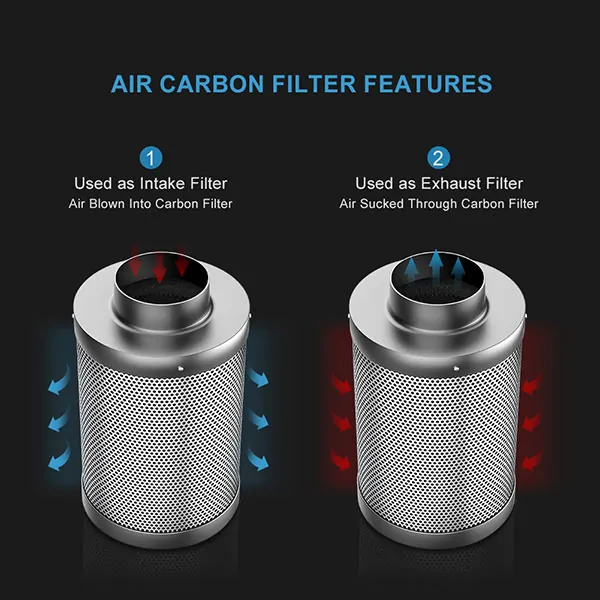
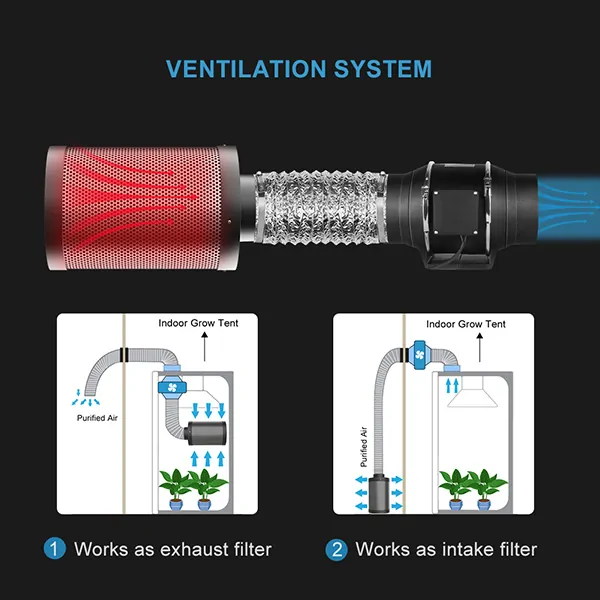
A carbon filter is almost always combined with mechanical ventilation — an inline duct fan or an exhaust fan pulls air through the carbon bed. This is why carbon filters are frequently sold and installed together with inline duct fans and filter boxes.
How Activated Carbon Filters Work
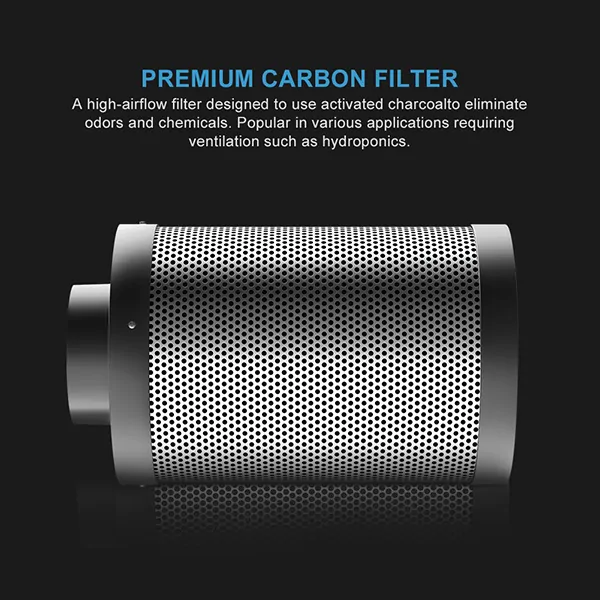
Activated carbon (also called activated charcoal) is a porous form of carbon with a very large surface area. During activation, the carbon is treated to create hundreds of pores per granule. Odor-carrying molecules that pass through the filter collide with this surface and are held there by a physical process called adsorption.
Adsorption, not absorption. The odor molecules stick to the surface of the carbon pores; they are not soaked up like a sponge. This is a reversible physical process — which is why saturated carbon cannot be “cleaned” back to full performance.
What it removes. Many volatile organic compounds (VOCs), cooking and plant odors, smoke components, and general smells. Performance depends on the molecule, the airflow, and the carbon bed.
What it does not remove. Particulate matter (dust, pollen, PM2.5), carbon monoxide, and many gases. For particles you need a mechanical filter such as HEPA; for ventilation you still need outdoor air exchange.
Activated carbon vs HEPA — not the same job
Fonctionnalité
Activated carbon filter
Filtre HEPA
Removes particles (dust, pollen, PM2.5)
No
Yes
Élimine les gaz et odeurs
Oui (de nombreux COV et odeurs)
No
Mécanisme
Adsorption sur la surface du charbon
Interception mécanique
Airflow resistance
Moderate, rises as carbon saturates
High, rises as filter loads
Typical partner
Inline duct fan + filter box
Fresh-air unit, air purifier
Because the two jobs are different, many ventilation systems use both in series: a pre-filter for particles and an activated carbon stage for gases and odors.
When to Use a Carbon Filter: Grow Rooms, Kitchens, and More
Carbon filters are common in controlled horticulture and indoor growing. The old KCVENTS article “Carbon Filters: Should I Use One in My Grow Room?” described exactly this use case: strong plant aromas, humidity-driven smells, and the need to keep the space discreet. That use case remains valid — the filter treats the air, it does not change the growing conditions.
Other places a carbon filter fits:
Kitchens and food preparation — cooking odors and grease-related smells.
Bathrooms and pet areas — persistent odors.
Greenhouses and grow rooms — plant and fertilizer odors, controlled environment agriculture (CEA) spaces.
Laboratories, print shops, and small workshops — solvent and chemical vapors.
Filter boxes in HVAC — as a gas-phase stage before or after particulate filtration.
The important boundary: a carbon filter controls odors in the air you are exhausting or treating. It is not a substitute for source control, and it does not remove particles, so it should be combined with particulate filtration and ventilation rather than used alone.
How to Size an Activated Carbon Filter
Sizing a carbon filter is about matching airflow and resistance, not just buying the biggest filter.
Know your airflow. Measure or calculate the airflow of the fan that will pull through the filter (typically in m³/h or cfm). A filter rated for a lower airflow than your fan will add excessive resistance.
Check pressure drop. Every filter adds static pressure to the system. If the pressure drop is too high, the fan delivers less airflow than its nominal rating. Use the filter’s pressure-drop data at your operating flow.
Match the duct size. The filter opening should match the duct and fan diameter (for example, 100 mm, 125 mm, 150 mm, 200 mm) so the connection is sealed.
Account for carbon quantity. A larger carbon bed (more activated carbon) adsorbs more odor before saturation, but also adds weight, size, and cost. Choose for your expected odor load and replacement interval.
Fan airflow
Suggested filter range
Notes
Up to 200 m³/h
Compact carbon filter, 100–125 mm
Single-room applications
200–400 m³/h
125–150 mm filter
Bedroom, kitchen, small grow tent
400–800 m³/h
150–200 mm filter
Larger rooms, greenhouses
800+ m³/h
Industrial filter or multiple units
Commercial/CEA, check pressure drop
A practical rule from the KCVENTS product experience: the carbon filter is used together with a duct fan — the fan provides the airflow, the filter cleans the air, and both must be matched to the duct size.
When to Replace an Activated Carbon Filter
Activated carbon saturates over time. There is no universal lifespan — it depends on odor load, airflow, humidity, and the type of contaminants. The practical signals are:
Smell breakthrough. Odors begin to pass through the filter. This is the most reliable sign that the carbon is saturated.
Reduced airflow. A clogged or saturated filter raises resistance; if the fan sounds strained or airflow drops, check the filter.
Visible dust buildup on the pre-filter or the carbon surface.
A fixed schedule. Many operators replace carbon filters every 6–12 months as a precaution, but the right interval for your environment may be shorter or longer. Follow the manufacturer’s instructions and your own odor checks.
What not to do: do not assume a saturated carbon filter can be reactivated at home. Adsorbed molecules are only released under high-temperature regeneration in controlled conditions; household washing or vacuuming does not restore adsorption capacity.
Activated Carbon Filter Maintenance Checklist
A simple maintenance routine keeps a carbon filter effective for its rated life:
[ ] Inspect the filter and pre-filter monthly for dust and debris.
[ ] Replace or clean the pre-filter (particle stage) according to its type — do not let it clog the carbon.
[ ] Check the duct connections for air leaks; a leak bypasses the filter.
[ ] Monitor airflow and fan noise — changes may indicate filter loading.
[ ] Track replacement dates in a service log so you can spot the pattern for your environment.
[ ] Follow the manufacturer’s replacement interval and verify by smell and airflow, not by calendar alone.
Carbon Filter Limitations — Read Before Buying
No complete removal guarantee. Adsorption is not 100% for all compounds, and high airflow reduces contact time. No responsible manufacturer promises that a carbon filter eliminates every odor or VOC.
Particles need a separate filter. If you need particulate removal (dust, pollen, PM2.5), combine carbon with a HEPA or other mechanical filter.
It is not a ventilation substitute. A filter cleans the air that passes through it; it does not bring in fresh outdoor air. You still need supply air and exhaust air.
Humidity matters. Very humid air can reduce adsorption performance; keep the filter in the designed airflow path and follow the datasheet.
Frequently Asked Questions
Q: Does an activated carbon filter remove HEPA-level particles? A: No. Carbon adsorbs gases and odors; particles require a mechanical filter such as HEPA. Many systems use both in series.
Q: How long does an activated carbon filter last? A: It depends on odor load, airflow, and environment — commonly 6 to 12 months, but you should confirm by smell breakthrough, airflow, and the manufacturer’s instructions.
Q: Can I wash and reuse a carbon filter? A: No. Washing does not restore adsorption capacity, and the carbon bed cannot be reactivated at home.
Q: Should I use a carbon filter in my grow room? A: If your goal is to control plant and fertilizer odors in the exhausted air, a properly sized carbon filter combined with an inline duct fan is the standard approach. It does not change growing conditions and must be replaced when saturated.
Q: Does a carbon filter bring in fresh air? A: No. It treats air that passes through it. Fresh-air supply is the job of a ventilation unit such as an HRV/ERV or fresh-air blower.
Related KCvents Products and Guides
Filter Box — a filter box for HVAC air filtration, applications, selection, and maintenance
Need help choosing a carbon filter or filter box for your project? KCvents manufactures duct fans, filter boxes, and ventilation systems for wholesale, OEM, and private-label buyers. Request a quote with your airflow, duct size, and application.
Mises à jour de la newsletter
Saisissez votre adresse e-mail ci-dessous et abonnez-vous à notre newsletter