Nous utilisons des cookies pour nous assurer que nous vous offrons la meilleure expérience possible sur notre site.
Restez informé avec KCVENTS Solutions de ventilation et CVC
Abonnez-vous à notre newsletter pour recevoir les dernières analyses en ingénierie aéraulique, les mises à jour sur les systèmes ERV/HRV écoénergétiques et les solutions CVC écologiques.
Soyez les premiers à recevoir des guides techniques exclusifs, à découvrir nos capacités OEM/ODM sur mesure et les actualités des salons mondiaux directement de KCVENTS.
Le guide de la ventilation commerciale : HRV, ERV et extraction — Que choisir et pourquoi ?
Un cadre décisionnel pour les espaces du petit tertiaire — cafés, cliniques, bureaux et salles de classe. Couvre le choix entre HRV et ERV, les zones climatiques, les calculs de dimensionnement et la sélection de produits KCvents.
Il y a trente ans, la ventilation d'un bâtiment commercial n'était pas une préoccupation majeure. Les bâtiments manquaient d'étanchéité. L'air circulait à travers les châssis de fenêtres, les interstices de portes et les percements non scellés à un débit qui horrifierait un auditeur énergétique moderne — mais il circulait. L'air neuf entrait. L'air vicié sortait. Le rôle du système CVC se limitait au contrôle de la température, non au renouvellement d'air.
Cela a changé lorsque les réglementations énergétiques sont devenues strictes. Les bâtiments sont devenus plus étanches — dès la conception. Les barrières d'étanchéité à l'air continues, les vitrages à haute performance et les enveloppes étanches sont devenus obligatoires dans la plupart des juridictions. Un bâtiment tertiaire moderne peut être 10 à 20 fois plus étanche que son équivalent des années 1980. L'avantage : des charges de chauffage et de refroidissement considérablement réduites. L'inconvénient : sans ventilation mécanique maîtrisée, la qualité de l'air intérieur s'effondre en quelques heures d'occupation.
principe fondamental: Un bâtiment étanche dépourvu de ventilation mécanique n'est pas écoénergétique — c'est un risque pour la santé. Les deux doivent être conçus conjointement.
La physique est simple. Une douzaine de personnes dans une salle de réunion expirent environ 5 litres de CO₂ par minute. Les composés organiques volatils s'évaporent des moquettes, du mobilier et des produits d'entretien. Les équipements de bureau génèrent de l'ozone. La cuisson dans un café produit des particules fines et de l'humidité. Sans renouvellement d'air contrôlé, ces polluants s'accumulent. Il en résulte ce que les chercheurs des années 1980 ont qualifié de “ syndrome du bâtiment malsain ” — maux de tête, fatigue, irritations respiratoires et dégradation mesurable des performances cognitives. Une étude de Harvard menée en 2015 a révélé que les occupants d'espaces bien ventilés obtenaient des résultats 61% supérieurs aux tests de fonctions cognitives par rapport à ceux situés dans des bâtiments conventionnels.
C'est là qu'interviennent la ventilation à récupération de chaleur (HRV) et la ventilation à récupération d'énergie (ERV). Ces systèmes résolvent le conflit fondamental au cœur de la conception des bâtiments modernes : vous devez introduire de l'air extérieur en permanence, mais vous ne pouvez pas vous permettre de gaspiller l'énergie dépensée pour traiter l'air intérieur. An HRV récupère 70–90% de la chaleur de l'air vicié extrait et la transfère à l'air neuf entrant. Un ERV fait de même pour la chaleur et l'humidité. La pénalité énergétique de la ventilation passe alors de “ prohibitive ” à “ négligeable ”.”
Des bâtiments perméables aux bâtiments étanches : une chronologie de l'évolution de la ventilation
1980s: Leaky Buildings
2000s: The Seal-Up
Today: Recovery Era
Les infiltrations naturelles assuraient le renouvellement d'air. Les réglementations énergétiques étaient minimes. Aucune ventilation dédiée en dehors des cuisines et des salles de bains.
Les réglementations énergétiques se sont durcies. Les bâtiments sont devenus 10–20× plus étanches. Des problèmes de qualité de l'air intérieur ont fait surface. Le syndrome des bâtiments malsains est entré dans le vocabulaire.
HRV/ERV obligatoire dans la plupart des codes pour le tertiaire. Ventilation continue avec 70–90% de récupération de chaleur. QAI et efficacité énergétique ne sont plus des compromis.
Pour les espaces commerciaux et tertiaires, les enjeux sont bien plus élevés que dans le résidentiel. La densité d'occupants est plus importante. Les plages de fonctionnement sont plus longues. La conformité réglementaire est obligatoire et non facultative — l'ASHRAE 62.1 spécifie les débits de ventilation minimaux par personne et par pied carré pour chaque catégorie d'usage commercial, des salles de classe aux cliniques en passant par les cafés. De plus, le calcul financier est différent : un bureau bien ventilé enregistre nettement moins de journées de maladie, une productivité accrue et une rotation plus faible des locataires. Un restaurant mal ventilé perd des clients qui, sans percevoir consciemment le confinement de l'air, ne reviennent pas pour autant.
La question n'est plus whether de ventiler. Il s'agit de quel système, quel débit, et comment adapter l'équipement à l'espace. Les sections suivantes établissent le cadre pour répondre à ces trois questions.
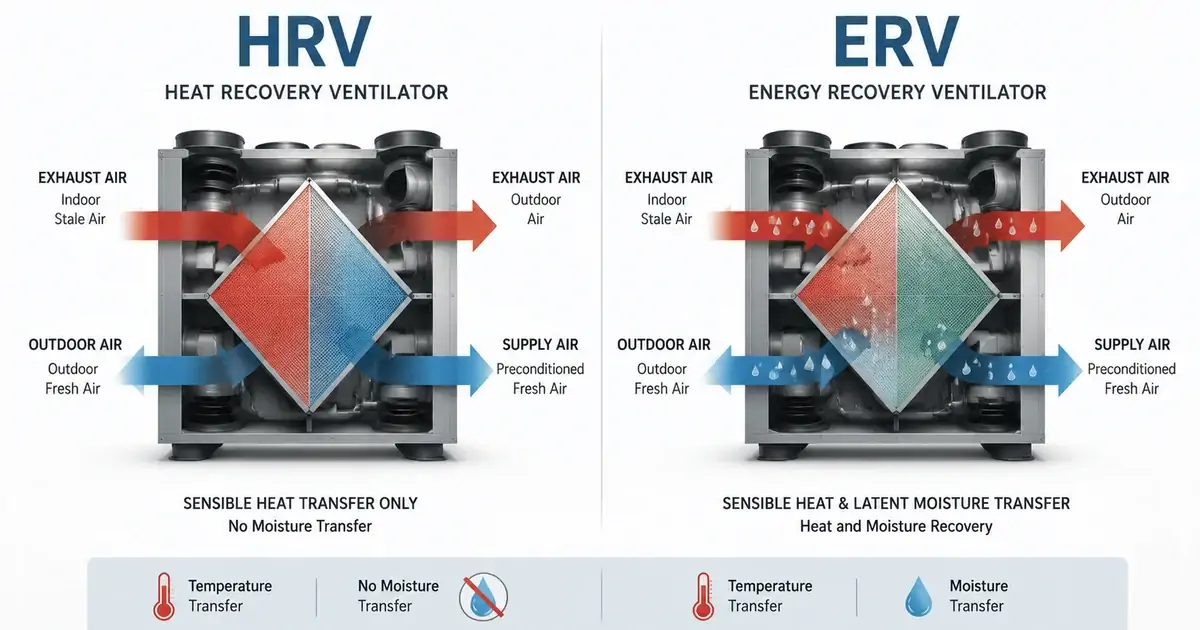
Un HRV transfère uniquement la chaleur ; un ERV transfère la chaleur et l'humidité. Le bon choix dépend principalement de l'humidité du climat.
HRV vs ERV : la véritable différence
À première vue, les HRV et les ERV semblent identiques — deux ventilateurs, un bloc échangeur de chaleur et un caisson. Mais la différence au niveau de cet échangeur détermine quel système convient à quel bâtiment.
How an HRV Works
Un ventilateur-récupérateur de chaleur (HRV) transfère heat only entre les flux d'air extrait et d'air neuf. Deux flux d'air distincts traversent un échangeur — généralement composé de plaques en aluminium ou en plastique — et l'énergie thermique traverse le matériau de l'échangeur. Les flux d'air ne se mélangent jamais.
En pratique : lors d'une journée d'hiver où l'air extérieur est à 0°C et l'air intérieur à 20°C, un HRV avec 85% d'efficacité préchauffe l'air entrant à environ 17°C en utilisant uniquement la chaleur récupérée de l'air extrait. Votre système de chauffage n'a plus qu'à élever la température de 3 degrés de plus.
How an ERV Works
Un ventilateur-récupérateur d'énergie (ERV) transfère both heat and moisture. L'échangeur permet à la vapeur d'eau de diffuser à travers une membrane. En hiver, il retient l'humidité intérieure — évitant l'air excessivement sec que les HRV peuvent créer. En été, il rejette l'humidité extérieure — empêchant l'air lourd d'être insufflé dans les espaces climatisés.
La règle de décision :
HRV — Idéal pour les climats froids et secs où l'humidité n'est pas un problème (Canada, nord des États-Unis, régions de haute altitude)
ERV — Idéal pour les climats humides ou mixtes où la gestion de l'humidité est primordiale (sud des États-Unis, régions côtières, étés du Midwest)
Either works — Climats tempérés comme le nord-ouest du Pacifique. L'ERV offre une plus grande flexibilité tout au long de l'année.
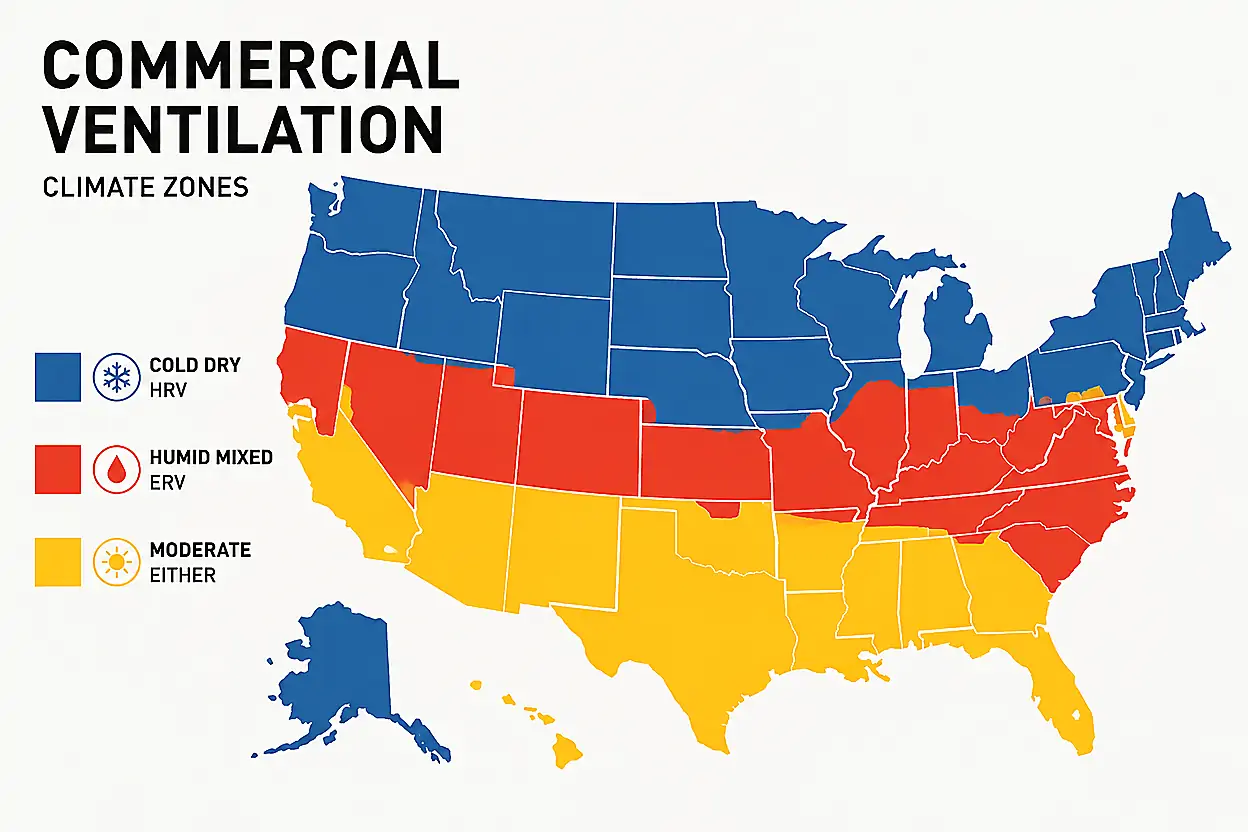
Le climat est le premier filtre de décision : les régions froides et sèches privilégient généralement le HRV ; les climats humides et mixtes privilégient généralement l'ERV.
L'importance du climat : température, humidité et choix du système
Le climat est le facteur le plus déterminant dans le choix entre HRV et ERV. Un HRV à Miami introduirait un air hivernal extrêmement sec (ce qui semble convenable), mais aussi un air estival humide (que la climatisation doit ensuite déshumidifier — un double traitement coûteux de l'humidité). Un ERV à Winnipeg transférerait l'humidité intérieure vers l'air extrait en hiver, risquant ainsi de provoquer l'accumulation de givre dans l'échangeur lors d'épisodes de froid extrême.
Climate Zone
Recommended System
Why
Froid & sec (Zones 5–7)
HRV
La récupération d'humidité présente peu d'intérêt. Les échangeurs HRV résistants au gel supportent mieux le froid extrême.
Mixed-Humid (Zones 3–4)
ERV
Le rejet de l'humidité en été réduit la charge de climatisation. La rétention d'humidité en hiver préserve le confort.
Hot-Humid (Zones 1–2)
ERV
Essentiel pour la déshumidification estivale. Sans ERV, l'air extérieur devient une charge thermique critique pour la climatisation.
Hot-Dry (Zone 2B–3B)
HRV
Aucune humidité à gérer. Maintenance simplifiée en environnement poussiéreux.
Marine (Zone 4C)
Either (ERV preferred)
Climat doux toute l'année mais humidité côtière. ERV pour la flexibilité.
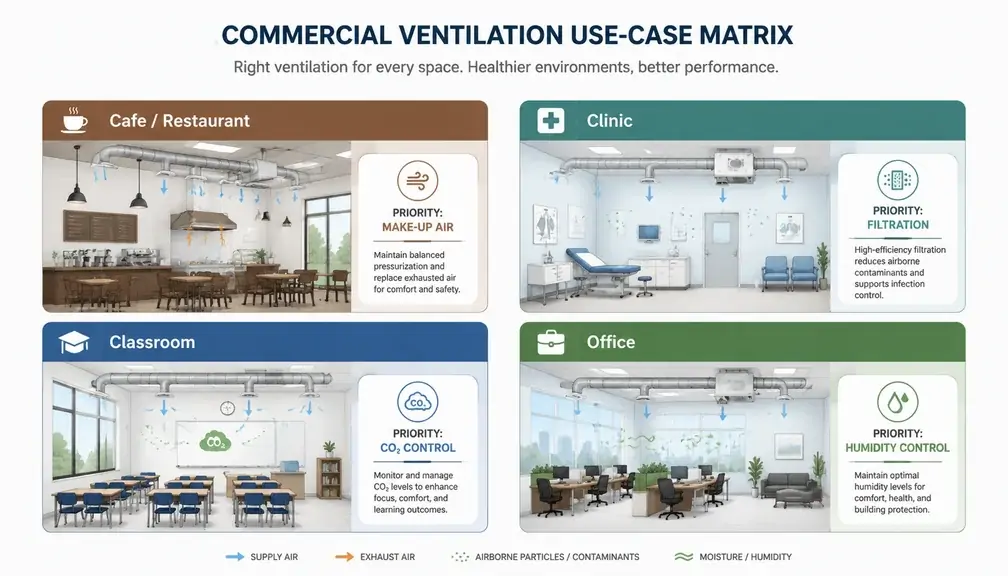
Différents espaces tertiaires génèrent des charges de ventilation variables : humidité de cuisson, filtration médicale, occupation des salles de classe et pics de CO₂ dans les bureaux.
Cas d'usage dans le tertiaire : ce dont votre espace a réellement besoin
Cafés & Restaurants
Les hottes d'extraction de cuisine évacuent d'importants volumes d'air hors du bâtiment. Sans air de compensation, le bâtiment se retrouve en dépression — refoulant les appareils à combustion et aspirant de l'air non filtré par chaque fissure. Un HRV ou ERV équilibré apporte de l'air neuf préconditionné pour remplacer ce que les hottes extraient. Besoins spécifiques : récupération de chaleur sur l'air extrait de la cuisine en hiver (avantage HRV), gestion de l'humidité en été (avantage ERV). Filtration au charbon actif recommandée pour les salles de restauration.
Clinics & Healthcare
La qualité de l'air intérieur est non négociable. Les salles d'attente ont une occupation élevée et variable. Les salles de soins nécessitent un renouvellement d'air constant. Un ERV est généralement privilégié : la régulation de l'humidité empêche la formation de moisissures et préserve le confort face aux variations du nombre de patients. Une filtration HEPA ou à haute efficacité MERV sur le flux d'air soufflé est essentielle. Les débits de ventilation sont plus élevés que dans le secteur commercial standard — souvent 12–15 CFM par personne.
Salles de classe & garderies
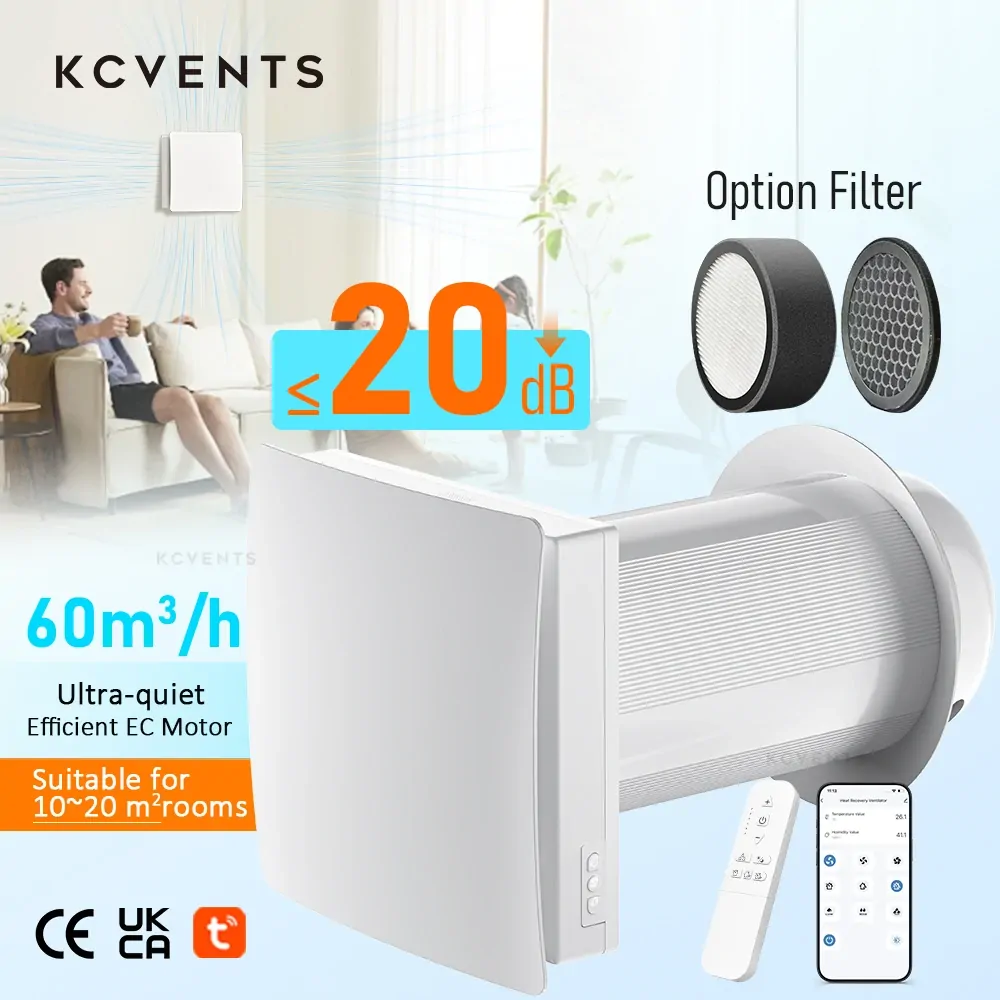
Les enfants respirent plus d'air par livre de poids corporel que les adultes et sont plus vulnérables aux contaminants en suspension dans l'air. La norme ASHRAE 62.1 spécifie 10 CFM par personne pour les salles de classe — un débit plus élevé que les taux standards pour les bureaux. Un HRV fonctionne bien dans les climats nordiques ; un ERV dans les régions humides. Le bruit est un critère essentiel : les appareils doivent fonctionner à basse vitesse de ventilation pendant les heures de cours. Des unités sans conduit pour pièce individuelle comme le VT501 peuvent desservir des salles de classe individuelles sans les coûts d'un réseau complet de gaines.
Bureaux & espaces de cotravail
Occupation intermittente mais dense. Le CO₂ augmente rapidement dans les salles de réunion. Un système gainable avec ventilation modulée selon les besoins (DCV) pilotée par sonde de CO₂ augmente le débit d'air pendant les réunions et le réduit pendant les périodes d'inoccupation — économisant de l'énergie tout en garantissant les performances cognitives lorsque la salle est occupée. Le HRV ou l'ERV convient selon le climat. L'intérêt économique est prouvé : une étude de Harvard de 2015 a associé des bureaux bien ventilés à des scores cognitifs 61% plus élevés.
Commerces de détail & petits locaux commerciaux
Le roulement des clients implique une occupation intermittente. L'objectif est une ventilation de fond constante — maintenir un air frais sans courants d'air perceptibles ni bruit. Des appareils sans conduit ou montés au plafond comme la série KCQR sont particulièrement adaptés. ERV recommandé dans les régions humides pour maîtriser les charges d'humidité extérieure causées par les ouvertures fréquentes des portes.
Dimensionnement : de quel débit d'air votre espace a-t-il besoin ?
La norme ASHRAE 62.1 fournit la formule de référence : taux de ventilation = (CFM par personne × nombre d'occupants) + (CFM par square foot × surface au sol). Pour la plupart des espaces du petit tertiaire, la composante liée au nombre d'occupants prédomine.
Space Type
CFM/Person
CFM/ft²
Exemple : 1,000 sq ft, 20 personnes
Office
5
0.06
160 CFM
Classroom
10
0.12
320 CFM
Café / Restaurant
7.5
0.18
330 CFM
Retail
7.5
0.12
270 CFM
Clinic Waiting Room
7.5
0.12
270 CFM
Clinic Treatment Room
10
0.18
380 CFM
Rule of thumb: Choisissez un appareil d'une capacité de 20–30% supérieure à votre minimum calculé. Cela offre une marge pour les pics d'occupation et permet à l'appareil de fonctionner à des vitesses plus basses et plus silencieuses en régime normal. Une unité fonctionnant à 60% de sa puissance maximale est plus efficace et bénéficie d'une durée de vie plus longue qu'une unité tournant à plein régime.
Correspondance produits KCvents : quel produit pour quel espace
Une fois que vous connaissez votre climat, votre cas d'usage et votre débit d'air cible, trouver le produit adéquat constitue l'étape finale. KCvents propose une gamme d'équipements de ventilation couvrant des applications allant de la pièce individuelle à l'ensemble du bâtiment commercial.
Extraction murale pour cuisine, buanderies, zones de stockage. Moteur EC pour vitesse variable et économies d'énergie
Cadre de décision : une liste de contrôle étape par étape
Utilisez cette liste de contrôle lors de la spécification de la ventilation pour tout projet petit tertiaire.
Confirmer l'usage du bâtiment — Bureaux ? Café ? Clinique ? Salle de classe ? Cela détermine les hypothèses d'occupation et les exigences réglementaires.
Vérifier la zone climatique locale — Froid et sec → HRV. Humide → ERV. Mixte → ERV privilégié.
Calculer le débit de ventilation minimal — Utiliser la formule ASHRAE 62.1 : (CFM/personne × occupants) + (CFM/ft² × surface).
Ajouter une marge de capacité — Multiplier par 1,2 à 1,3× pour disposer d'une marge lors des pics d'occupation.
Choisir entre gainable et non gainable — Pièce unique ≤ 500 sq ft : non gainable (VT501). Pièces multiples / bâtiment entier : gainable (HRV Series, KCQR).
Sélectionner le niveau de filtration — Standard : MERV 8. Santé / forte fréquentation : MERV 13 ou HEPA.
Prévoir l'air de compensation pour l'extraction de cuisine — Les hottes de cuisine nécessitent un air de compensation équilibré. Coordonner l'admission d'air du HRV/ERV avec l'extraction de la hotte.
Vérifier les limites acoustiques — Bureaux/salles de classe : maintenir une vitesse de ventilation basse pendant les heures d'occupation. Surdimensionner légèrement pour un fonctionnement plus silencieux.
Essais et mise en service — Vérifier l'équilibrage des débits d'air (déséquilibre <10%), niveaux de CO₂ inférieurs à 1 000 ppm en période de pointe, perte de charge des filtres conforme aux spécifications.
Références faisant autorité
Norme ASHRAE 62.1 — débits de ventilation de référence pour une qualité d'air intérieur acceptable dans les bâtiments commerciaux.
Étude Harvard COGfx — recherches associant la ventilation et la qualité de l'environnement intérieur aux performances cognitives.
Pour des conseils spécifiques à un projet, des consultations ou des spécifications techniques de produits, contactez l'équipe d'ingénierie KCvents. Chaque espace commercial présente des exigences uniques — ce cadre vous assure de partir sur des bases solides.
Mises à jour de la newsletter
Saisissez votre adresse e-mail ci-dessous et abonnez-vous à notre newsletter