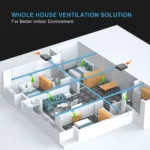
Thirty years ago, ventilating a commercial building was not something anyone spent much time thinking about. Buildings leaked. Air moved through window frames, door gaps, and unsealed penetrations at a rate that would horrify a modern energy auditor — but it moved. Fresh air got in. Stale air got out. The HVAC system’s job was temperature control, not air exchange.
That changed when energy codes got serious. Buildings became tighter — by design. Continuous air barriers, high-performance glazing, and sealed envelopes became mandatory in most jurisdictions. A modern commercial building can be 10 to 20 times tighter than its 1980s equivalent. The upside: dramatically lower heating and cooling loads. The downside: without intentional mechanical ventilation, indoor air quality collapses within hours of occupancy.
core judgment: A sealed building without mechanical ventilation is not energy-efficient — it’s a health hazard. The two must be designed together.
The physics is straightforward. A dozen people in a meeting room exhale roughly 5 liters of CO₂ per minute. Volatile organic compounds off-gas from carpet, furniture, and cleaning products. Office equipment generates ozone. Cooking in a café produces particulate matter and moisture. Without deliberate air exchange, these pollutants accumulate. The result is what researchers in the 1980s termed “sick building syndrome” — headaches, fatigue, respiratory irritation, and measurably degraded cognitive performance. A 2015 Harvard study found that occupants in well-ventilated spaces performed 61% better on cognitive function tests compared to those in conventional buildings.
Enter heat recovery ventilation (HRV) and energy recovery ventilation (ERV). These systems solve the fundamental conflict at the heart of modern building design: you need to bring in outside air constantly, but you cannot afford to throw away the energy you spent conditioning the indoor air. An HRV captures 70–90% of the heat from outgoing exhaust air and transfers it to incoming fresh air. An ERV does the same for both heat and moisture. The energy penalty of ventilation drops from “prohibitive” to “negligible.”
From Leaky to Sealed: A Timeline of Ventilation Thinking
1980s: Leaky Buildings
2000s: The Seal-Up
Today: Recovery Era
Natural infiltration handled air exchange. Energy codes were minimal. No dedicated ventilation outside kitchens and bathrooms.
Energy codes tightened. Buildings got 10–20× tighter. Indoor air quality problems surfaced. Sick building syndrome entered the vocabulary.
HRV/ERV mandatory in most codes for commercial. Continuous ventilation with 70–90% heat recovery. IAQ and efficiency no longer trade-offs.
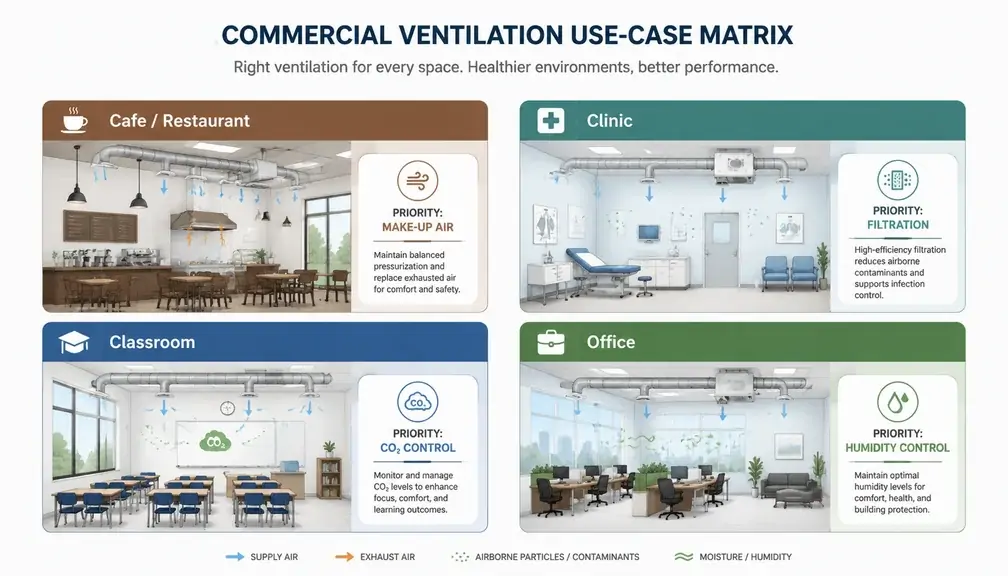
For commercial spaces, the stakes are higher than residential. Occupant density is greater. Operating hours are longer. Regulatory compliance is mandatory, not optional — ASHRAE 62.1 specifies minimum ventilation rates per person and per square foot for every commercial occupancy type, from classrooms to clinics to cafés. And the financial calculus is different: a well-ventilated office has measurably fewer sick days, higher productivity, and lower tenant turnover. A poorly ventilated restaurant loses customers who don’t consciously notice the stuffiness but don’t come back either.
The question is no longer whether to ventilate. It’s which system, how much, and how to match equipment to the space. The following sections build the framework to answer all three.
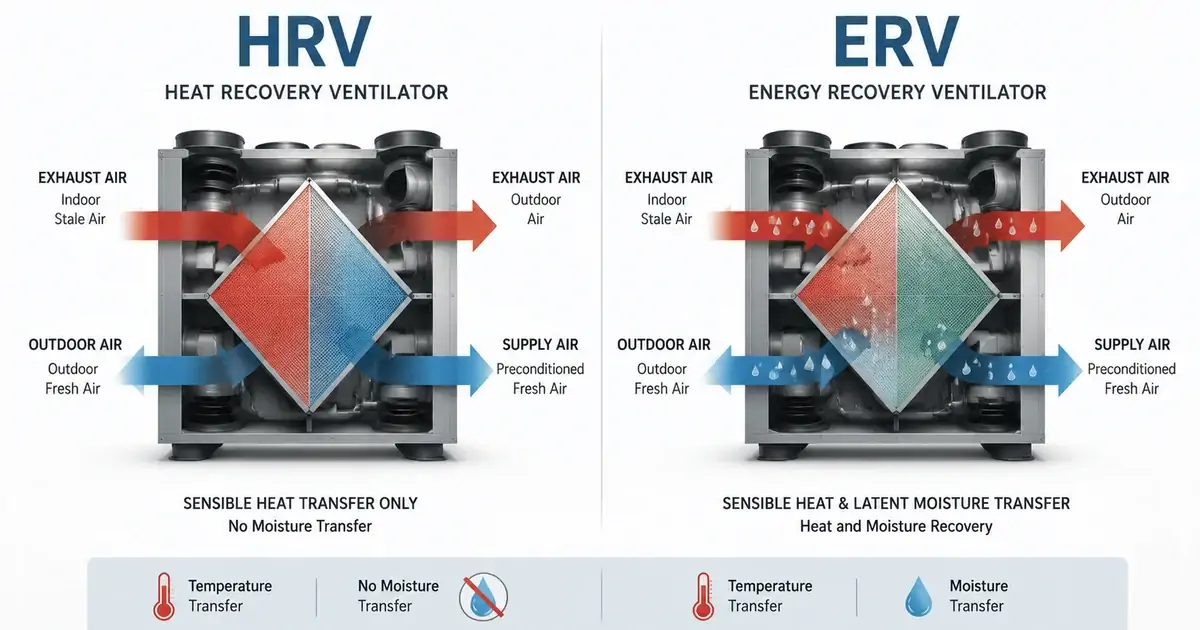
HRV transfers heat only; ERV transfers heat and moisture. The right choice depends mainly on climate humidity.
HRV vs ERV: The Real Difference
At first glance, HRVs and ERVs look identical — two fans, a heat exchanger core, and a box. But the difference in that core determines which system belongs in which building.
How an HRV Works
A Heat Recovery Ventilator (HRV) transfers heat only between exhaust and intake air streams. Two separate air paths flow through a core — typically aluminum or plastic plates — and thermal energy passes through the core material. The air streams never mix.
In practical terms: on a winter day when outdoor air is 0°C and indoor air is 20°C, an HRV with 85% efficiency pre-heats the incoming air to about 17°C using only the heat recovered from exhaust. Your heating system only needs to raise the temperature 3 more degrees.
How an ERV Works
An Energy Recovery Ventilator (ERV) transfers both heat and moisture. The core allows water vapor to diffuse across a membrane. In winter, it retains indoor humidity — preventing the excessively dry air that HRVs can create. In summer, it rejects outdoor humidity — preventing the muggy air from being pumped into air-conditioned spaces.
The Decision Rule
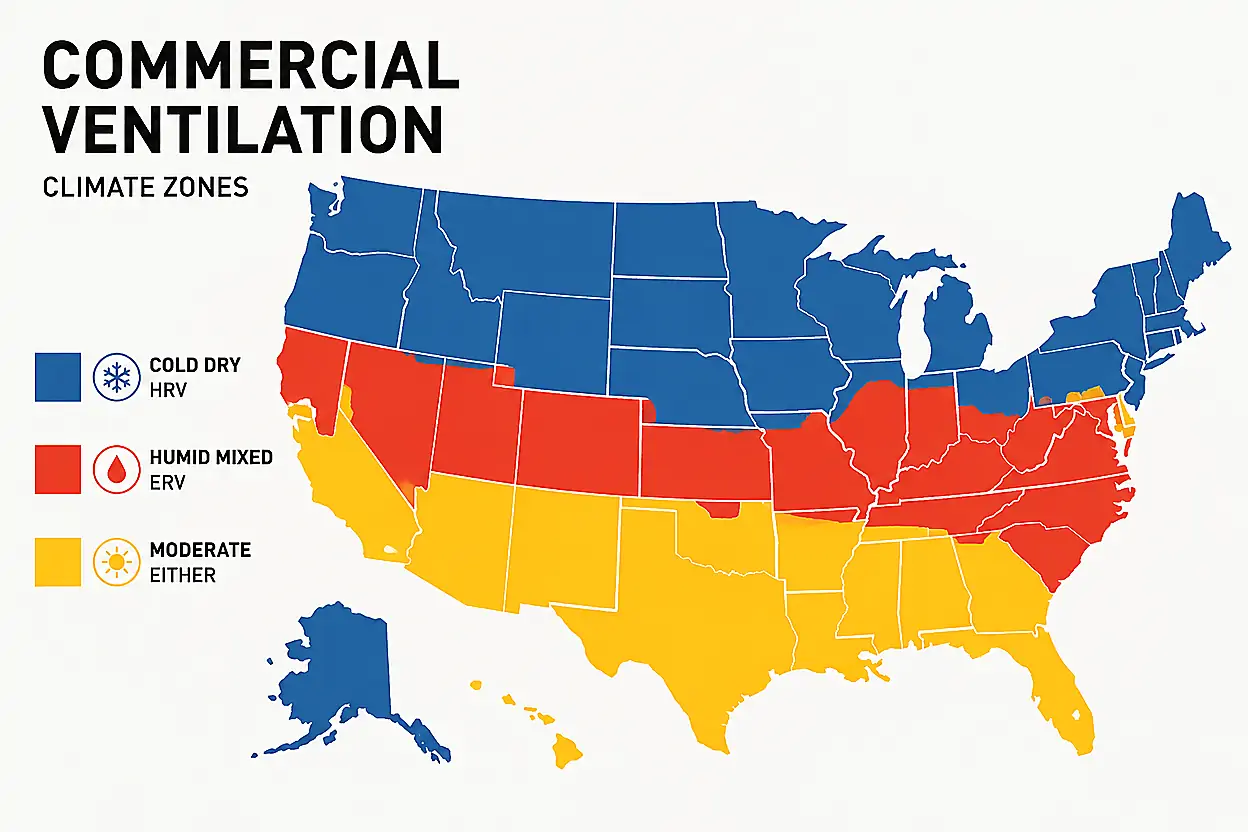
HRV — Best for cold, dry climates where humidity isn’t a concern (Canada, northern US, high-altitude regions)
ERV — Best for humid or mixed climates where moisture management matters (US South, coastal regions, Midwest summers)
Either works — Moderate climates like the Pacific Northwest. ERV offers more flexibility year-round.
Climate is the fastest filter: cold/dry regions usually favor HRV; humid and mixed climates usually favor ERV.
Climate Matters: Temperature, Humidity, and System Choice
Climate is the single most important factor in choosing between HRV and ERV. An HRV in Miami would bring in bone-dry winter air (which sounds fine) but also humid summer air (which the AC then has to dehumidify — an expensive double-handling of moisture). An ERV in Winnipeg would transfer indoor humidity to the exhaust in winter, potentially causing frost buildup in the core during extreme cold snaps.