Nous utilisons des cookies pour nous assurer que nous vous offrons la meilleure expérience possible sur notre site.
Restez informé avec KCVENTS Solutions de ventilation et CVC
Abonnez-vous à notre newsletter pour recevoir les dernières analyses en ingénierie aéraulique, les mises à jour sur les systèmes ERV/HRV écoénergétiques et les solutions CVC écologiques.
Soyez les premiers à recevoir des guides techniques exclusifs, à découvrir nos capacités OEM/ODM sur mesure et les actualités des salons mondiaux directement de KCVENTS.
How ERVs (Energy Recovery Ventilators) Lower Energy Costs
How energy recovery ventilators lower energy costs by transferring heat and moisture between exhaust and supply air.
How ERVs (Energy Recovery Ventilators) Lower Energy Costs
An energy recovery ventilator (ERV) lowers energy costs by capturing the heat — and in many cases the moisture — from the air being exhausted and using it to pre-condition the fresh air coming in. So the building gets continuous fresh air, but the heating and cooling system does not have to re-condition every cubic meter from scratch. This guide explains how ERVs save energy, when they pay off, and how they compare to simpler alternatives.
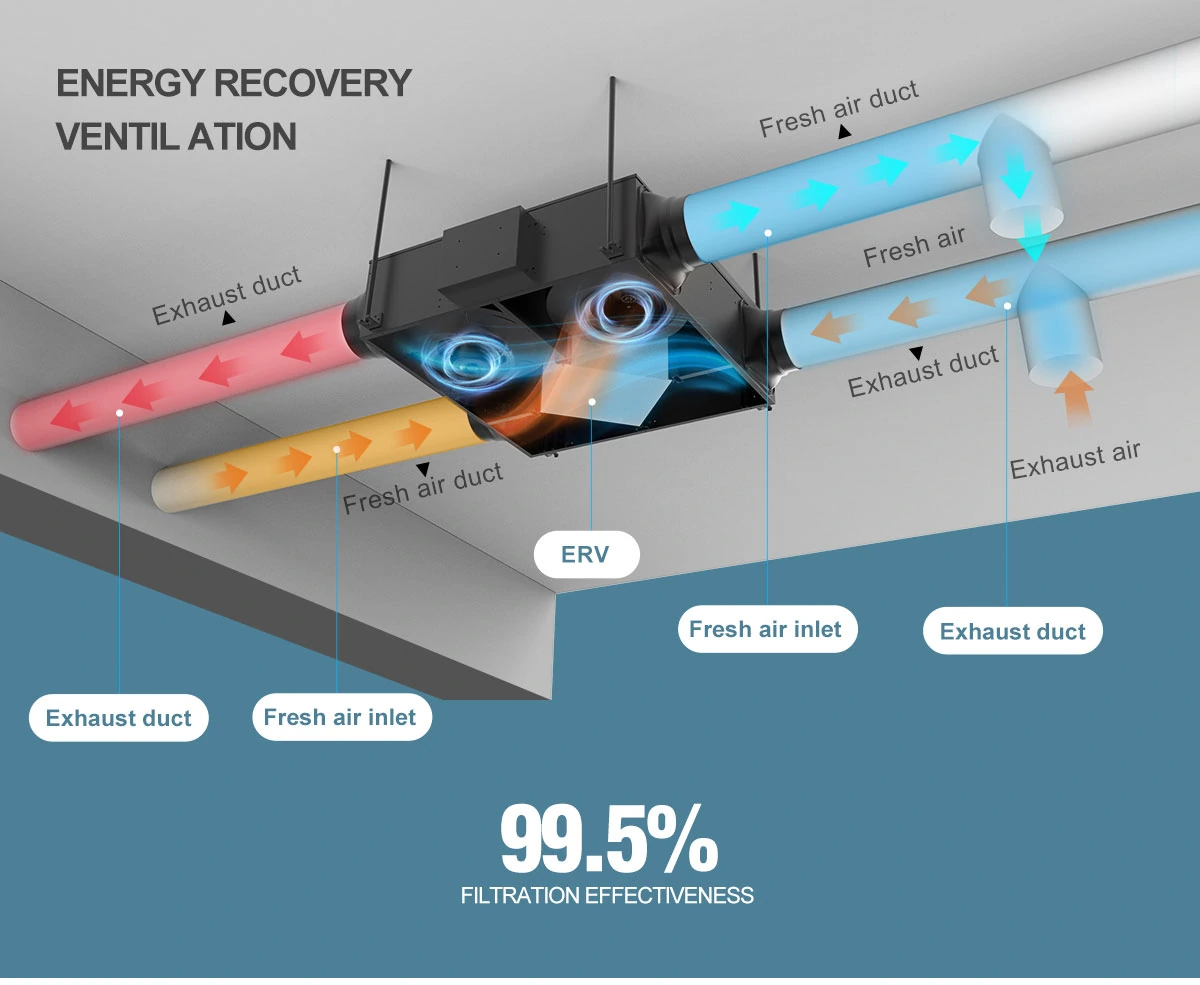
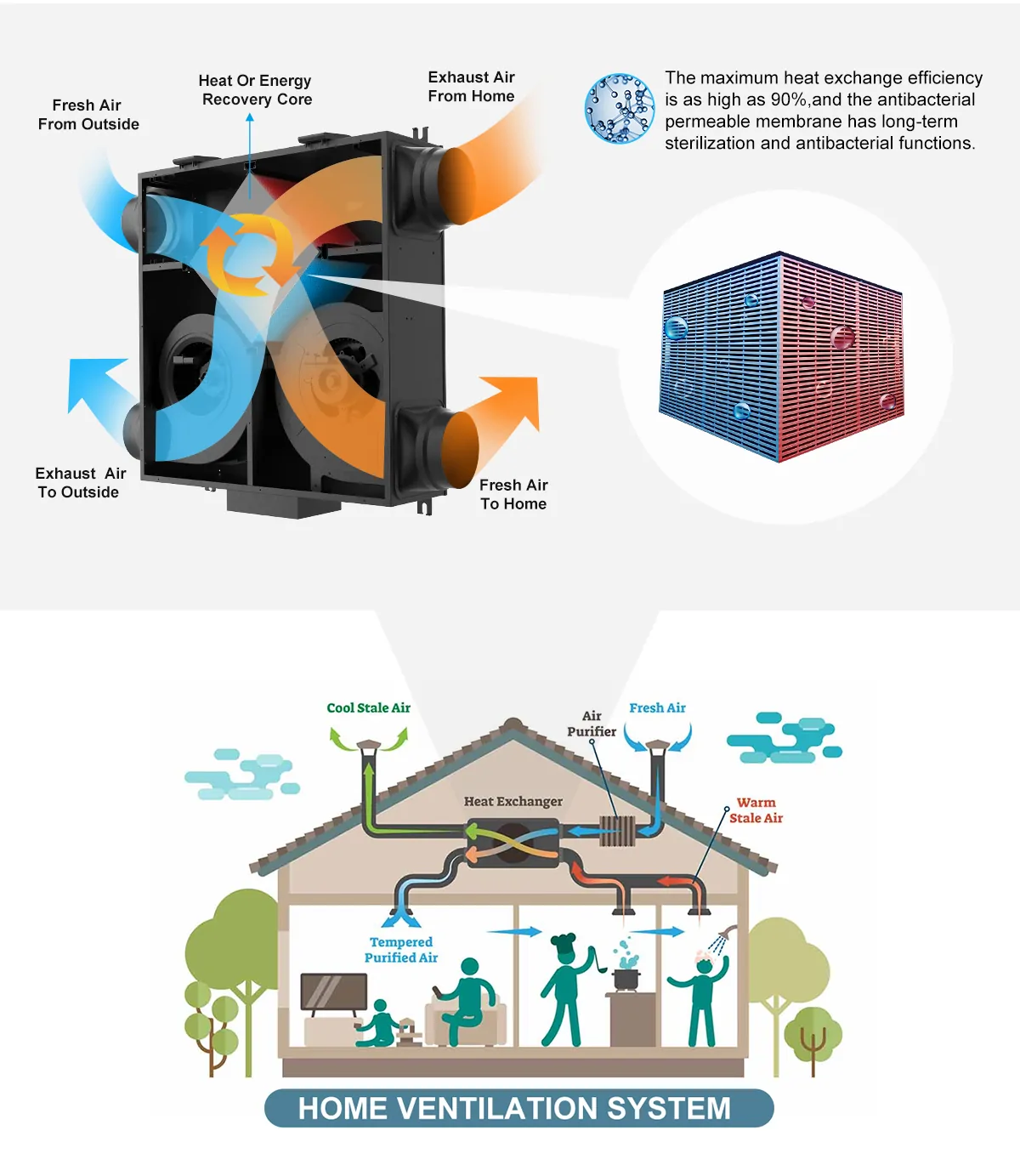
An energy recovery ventilator (ERV) is a balanced ventilation unit: it supplies fresh outdoor air and exhausts stale indoor air at matched rates. Between the two airstreams is an energy recovery core that transfers both heat and moisture.
In winter, the warm outgoing air preheats the cold incoming air before it enters the room.
In summer, the cool air-conditioned exhaust air pre-cools the hot incoming air.
The same core transfers moisture, so in humid climates less outdoor humidity enters with the fresh air.
The result is fresh air without the usual energy penalty of ventilation.
How an ERV Saves Energy
Heating or cooling outdoor air is the largest energy load in many buildings. When a conventional fan vents air out, that conditioned air is simply discarded, and the HVAC system has to re-condition the replacement air from outdoor temperature.
An ERV changes that equation:
Heat transfer — most of the temperature difference between indoor and outdoor air is recovered, so the supply air arrives close to indoor temperature.
Less load on the HVAC system — the furnace or AC does less work to bring fresh air to room temperature.
Reduced peak demand — in extreme weather, the recovered energy also cuts peak heating/cooling load.
Heat recovery systems typically recover 60%–95% of the heat from exhaust air, according to technical industry references; the Passive House standard calls for at least 75% dry heat recovery efficiency.
For B2B context: the global energy recovery ventilator (ERV) core market is estimated to grow from about USD 1.01 billion in 2024 to USD 1.56 billion by 2030, at a CAGR of 7.4%. Source: MarketsandMarkets, ERV core market
ERV vs HRV: Which Saves More?
Critère
ERV
HRV
Recovers heat
Yes
Yes
Recovers moisture
Yes
No
Best climate
Warm, humid
Cold, dry
Summer humid outdoor air
Keeps humidity out
Does not help much
Winter moisture balance
Returns some moisture
Keeps indoor moisture in
An ERV generally saves more energy in humid climates because it also reduces the latent (moisture) load on the cooling system. In cold, dry climates an HRV is usually the better match and costs less. The full comparison is in our HRV vs ERV guide.
When an ERV Pays Off
Cold winters, hot humid summers, or both — the more extreme the climate, the faster the payback.
Airtight buildings — where ventilation must be mechanical and every lost air volume is expensive to replace.
High-occupancy commercial spaces — offices, classrooms, gyms need high ventilation rates; recovery reduces the ventilation load.
Continuous ventilation — the longer the system runs, the more it recovers.
Passive House / green building projects — heat recovery is effectively required.
For a whole home, units like the KCQR energy recovery unit handle continuous fresh air plus energy recovery. For a single room, a compact single-room HRV may be enough if humidity is not the issue.
Frequently Asked Questions
Q: How much energy does an ERV save? A: It depends on climate and runtime, but because an ERV captures most of the temperature difference between indoor and outdoor air, it can cut a large share of the ventilation-related heating/cooling load. The savings are highest in extreme climates.
Q: Is an ERV worth it in a mild climate? A: Usually less so — in mild weather the temperature difference is small, so there is less energy to recover. Heat recovery pays off most where heating or cooling runs for long seasons.
Q: Does an ERV reduce humidity? A: In summer, the ERV’s moisture transfer reduces the amount of outdoor humidity that enters with fresh air. It is not a dehumidifier, but it lowers the latent load.
Q: Do ERVs use a lot of electricity? A: The fans use modest power (many use efficient EC motors), and the energy saved on heating/cooling typically far outweighs the fan power.
Q: How is an ERV different from an air conditioner? A: An ERV ventilates and recovers energy between exhaust and supply air; it does not cool a space by itself. An air conditioner cools and recirculates indoor air. Many buildings use both: ERV for fresh air + energy recovery, AC for temperature.
Looking to cut the energy cost of ventilation? KCvents manufactures ERV/HRV units, from single-room to whole-home and commercial, for wholesale, OEM, and private-label projects. Request a quote with your climate, market, and airflow requirements.
Mises à jour de la newsletter
Saisissez votre adresse e-mail ci-dessous et abonnez-vous à notre newsletter