Nous utilisons des cookies pour nous assurer que nous vous offrons la meilleure expérience possible sur notre site.
Restez informé avec KCVENTS Solutions de ventilation et CVC
Abonnez-vous à notre newsletter pour recevoir les dernières analyses en ingénierie aéraulique, les mises à jour sur les systèmes ERV/HRV écoénergétiques et les solutions CVC écologiques.
Soyez les premiers à recevoir des guides techniques exclusifs, à découvrir nos capacités OEM/ODM sur mesure et les actualités des salons mondiaux directement de KCVENTS.
Intermittent Ventilation for CO2 Control
What indoor CO2 numbers really mean, how to size an intermittent fan run time, and why 1000 ppm is a ventilation indicator, not a health limit.
You can effectively manage stuffy rooms and elevated carbon dioxide using intermittent ventilation rather than running an exhaust fan continuously, provided you size your airflow and duty cycle correctly. Running an exhaust fan or single-room unit intermittently clears accumulated carbon dioxide while preserving conditioned indoor air in heated or air-conditioned spaces. An indoor reading above 1,000 ppm is not a toxic exposure limit or an acute health hazard; rather, it indicates that the rate of outdoor air ventilation per occupant has dropped. By sizing your equipment to provide higher airflow across planned 20- to 30-minute intervals each hour, you achieve adequate air exchange without chilling your living space or overburdening your cooling system.
What CO2 in a Room Actually Tells You
Carbon dioxide (CO2) indoors serves primarily as a surrogate for human bioeffluents and an indicator of outdoor air exchange rates, not as a standalone toxic contaminant under typical residential conditions. Outdoor ambient air typically measures around 400 ppm, according to the Minnesota Department of Health (2026), though concentrations can rise in dense urban or industrial corridors. As people occupy an enclosed room, exhalation naturally increases indoor concentrations unless diluted by mechanical or natural fresh air.
Many consumer air quality monitors display warning lights at 1,000 ppm, leading homeowners to mistake this threshold for an official safety standard. In its position document on indoor carbon dioxide, ASHRAE directly clarifies the standard’s scope:
“Despite many statements to the contrary, ANSI/ASHRAE Standard 62.1 (ASHRAE 2022b) does not provide a limit value for indoor CO2.”
ASHRAE Position Document on Indoor Carbon Dioxide
The standard further elaborates on the historical role of this figure in ventilation engineering:
“An indoor CO2 concentration below 1000 ppmv has long been considered an indicator of acceptable IAQ, but this concentration is at best an indicator of outdoor air ventilation rate per person.”
ASHRAE Position Document on Indoor Carbon Dioxide
Similarly, public health authorities discourage treating indoor CO2 levels as a direct diagnostic for pathogen exposure. According to the U.S. Centers for Disease Control and Prevention (CDC/NIOSH), while maintaining good airflow helps dilute airborne contaminants, CO2 concentrations cannot predict who has a respiratory infection. Tracking levels with an indoor CO2 monitor helps evaluate whether your co2 ventilation system is exchanging sufficient air for the number of people inside, rather than measuring immediate toxicity.
The Numbers Worth Remembering
Evaluating indoor air quality data requires distinguishing between ventilation reference guidelines, comfort targets, and regulatory occupational thresholds. The table below outlines key benchmarks established by environmental and public health agencies.
Workplace safety ceiling for short-term 15-minute acute occupational exposure.
Why Intermittent Beats Continuous in a Cooled Room
When running air conditioning during warm months or heating during winter, operating a basic continuous exhaust fan pulls out expensive, conditioned air 24 hours a day. Every cubic foot of air exhausted through a co2 vent must be replaced by outdoor air that enters through building infiltration gaps or dedicated inlets, adding a thermal and humidity load that your HVAC system must treat.
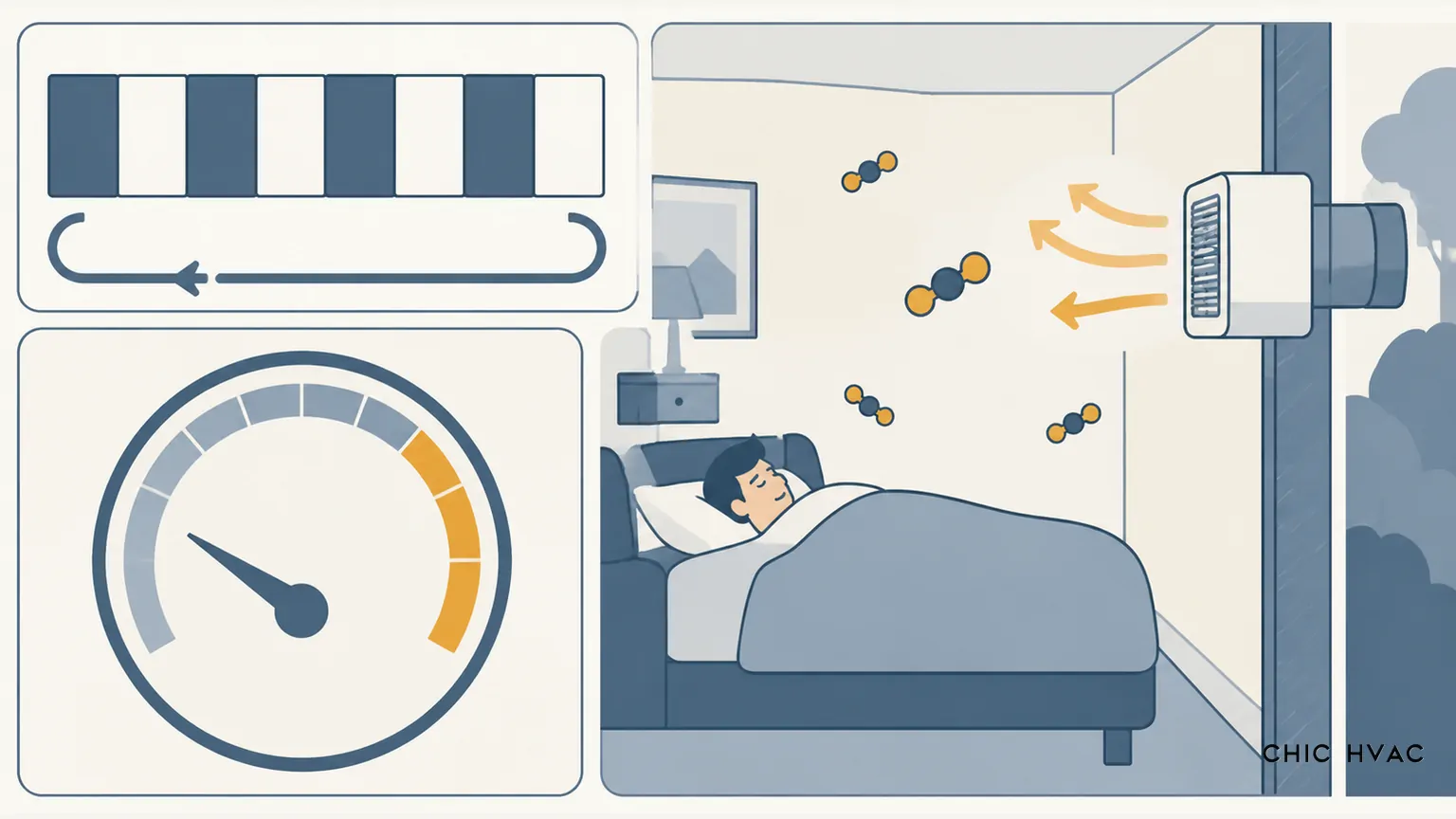
Intermittent co2 ventilation addresses this energy penalty by trading longer continuous operation at low airflow for higher airflow over shorter, controlled periods. Building codes and residential standards recognize this equivalence. In residential standards such as ASHRAE 62.2 and Home Ventilating Institute (HVI) guidelines, local ventilation requirements often establish a baseline comparison: a continuous fan running at 20 CFM provides equivalent cumulative contaminant dilution to an intermittent system operating at 50 CFM on a scheduled duty cycle, often managed with a 20-minute run-on timer.
Rather than dumping cooled room air for 60 minutes every hour, an intermittent strategy operates the fan for a fraction of that hour—for instance, 20 to 30 minutes. During unventilated intervals, indoor thermal comfort remains stable. When the ventilation cycle engages, the fan runs at an elevated volume to displace stale air and restore acceptable CO2 levels.
How to Size Your Run Time
Calculating the required intermittent fan speed requires determining your continuous airflow baseline and scaling it according to your planned run-time fraction per hour.
For residential sizing, the Home Ventilating Institute (HVI, 2026) references continuous baseline rates such as 0.35 air changes per hour (ACH) or 5 CFM per 100 square feet of conditioned floor area. As detailed in ASHRAE 62.2 implementation guidance, when ventilation is delivered intermittently, the fan flow rate must increase proportionally to deliver the same total air volume within each operating cycle.
The mathematical relationship follows a straightforward duty-cycle formula:
Run-Time Fraction = Operating Minutes per Hour / 60
Example 1: Single Occupant Bedroom (20 CFM Continuous Equivalent) If a sealed 150 sq ft bedroom requires a continuous equivalent of 20 CFM to keep morning CO2 below recommended levels, and you choose to run the fan for 30 minutes every hour:
The fan operates for 30 minutes at 40 CFM and rests for 30 minutes, cutting the continuous cooling load in half while delivering the necessary air exchange.
Example 2: Master Suite with Dual Occupancy (40 CFM Continuous Equivalent) Two occupants in an enclosed 300 sq ft room raise indoor CO2 faster than one, so the required dilution rate is higher. If your target continuous dilution rate is 40 CFM and you prefer shorter 20-minute operating bursts each hour to limit noise during sleep:
Operating the unit at 120 CFM for 20 minutes out of every hour flushes accumulated occupant emissions without running the fan continuously throughout the night.
What to Actually Buy: Three Levels
Homeowners and property managers have three distinct equipment tiers to choose from when implementing an intermittent co2 ventilation system, balancing upfront cost against thermal efficiency.
Level 1: Existing Exhaust Fan with a Countdown or Smart Duty-Cycle Switch
The most budget-friendly method utilizes an existing wall or ceiling exhaust fan paired with an in-wall programmable timer or smart plug switch. Set the switch to trigger for 20 minutes every hour during sleeping hours. Note that fan behavior following power cycling depends on the motor and control board design; while basic AC fans or EC fans with internal memory functions retain their operational state upon power restoration, fans lacking physical toggle memory may revert to standby.
Level 2: Fan with Automated Sensor Triggering or App Scheduling
The next tier automates airflow using an integrated co2 controller, humidity threshold, or smart app scheduling. Incorporating onboard sensor automation is an established standard across residential ventilation units:
La Zehnder ComfoSpot 50 supports optional internal sensor modules for relative humidity, CO2, and VOC detection.
La Vent-Axia Lo-Carbon Solo Plus HT operates with a continuous trickle that boosts automatically via an integrated humidity sensor or PIR motion detector.
La Blauberg Vento Expert uses a built-in humidity sensor that automatically increases the fan to speed III when threshold levels are crossed.
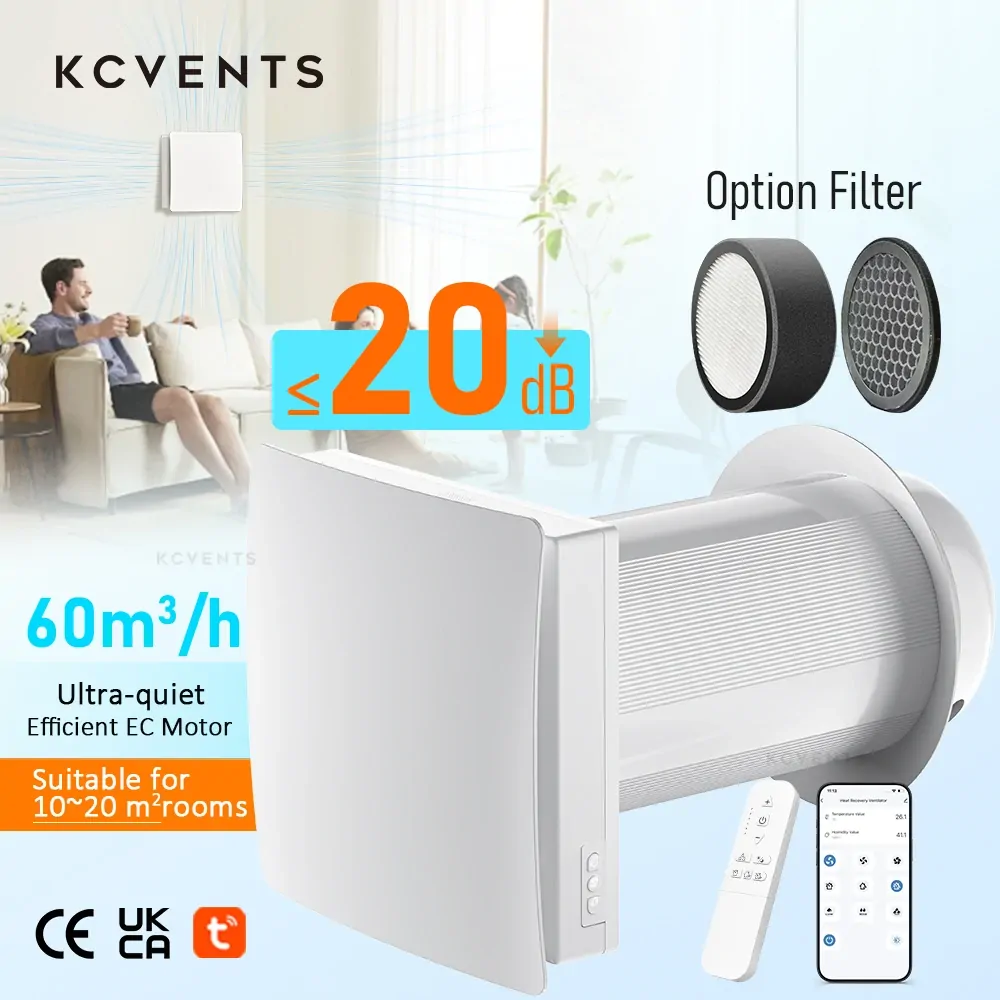
Within the KCvents lineup, the VT501-Wifi connects to the Tuya App, allowing homeowners to configure hourly duty-cycle schedules or automate fan speeds directly from indoor CO2 sensor triggers. For supply-only fresh air in smaller 10–20 m² rooms, the VT501-F HEPA delivers filtered outdoor air to maintain positive dilution.
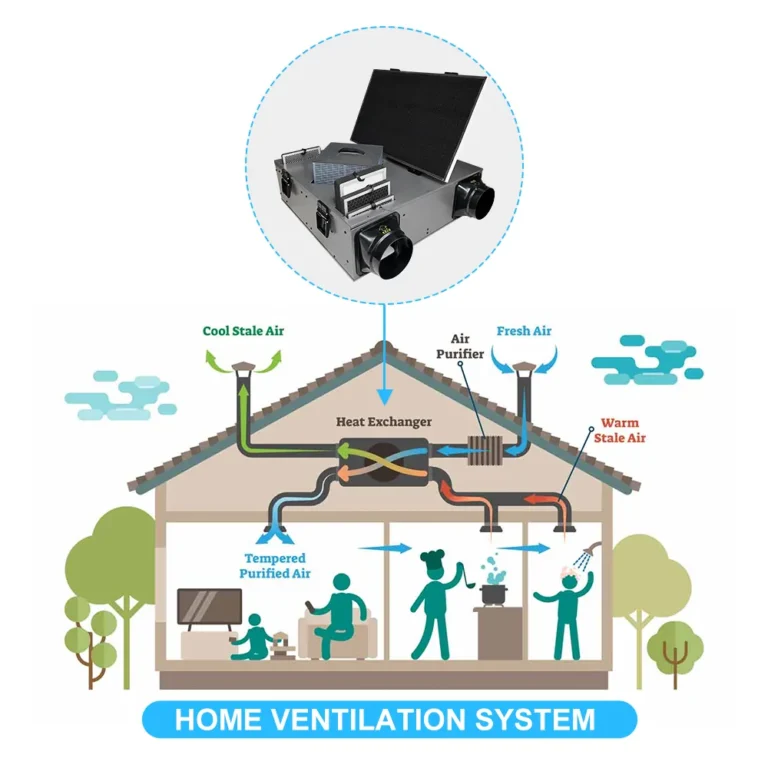
The most comprehensive solution is a decentralized, through-the-wall heat recovery ventilator, such as the KCvents VT100 or VT125. Unlike straight exhaust fans that dump cooled or heated air directly outside, decentralized HRVs employ alternating ceramic or counterflow heat exchangers. As stale indoor air is extracted, thermal energy is captured within the core; the airflow then reverses to draw in outdoor fresh air, pre-cooling it in the summer or pre-warming it in the winter with thermal recovery performance of up to 90%. This setup eliminates negative pressure and prevents room temperature drops during winter operation.
Common Mistakes in CO2 Ventilation
Avoiding common configuration errors ensures your ventilation setup delivers fresh air without driving up heating bills or degrading building air quality.
Treating 1,000 ppm as an acute health danger: Modern commercial indoor co2 sensor displays often flash red at 1,000 ppm. This number indicates that outdoor airflow per person has decreased, not that the room air is toxic. Panicking and over-ventilating at maximum capacity wastes conditioning energy unnecessarily.
Exhausting air without make-up air: Powerful exhaust fans create negative indoor pressure in tight rooms. If windows and doors are sealed without a dedicated inlet or passive trickle vent, the fan can pull air from building wall cavities, subfloors, or backdraft combustion flues.
Setting operating cycles too short: Running a fan for 2 minutes every 10 minutes creates localized air turbulence near the grille without achieving meaningful bulk air displacement in the far corners of the room. A 20- to 30-minute block allows complete room air mixing and turnover.
Using unrecovered exhaust fans during extreme outdoor temperatures: Running a straight exhaust fan for extended periods during freezing weather or peak summer heat continuously draws in untempered, unconditioned air, creating cold drafts or high indoor humidity.
Sensor misplacement and missing calibration: Locating a smart CO2 sensor right next to a window, directly in line with a supply vent, or directly adjacent to someone’s bed pillow produces skewed readings. Sensors should be placed at breathing height (3 to 6 feet above the floor) on an interior wall away from direct air drafts.
Foire aux questions
What CO2 level in a bedroom is considered high? There is no health-based indoor CO2 limit in ASHRAE Standard 62.1, so the useful question is whether the reading signals too little fresh air per occupant. ASHRAE notes that indoor concentrations above 1,000 ppmv have been associated with increases in self-reported, nonspecific symptoms, and that the long-standing 1,000 ppmv figure is best read as an indicator of outdoor air ventilation rate per person. For bedrooms specifically, the historical marker Pettenkofer proposed was 700 ppmv. Outdoor ambient air sits around 400 ppm (Minnesota DOH, 2026), while CDC/NIOSH cites readings below 800 ppm as an indicator of good ventilation in occupied rooms.
How long should an exhaust fan run to lower room CO2? For typical bedrooms (120 to 250 sq ft), running an intermittent fan rated at 50 to 100 CFM for 20 to 30 minutes per hour generally provides sufficient air exchange to reduce elevated CO2 levels. Very short run times (e.g., 5 minutes) fail to establish adequate cross-room air displacement.
Does intermittent ventilation consume more electricity than continuous trickle ventilation? For the fan itself, not necessarily less: moving the same total volume of air in short high-speed bursts usually draws more fan power than moving it slowly and continuously, because fan power rises steeply with airflow. The saving comes from the building side. Because the fan runs for only part of each hour, far less conditioned air is thrown away, so the heating or cooling system has less air to re-treat. In a cooled or heated room that trade is normally what decides the outcome, which is why intermittent operation is a common strategy for rooms where continuous exhaust would be wasteful.
Do I need a smart CO2 sensor or a co2 controller to run intermittent ventilation? A dedicated sensor is not mandatory if you use an hourly duty-cycle timer. However, placing an indoor CO2 monitor in the room verifies whether your chosen run-time fraction is adequate. Advanced setups can integrate co2 sensors hvac systems or standalone smart switches to trigger ventilation only when thresholds exceed 900–1,000 ppm.
What is the difference between an exhaust fan and a single-room heat recovery ventilator (HRV)? A standard exhaust fan only extracts indoor air, creating negative pressure that pulls unconditioned outdoor air through cracks in building assemblies. A single-room heat recovery unit (such as the KCvents VT100 or VT125) balances air supply and extraction through a thermal storage core, recovering up to 90% of the heating or cooling energy before the fresh air enters the room.
Working with KCvents
Selecting the right equipment for decentralized CO2 control depends on matching mechanical capabilities to room architecture and regional climate. When specifying single-room ventilation units, consider the following parameters:
Room Volume and Capacity: Match the unit’s speed settings (m³/h or CFM) to room dimensions. Check the published airflow range of each model against your calculated requirement rather than assuming a larger or newer model moves more air: the VT501 series, for example, publishes 20–60 m³/h across four speeds, while the VT100 publishes 20–50 m³/h. Confirm the figures for the specific unit before sizing.
Filtration Needs: In urban areas or near busy roadways, straight exhaust can pull in fine particulate matter through structural leaks. Units equipped with sub-micron filtration, such as the VT501-F HEPA, ensure that incoming air is stripped of pollen and fine dust.
Core Penetration and Installation: Decentralized HRVs require a through-wall core drill (typically 100 mm to 160 mm depending on duct size) with external weather louvers designed to prevent water ingress and wind buffeting.
Control System Integration: Determine whether you require automated app scheduling (such as the Tuya App control on the VT501-Wifi) or direct relay switching via external building controls.
Whether you need individual room units for apartment retrofits or bulk supply for multi-family residential developments, KCvents manufactures single-room ventilation hardware and supports OEM programmes. Contact our technical team to discuss project requirements, obtain dimensional specifications, or request a project quote directly, or reach out through our page de contact.
U.S. CDC / NIOSH Ventilation FAQs — Guidelines on ventilation benchmarks, target CO2 thresholds below 800 ppm, and limits of CO2 monitoring for infection risk.