How to Get More Fresh Air in Your Office Without Freezing or Baking
Getting more fresh air in an office usually means supplying outdoor air through the ventilation system and exhausting stale air — and the trick is doing it without ruining the indoor temperature or running up the energy bill. The answer is balanced mechanical ventilation with heat recovery: fresh filtered air in, stale air out, with the heat recovered so the office stays comfortable. This guide explains the options for improving office fresh air at every level of budget.
An office is a dense occupancy space: people, computers, printers, and cleaning products all add CO₂, particles, and VOCs to the air. In a modern, sealed office with limited ventilation, the CO₂ climbs during the day, and occupants feel drowsy and unfocused. The concentration is commonly worse in meeting rooms and open-plan zones near midday.
米国環境保護庁(U.S. EPA)によると、人は一日の約90%を室内で過ごしており、室内の特定汚染物質の濃度は屋外の2〜5倍に達することがあります。. 出典:U.S. EPA『The Inside Story: A Guide to Indoor Air Quality』. For an office, fresh-air supply is not a luxury — it is the difference between a productive afternoon and a stuffy one.
What “Fresh Air” Means for an Office
Three things together make an office feel fresh:
Outdoor air supply — enough fresh air to dilute CO₂ and pollutants.
Exhaust — stale air (CO₂, odors, pollutants) actually leaving.
Comfort — the fresh air arrives at a comfortable temperature, not as a draft or a furnace blast.
The standard guidance for how much outdoor air an office needs comes from ventilation codes (e.g., ASHRAE 62.1), which set outdoor-air rates based on occupancy and floor area. If your office feels stuffy, the first question is whether the fresh-air rate is actually being met — not whether someone should simply open a window.
Level 1: Improve Natural Ventilation
The cheapest steps, useful in mild weather or as a supplement:
Open windows cross-ventilated — inlet low on one side, outlet high opposite, so air flows through.
Use CO₂ as a guide — a small CO₂ monitor tells you when the room is actually stale.
Night purge — in mild seasons, open the office at night to flush out accumulated CO₂ and heat before staff arrive.
Limits: windows depend on weather, noise, and outdoor air quality, do not filter the air, and in winter or summer they fight the HVAC system. Natural ventilation is a supplement, not the office solution.
Level 2: Exhaust and Supply Fans
When windows are not enough, add mechanical fans:
Exhaust fans pull stale air out; fresh air enters through intake vents or fans.
Supply fans push filtered fresh air in; stale air leaks out through exhaust paths.
This is simple and affordable, and it delivers real fresh air. But without heat recovery, the air you exhaust is conditioned air — in winter you are pumping heated air out, which raises the energy bill and can make the space drafty if the replacement air is cold.
Level 3: Balanced Ventilation with Heat Recovery
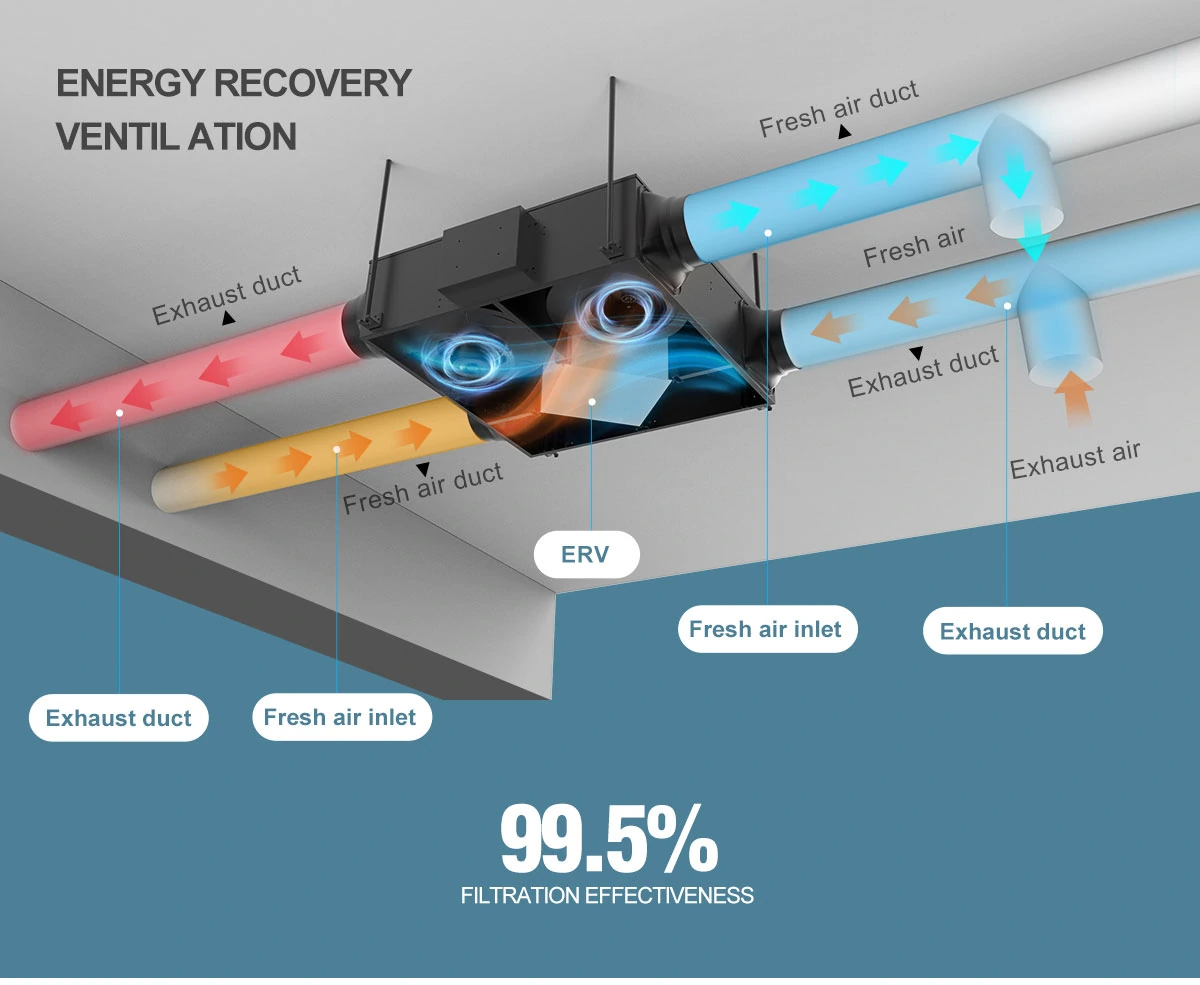
The durable office solution is a balanced ventilation system with heat recovery (an HRV, or an ERV where humidity matters):
A supply fan brings in filtered fresh air.
An exhaust fan removes stale air at a matched rate.
A heat recovery core transfers heat between the two, so the fresh air arrives pre-tempered — no freezing, no baking, no energy waste.
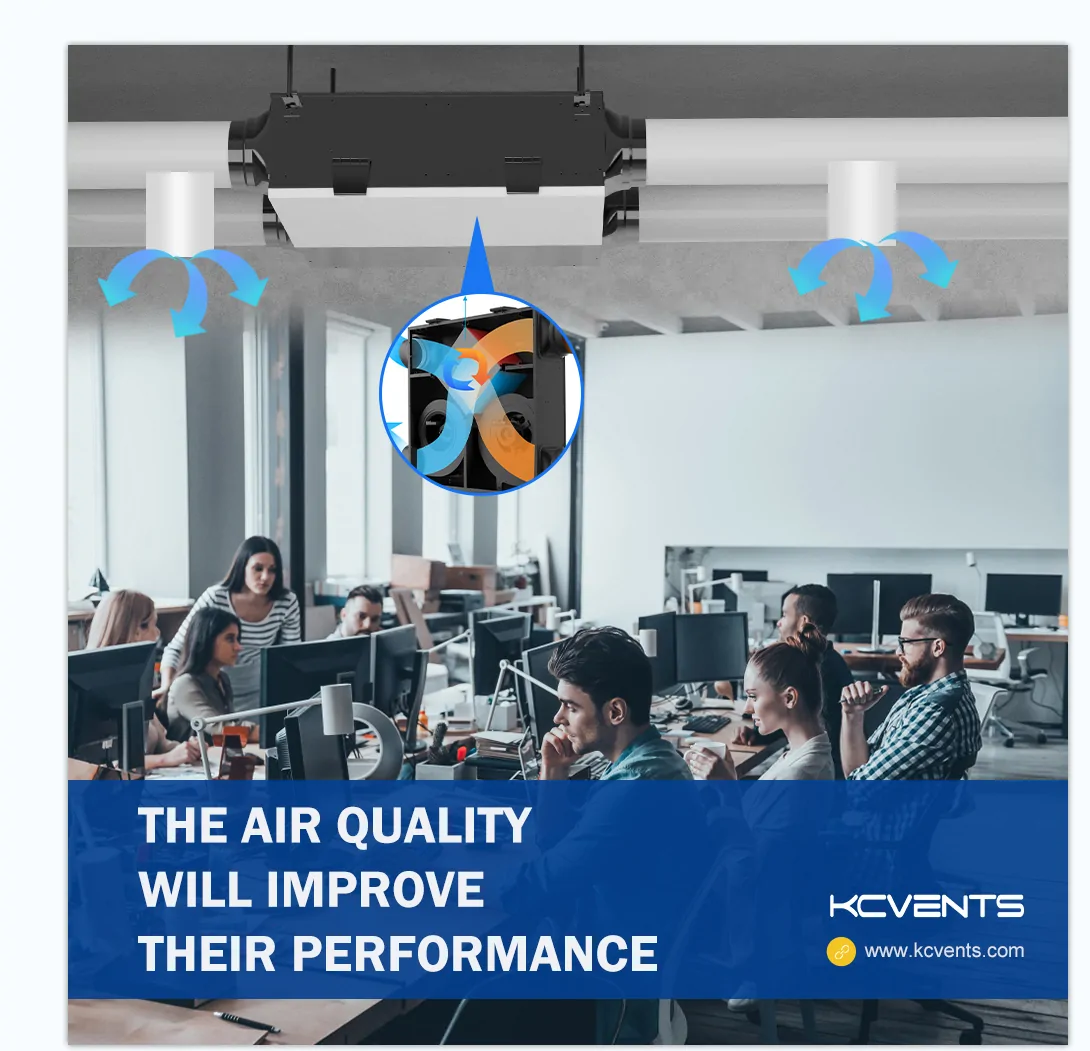
This is the system Commercial Ventilation design guidance describes. For offices, a commercial ERV/HRV handles the outdoor air supply while the existing HVAC handles temperature — the two work together, not against each other.
Putting It Together
Office situation
Recommended approach
Mild weather, operable windows
Natural cross-ventilation + CO₂ monitor
Tight budget, fixed air temperature
Exhaust fans + filtered supply, accept energy cost
Sealed office, comfort + energy matter
Balanced HRV/ERV with heat recovery
High CO₂ in specific rooms
Demand control — increase ventilation where CO₂ is high
Practical steps regardless of system:
Measure CO₂ in the worst rooms — data beats guesswork.
Keep the ventilation running during occupied hours, and start it before peak occupancy.
Maintain filters — a clogged filter silently cuts fresh-air delivery (see our maintenance guide).
Don’t just recirculate — if the system is in recirculation-only mode, it is moving CO₂ around, not removing it.
Frequently Asked Questions
Q: How much fresh air does an office need? A: Ventilation codes (e.g., ASHRAE 62.1) base outdoor air on occupancy and floor area. The practical check is a CO₂ monitor: if CO₂ climbs to high levels, the fresh-air rate is too low for the occupancy.
Q: Is opening a window enough to get fresh air in an office? A: Sometimes in mild weather, but not reliably. Windows bring unfiltered, unconditioned air, depend on weather and noise, and in hot/cold seasons fight the HVAC system. Mechanical fresh-air supply is the consistent answer.
Q: What is the best way to add fresh air to an office without losing heating or cooling? A: A balanced ventilation system with heat recovery (HRV/ERV) supplies filtered fresh air and recovers heat from the exhaust, so the fresh air arrives near room temperature. This is the approach in our commercial ventilation playbook.
Q: Can an air purifier replace fresh-air ventilation in an office? A: No. An air purifier filters the air already in the room; it does not bring in fresh air or remove CO₂. Use ventilation for air exchange and a purifier only as a supplement for particle filtration.
Q: Why does my office get stuffy by mid-afternoon? A: CO₂ and pollutants build up when fresh-air supply is below the rate the occupancy needs. Check the ventilation rate and CO₂; the fix is more outdoor air, not more cooling.
Q: What size fresh-air ventilation does an office need? A: Size the outdoor airflow from occupancy and floor area per code, then match the unit’s airflow at working static pressure. Demand control (CO₂) can then run the system at the rate the office actually needs.
Improving office air quality? KCvents manufactures commercial energy recovery units, inline duct fans, and fresh air systems for offices and commercial buildings, for wholesale, OEM, and private-label projects. Request a quote with your floor area, occupancy, and ventilation requirement.