We use cookies to ensure that we give you the best experience on our website.
Stay Updated with KCVENTS Ventilation & HVAC Solutions
Subscribe to our newsletter for the latest airflow engineering insights, energy-efficient ERV/HRV system updates, and eco-friendly HVAC solutions.
Be the first to receive exclusive technical guides, custom OEM/ODM capabilities, and global exhibition news directly from KCVENTS.
Single-Room HRV in 2026: Why the VT501-Wifi Works for Bedrooms, Apartments and Renovations
2026 guide: why a single-room heat recovery ventilator like the KCVENTS VT501-Wifi belongs in bedrooms and apartments — 90% heat recovery, under 30 dB, HEPA + carbon filtration, Wi-Fi control.
Single-Room HRV in 2026: Why the VT501-Wifi Works for Bedrooms, Apartments and Renovations
By 2026, three forces have quietly changed how homes get ventilated: higher energy prices, stricter building efficiency rules, and worse outdoor air during wildfire and pollen seasons. New homes are built tighter than ever, which turns mechanical ventilation from a nice-to-have into a necessity — while most households still don’t have the space, budget, or permission for a full ducted system.
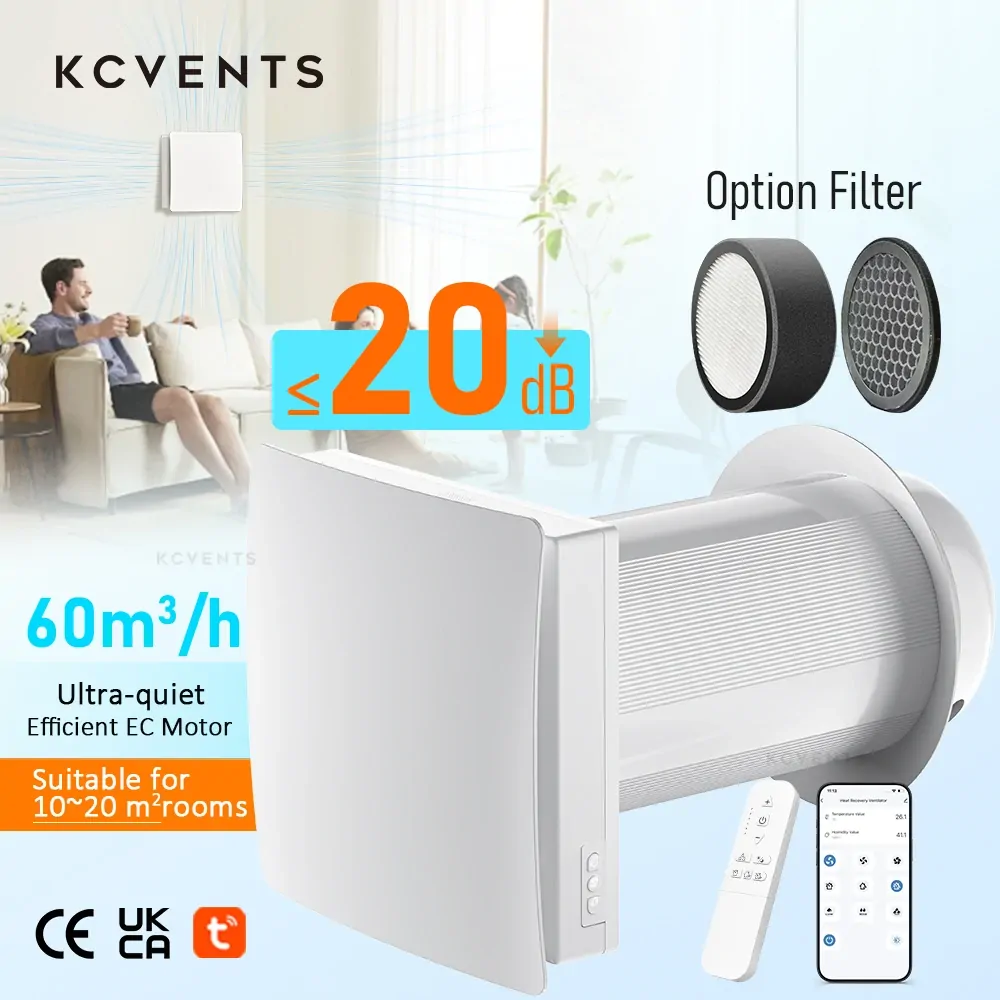
That gap is exactly what single-room heat recovery ventilators (HRVs) fill. The KCVENTS VT501-Wifi recovers up to 90% of the heat in outgoing air, runs below 30 dB, filters incoming air with HEPA and activated carbon, and mounts through a single wall hole — no ductwork at all. Below, we look at the 2026 trends behind the product, where it beats an open window or an exhaust fan, and what living with one actually feels like day to day.
VT501-Wifi installs through one exterior-wall opening: the room-side panel connects to a telescopic duct and outdoor grille, without central ductwork.
Three Ventilation Challenges Shaping 2026
1. Energy bills and tightening efficiency rules
The EU, UK and North America are all tightening energy performance requirements for buildings through 2026, and renovation work increasingly has to include a ventilation upgrade. Household energy prices, meanwhile, stay near the top of everyone’s budget concerns.
The arithmetic is simple: every cubic metre of warm (or cool) air you exhaust without heat recovery is paid for twice — once to heat or cool it, and once again to replace it. A heat recovery ventilator captures that energy before it leaves. The VT501-Wifi’s ceramic core is rated at up to 90% efficiency, and on its Sleep setting the whole unit draws just 2.5 W — less than a night-light.
2. Smoke, pollen and outdoor pollution
Wildfire smoke is no longer a rare event — in many regions it is a seasonal reality, sometimes thousands of kilometres from the fire itself. Pollen seasons start earlier and last longer. In both cases, the instinct to “open a window for fresh air” often makes the indoor air worse, not better.
A balanced HRV keeps air moving without opening anything, because supply air passes through filtration first. The VT501-Wifi ships with a dual filter set — HEPA plus activated carbon — which knocks down pollen, dust, particulates and many outdoor odours before they reach the room. That is practical protection during a smoke event and across allergy season alike.
3. Sealed, CO₂-heavy bedrooms
Good windows and insulation keep heat in — and also trap CO₂, moisture and pollutants. Elevated bedroom CO₂ is repeatedly linked to poorer sleep, morning headaches, and sluggishness the next day. Exhaust fans remove some of it, but they pull heat out and hum all night; an open window in winter or summer undoes both comfort and energy bills.
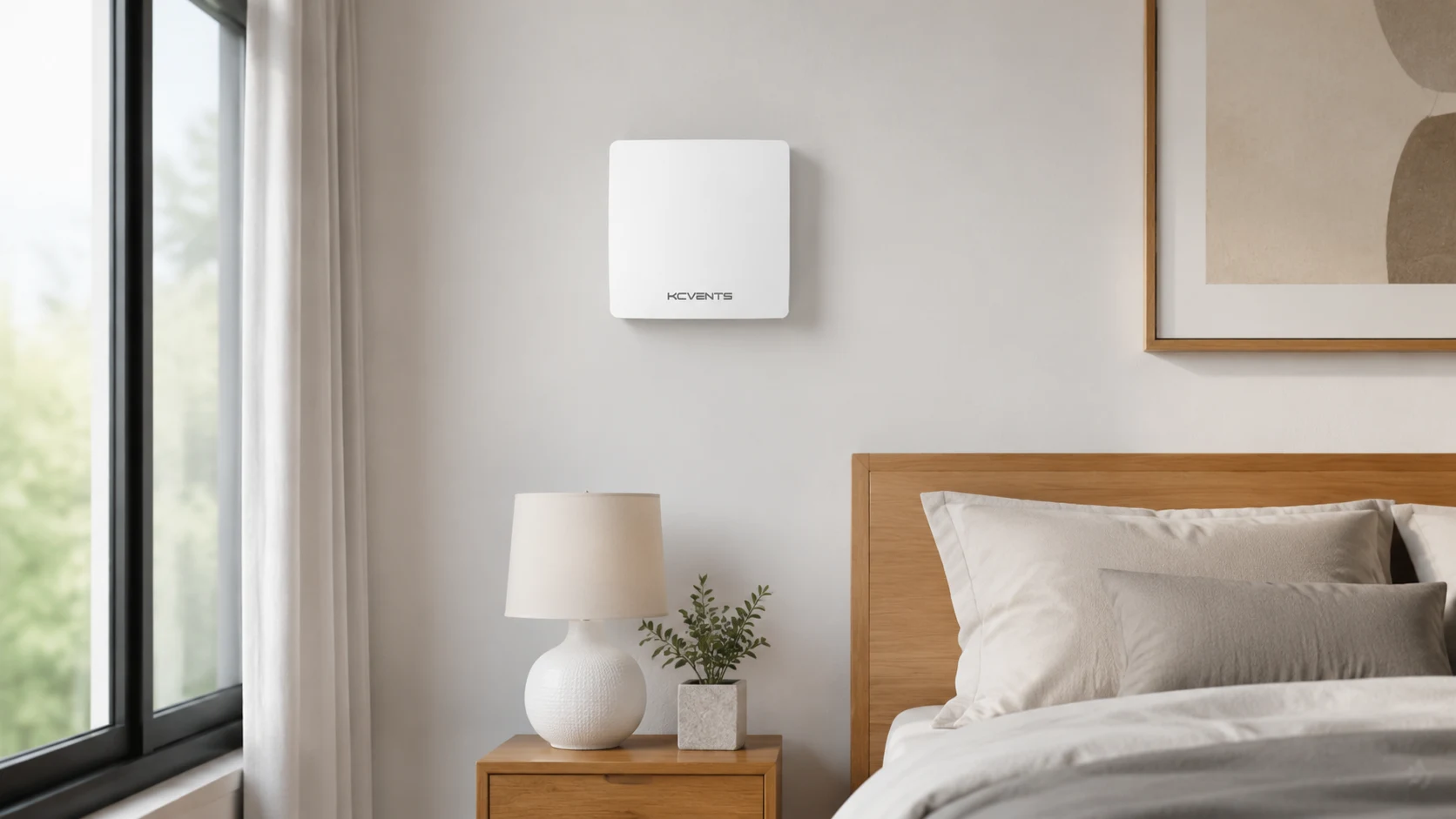
A quiet, balanced single-room HRV is the practical fix: continuous fresh-air exchange with minimal heat loss, quiet enough to sleep right next to.
No heat recovery, no supply-air filtration, noisy, creates negative pressure and draughts
Central ducted HRV/ERV
Whole-house performance
Expensive, requires duct design, difficult for apartments, renters and retrofits
Portable air purifier
Filters recirculated air
Does not bring in fresh air or remove CO₂, no heat recovery
Single-room HRV (VT501-Wifi)
Heat recovery up to 90%, HEPA + carbon filtration, under 30 dB, Wi-Fi control, single-hole installation
Serves one room at a time (extendable with a master/slave setup)
For bedrooms, home offices, apartments and renovation projects, the single-room HRV is usually the best trade-off between performance, noise, installation effort and cost.
VT501-Wifi at a Glance
Heat recovery up to 90% — the ceramic core recovers heat from outgoing air in both heating and cooling seasons
Quiet, rated under 30 dB — brushless DC motor in a sound-damped housing, aimed squarely at bedrooms, nurseries and home offices
Dual filtration — HEPA and activated carbon against pollen, dust, particulates and outdoor odours
Wi-Fi smart control — Tuya-based app for modes, schedules and automation routines
Single-hole wall installation — telescopic duct through an exterior wall, no central ductwork
Three operating modes — Fresh Air, Exhaust, and the 65-second Cycle mode
Wide voltage and climate range — 12 VDC or 100–240 V, 50/60 Hz; operates from -20°C to +50°C
Performance Parameters
Speed
Airflow (m³/h)
Total Power (W)
Current (A)
Motor Speed (RPM)
Sleep
20
2.5
0.025
630
I
48
3.0
0.030
1,100
II
54
4.5
0.045
1,600
III
60
8.5
0.070
2,200
Even at maximum speed the unit draws just 8.5 W — a full year of nightly operation costs only a few dollars in electricity, while the heat it recovers saves several times that on heating and cooling bills.
What the noise levels actually sound like at night
“Under 30 dB” is a spec number; what matters is what it sounds like in a silent bedroom. In our own installations on a typical plasterboard wall, Sleep runs in the low 20s (dB) and I sits in the mid-20s — roughly a quiet library; you only hear it if you listen for it. At II it becomes noticeable in a silent room, and at III (60 m³/h) the motor is clearly audible, closer to a small desk fan on medium. The important part is the tone: it is a soft, low hum rather than a high-pitched whine, which is what actually keeps people awake.
Your exact numbers will shift a few dB with wall thickness and room acoustics, so treat these as ballpark figures. One honest note for light sleepers: run the unit in Fresh Air mode on Sleep or I overnight. The 65-second Cycle mode is the one mode where you will notice the motor reversing every minute or so — useful for a quick refresh, not for sleeping.
Three Modes for Everyday Control
Fresh Air Mode — continuous balanced supply of filtered outdoor air for everyday ventilation.
Exhaust Mode — quick removal of stale air, cooking smells or humidity spikes.
65-second Cycle Mode — alternates intake and exhaust to refresh the room rapidly when needed, such as after guests leave or before sleep.
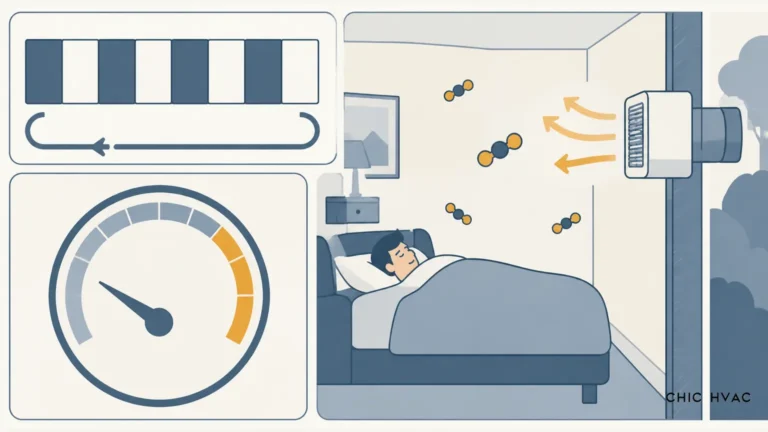
How the 65-second cycle works: the ceramic core stores heat. The fan draws exhaust air through the core, warming it as the air leaves; then it reverses and draws supply air back through that same warm core, which pre-warms the incoming air (and gently pre-cools it in summer). The VT501 flips direction every 65 seconds, so a compact single-hole unit gets real heat recovery without a bulky cross-flow core. For daily use, think of Cycle mode as a quick refresh button — Fresh Air mode is the one you leave running.
Smart Control with the Tuya/Wi-Fi App
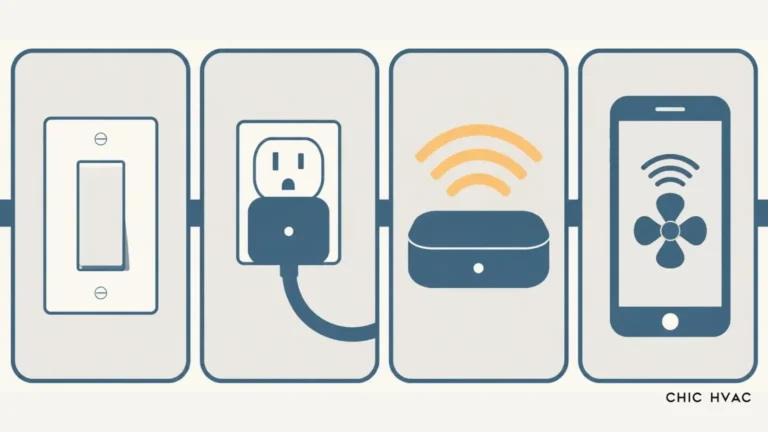
Ventilation only helps if it actually runs, and a Wi-Fi-enabled HRV removes the “set and forget” friction. With the Tuya-based app you can switch modes, adjust speed and set schedules from your phone: start Exhaust mode before cooking, run Sleep speed overnight, or boost Fresh Air before you get home. It also drops into common smart-home routines without extra gateways.
One practical tip from field experience: the VT501 connects over 2.4 GHz Wi-Fi, like most Tuya devices. If pairing stalls, switch your phone onto the 2.4 GHz band (or temporarily disable your router’s “band steering” / smart connect feature) and retry — that clears up the vast majority of pairing failures we hear about.
Installation: What to Check Before You Drill
The VT501-Wifi is built for retrofit-friendly installation:
Through an exterior wall with a single hole and a telescopic duct
No central ductwork — ideal for apartments, renters and renovation projects
Duct length: 250–500 mm, cuttable to your wall thickness (hole size 160 mm Ø)
Room-side cover panel: 242 × 242 mm, a compact footprint for most rooms
Before drilling, sort out these four things — they are where most installation problems start:
Permission, if you rent. A 160 mm hole is a permanent change to the building envelope. Check your lease and talk to the landlord or property manager before drilling. In practice many owners approve once they see the hole can be properly sealed and patched if you move out.
What is inside the wall. Confirm there are no cables, pipes or rebar in the drill path. For concrete or brick walls, a contractor with a core drill will do the cleanest job — and it takes them about an hour.
Wall thickness and duct length. Measure the wall before ordering: the telescopic duct covers 250–500 mm, and cavity or insulated walls usually sit at the longer end. A duct that is too short is the most common install mistake.
The outside face. The outdoor grille should be mounted with a slight downward slope so driving rain sheds off it, and away from obvious places where leaves, birds or strong wind-driven draughts will hit it. Seal the duct-to-wall gap properly — the sealant does the waterproofing work.
The job is very much DIY-scale for capable owners; for everyone else, an HVAC technician or handyman with a core drill finishes it in an hour or two — and the sealed, finished result is worth it.
Who Should Choose the VT501-Wifi — and Its Honest Limits
Bedrooms and nurseries — quiet, filtered fresh air every night, rated under 30 dB
Apartments and renovations — heat recovery ventilation for one room without installing a central duct system
Home offices and small rooms — fresher air, less stuffiness, fewer odours, saner humidity while you work
Anyone tired of cold winter draughts — balanced ventilation with up to 90% heat recovery instead of losing warmth through an open window
And who should probably skip it? One VT501 serves roughly a 15–20 m² room (about 160–215 sq ft). If you need whole-house exchange, a single unit will not cover it — the realistic path is either several units working together (the master/slave setup lets a second unit follow the first), or a central system. And if you cannot drill an exterior wall at all, this whole product category won’t fit your situation.
Quick Answers: VT501-Wifi FAQ
How does the 65-second ceramic cycle work?
The ceramic core stores heat. For a stretch of each cycle, exhaust air is drawn through the core and warms it on its way out; then the fan reverses and supply air is drawn back through the same warm core, picking up that stored heat — and being gently pre-cooled in summer. The VT501 flips direction every 65 seconds, which is how a compact single-hole unit achieves up to 90% heat recovery without a large cross-flow core.
Is the VT501-Wifi quiet enough for a light sleeper?
At night, run Fresh Air mode on Sleep or I: in practice that sits in the low-to-mid 20s (dB), about a quiet library — for most people it disappears within a night or two. The motor tone is a soft low hum rather than a whine. One honest caveat: in the 65-second Cycle mode you will hear the motor reverse every minute or so, so sensitive sleepers should not run that mode overnight.
Can two VT501 units work together for push-pull ventilation?
Yes, up to a point: the VT501 supports a master/slave setup, in which a second unit follows the first unit’s mode so two rooms can be ventilated in a push-pull arrangement (for example, a bedroom plus a living room). This is part of what makes single-room HRV extendable beyond one room. Wiring and configuration details depend on the setup, so confirm the specifics with your dealer or with KCVENTS before ordering multiple units.
What hole size does it need — and can I install it in a rented apartment?
The wall opening is 160 mm Ø and the telescopic duct covers 250–500 mm of wall thickness; the room-side panel is 242 × 242 mm. In a rental, the practical answer is: ask first. A 160 mm hole is a permanent modification, so check your lease and get written approval from the landlord — many accept once the install is explained and the hole can be patched at move-out.
Why won’t it connect to my Wi-Fi?
The VT501 connects over 2.4 GHz Wi-Fi, which is standard for Tuya-based devices. If your router broadcasts a combined 5 GHz / 2.4 GHz network, the phone and the unit can end up on different bands. Fix: put your phone on the 2.4 GHz network during pairing, or temporarily disable the router’s band steering (smart connect) setting, then pair again.
How much space does one unit actually cover?
Realistically, a single VT501-Wifi suits a 15–20 m² room — a typical bedroom, nursery or home office. It is not a whole-house or whole-apartment solution by itself; for several rooms, look at the master/slave setup so units follow each other, or a central ducted system.
What about condensation or frost in cold winters?
The VT501 is rated to operate from -20°C to +50°C. In practice, during very cold snaps, it helps to keep the unit running continuously at a low speed so the ceramic core stays warm, and to use the 65-second Cycle mode when you need a burst — the periodic reversal also gives the core a chance to shed frost. Standard practice for ceramic-core HRVs: a little regular use beats long idle stretches.
Choose Quiet, Efficient Ventilation in 2026
Between energy prices, smoke and pollen seasons, and the sleep science behind fresh bedrooms, single-room HRV has moved from niche to mainstream in 2026. The VT501-Wifi covers the three things a bedroom or apartment needs: real heat recovery (up to 90%), genuinely quiet running (rated under 30 dB), and filtration that keeps outdoor pollution out — all behind a single-hole installation that works without central ductwork. For a single room, it is the honest, practical answer; for bigger spaces, scale it with master/slave units or a ducted system.
Want to dig deeper? Read the VT501-Wifi product page, the VT501 series FAQs, or contact KCVENTS for OEM/ODM support. Every batch is factory-tested before shipment (CE, RoHS and ISO9001 compliant), and custom airflow design and smart-control integration are available for B2B projects.
Newsletter Updates
Enter your email address below and subscribe to our newsletter